Google AI Mode Can Wait for a DealAn alert arrived. Is it actually cheaper?
You want the headphones, just not at today’s price. Wait for a sale and they might sell out. So you open the store again. And again. Before the shopping cart fills up, your browser tabs do. Google AI Mode’s info monitoring is built to take over that repeat checking, and since September 28 it has been rolling out to everyone, not just paid subscribers. But one question remains: does a price-drop alert mean you have found the cheapest way to buy? Let’s follow one pair of headphones from waiting to checkout.
- On September 28, Google began rolling out AI Mode’s info monitoring, previously used by paid subscribers, to everyone globally. Alerts going global does not mean checkout works everywhere.
- One study compared search listings matched by product ID and found AI Mode’s first-listed price averaged 21.6% higher than regular search. That gap was in search results, not alerts. Some pairs mixed new and used items, and the study did not measure what shoppers paid.
- When an alert arrives, check the exact item, seller and delivered total. Permission to notify is not permission to pay.
01Search gets a second verb: wait
Your kid’s sneakers are sold out in the right size. The headphones still cost too much. One search cannot finish either job. Google Search now takes a second kind of request: leave your conditions and hear back when something changes. Searching once becomes watching over time.
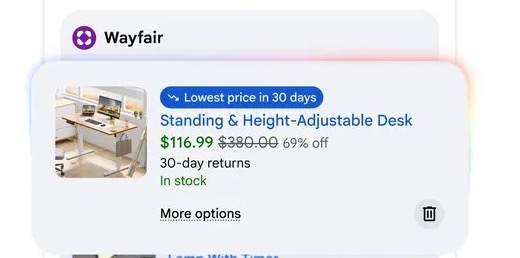
Price tracking and alerts are not new: Google described them in November 2025. The news is who gets AI Mode’s ongoing info monitoring, not the invention of the price-drop alert.[1]
On September 28, 2026, Google Search VP Robby Stein said AI Mode’s info monitoring, previously used by Pro and Ultra subscribers, was rolling out to everyone globally. Tell it what to look for, and Search keeps checking the web and lets you know when something relevant changes. His examples: new restaurants or pop-ups nearby, local holiday activities for the kids, and back-in-stock and price-drop updates.[2]
At I/O in May, Google described information agents operating in the background, 24/7. That means you do not have to keep the app open. It does not mean every website is checked every second. We found no published commitment on how quickly an alert arrives.[3]
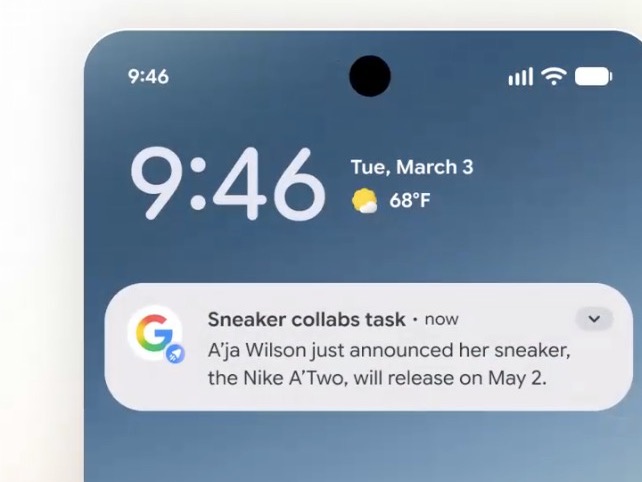
“Watch a new, black [brand and model]. Tell me if a seller can deliver it to Ontario, Canada for CAD 200 or less including shipping and tax. Do not order or pay.”
This shows how to write a specific request. It does not guarantee that every condition will be verified automatically. Check the saved task conditions, and confirm the exact item and total in the seller’s checkout before buying.A shopping radar cuts the time you spend watching. It cannot tell you whether the item is worth your money right now. This article focuses on the gap between the blip on the radar and the payment.
Extra: what does the 60-billion figure count?
Google’s May 2026 Universal Cart announcement describes a Shopping Graph of over 60 billion product listings. Listings are not unique models or stores. One product can appear in multiple offers and configurations. Google also uses this catalog for Universal Cart’s price-drop and back-in-stock experiences.[4]
The often-repeated “2 billion updated every hour” figure comes from a November 2025 announcement, when Google described the total as over 50 billion. Pairing that older refresh rate with the newer 60 billion figure would suggest a current, verified update speed that Google has not published.[1]
02Keep watching, check now, buy: three different requests
Waiting for a price drop, checking today’s stock and placing an order are different jobs. Info monitoring tracks changes over time. Check for me gathers current information. Agentic checkout executes a purchase after confirmation. Opening the door wider for one does not relax the conditions on the others.
Use the buttons below to turn the same headphone request into three different ones. This is an editorial demonstration, not Google’s interface or a connected agent.
“Check for me” gathers information from the web and can call a business when online details are missing. It is not a calls-only feature. The help page says it is available in English to signed-in users over 18. Web results can take a few minutes; call results can take up to 30 minutes. Add “don’t call” if you want online checking only. Those conditions and timings describe this check-now feature; they are not a promise about ongoing monitoring.[5]
The help page recommends turning on history and personalized recommendations “for the best experience.” Before approving a request, review what will be checked and whether calls may be made.
03Is the first price AI shows really the cheapest?
21.6%. Read on its own, it sounds like a surcharge for letting AI shop for you. That is not what was measured. Productrise, a company that tracks product visibility in Google, compared product prices displayed in AI Mode and regular Google search, not monitoring alerts. From August 9 to 31, 2026, it collected more than 100,000 search results and AI Mode responses in the US and UK, covering over 2 million product listings.[6]
For pairs matched by query, date and Google product ID, AI Mode’s first displayed offer price, or lead price, averaged 21.6% higher. But a matching product ID does not guarantee matching purchase terms. Some pairs compared a new item with a used one.[6]
So this is neither money shoppers actually overpaid nor the premium for buying the identical offer. It is a reason to look beyond the first displayed price, not a tax on using AI.

In 49.6% of matched pairs, the first-listed seller was different too. Finding the same product is not the same as showing the same seller’s terms. The number of choices differed sharply as well: an average of 3.9 product cards per query in AI Mode versus 27.8 in regular search’s popular-products carousel. A shorter answer is convenient. It does not certify that the offers you never saw were worse.[6]
If you build an AI shopping service, grade it on three separate report cards: how quickly a change was reported, how many comparable seller offers were considered, and how accurately the delivered total was shown. Faster alerts do not automatically mean savings. And seeing a different first offer does not tell you why it was chosen. Rather than guess at Google’s internals, measure those three user outcomes separately.
Study notes: the comparison has boundaries
- Regular-search collection covered the
popular_productscarousel; AI Mode collection used all tracked product cards. It did not cover every shopping placement. - The introduction says both sides were collected at the same moment, while the methodology specifies matching on the same date. The public methodology does not let us verify identical capture times for every price.
- A shared product ID does not guarantee the same seller, condition or purchase terms. The source includes new-versus-used examples.
- The 21.6% result covers matched products. The 49% full-catalog median gap is a different comparison. The source prints medians of 149 and 100 but says USD and GBP were not converted. We do not apply that mixed-currency statistic to a shopper’s dollar budget.
- The 38.1% disagreement figure does not neatly reconcile with another sentence saying prices agree “about 68%” of the time. The source does not explain the difference.
- This is one US/UK observation window. It cannot tell you what a search in Canada or Korea shows today, or what holds for every product category.

Source: Productrise’s original study and methodology. We did not independently reproduce it.[6]
04Does the cheapest price tag make the cheapest receipt?
Seller A has the lower sticker price. Add shipping, subtract discounts, and B comes out cheaper. The cheapest price tag does not always make the cheapest receipt. First match the model, condition, warranty and return terms, then compare what you would actually pay delivered to your address.
Try changing the prices, shipping and discounts in this fictional USD example. Watch the winner change. You can also enter an assumed tax rate. This is not a recreation of Productrise’s 21.6% result.
- Same item? Match the model number, capacity, size or color, and new versus refurbished condition.
- Same seller terms? Check the merchant, warranty, return window and return costs.
- Same delivered total? Keep currency and destination consistent; include discounts, shipping and tax.
- A better offer elsewhere? Open the regular shopping results or a retailer you trust before committing.
This is not about redoing all the work the agent saved you. Let it handle the waiting while you handle the last comparison. Treat an alert as a starting signal, not a certificate of the lowest price.
05So where does checkout finish?
Once the price checks out, one question is left: “So where do I pay?” Sometimes the order finishes inside the AI conversation. Sometimes you are sent to the merchant’s own store. Start with the current paths for Shopify products.
Two checkout paths for Shopify products
Based on Shopify help checked October 4, 2026. This is not a comparison of everything UCP and ACP can do.
Direct checkout in the conversation, if eligible
The store and the customer must both be US-based, and the store’s direct checkout must be switched on. Customers elsewhere, or shoppers at stores that turn direct checkout off, find the product and then finish on the merchant’s website.
To the merchant’s online-store checkout
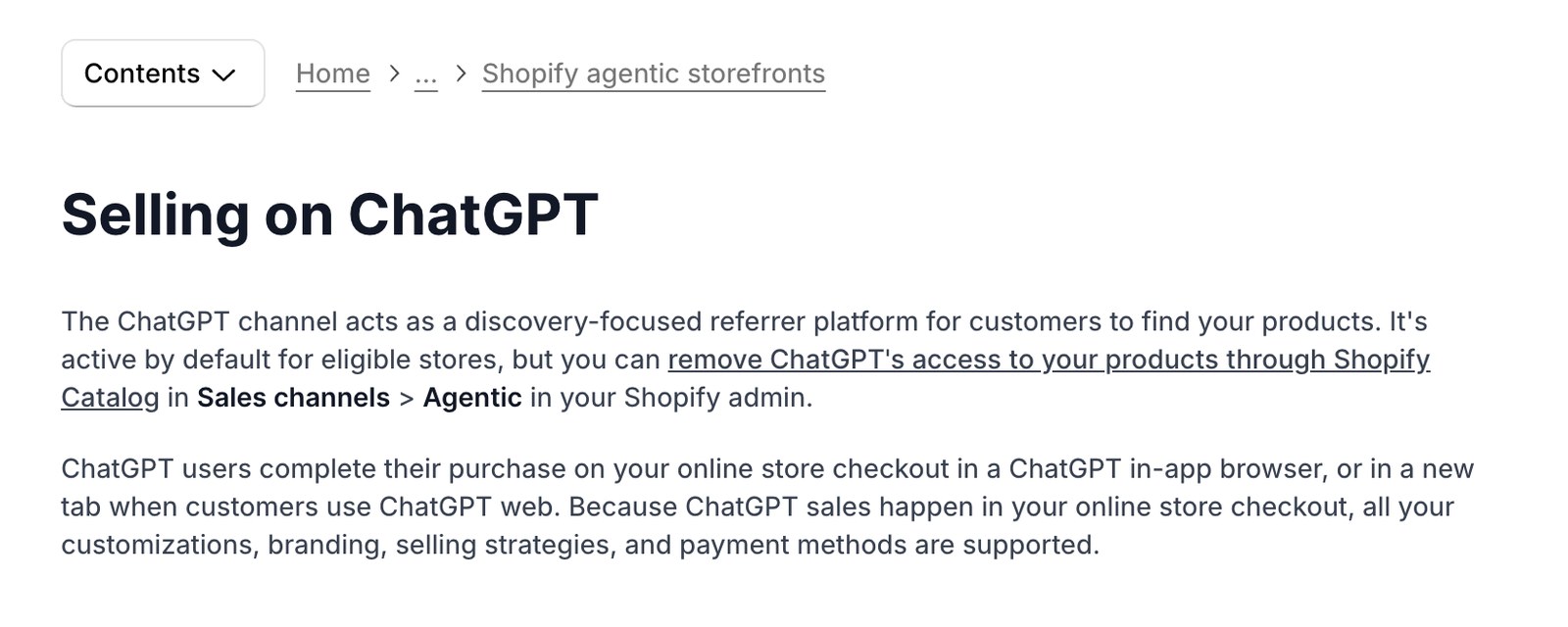
After finding a product, buyers pay in the merchant’s own checkout, opened in ChatGPT’s in-app browser or, on the web, in a new tab. Shopify admin has no ChatGPT direct-checkout setting to switch on or off.
In March 2026, OpenAI said the initial version of Instant Checkout did not offer enough flexibility and shifted its focus to discovery and merchants’ own checkout. Some merchants, such as Walmart, go deeper with a dedicated ChatGPT app, so the Shopify path above does not stand in for every ChatGPT purchase.[9]
Extra: UCP and ACP are not labels for inside versus outside checkout
UCP is an open standard for connecting merchant commerce capabilities to surfaces such as AI Mode and Gemini. ACP also enables agents to complete purchases through cart, checkout and order interactions with businesses. Whether checkout finishes in the conversation or on the store’s site depends on what each service and merchant implements and supports, not on the protocol name.[10][11]
More standards are on the way. On October 6, Meta and Sierra previewed the Personal Agent Protocol, an open standard they are building with partners including Shopify, Stripe and Walmart that defines how personal agents sign in to and work with a business’s website or API.[16] Payments appear only as a possible future extension for now.[17]
Paying inside an AI conversation does not make Google the seller. UCP documentation says the merchant remains the Merchant of Record and keeps customer relationships and data. Who sells the item, and on what terms, matters more than where the checkout window appears.[10]
Between an alert and payment comes confirmation
Google Pay’s agentic checkout runs only after you confirm the purchase and shipping details. Its help page says that if the final price rises above the total you confirmed, the purchase does not go through and you are not charged. Info monitoring, which sends alerts, and “Buy for me,” which makes the purchase, are different features. An alert is not purchase authorization.[12][1]
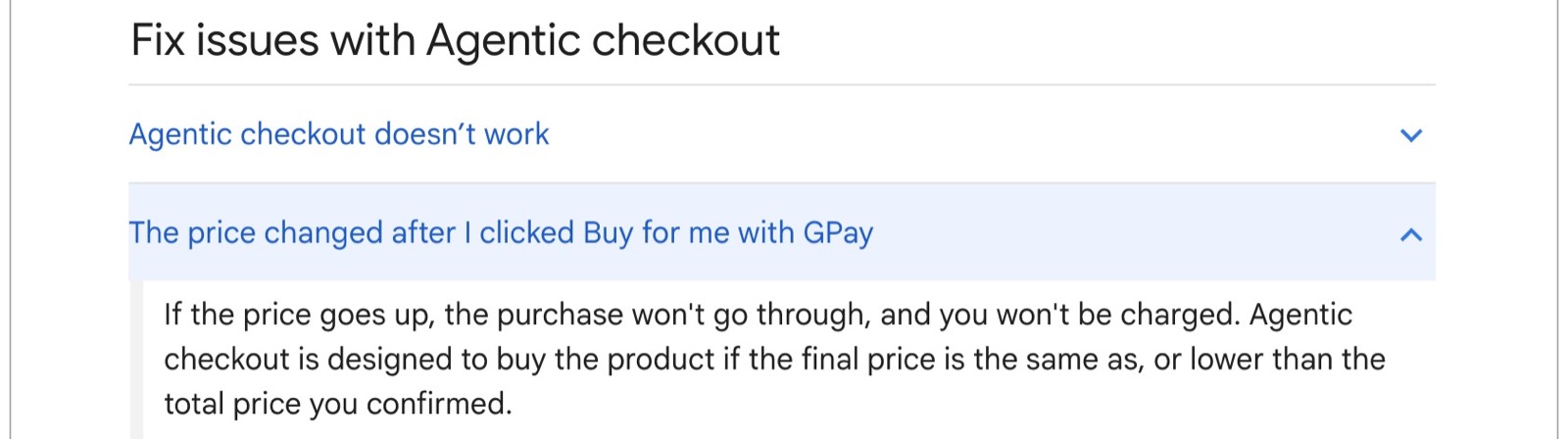
A global rollout for alerts does not make checkout global. Google Pay’s help page limits agentic checkout to the US and Australia, in English, at select merchants, and its troubleshooting section still says US only. Shopify’s Google direct checkout carries its own US requirements, as shown above. Check what actually works for your account, item and retailer.
[12][7]06For sellers: fix the price tags before polishing the copy
How to avoid inviting shoppers with the wrong information
Your product page says in stock, while the data you sent Google still says sold out. Which should a shopper believe? Align the price, currency, availability and condition on the page and in submitted product data. Google says products or accounts can be disapproved when landing pages fail requirements, including consistency with submitted data.[13]
Update product data when website prices or stock change, and check that the same item and terms continue through checkout.[14]
Accurate structured data (machine-readable price, currency, availability and condition on your product page) also powers automatic item updates.[15] It will not buy you first place in AI recommendations. It keeps you from attracting shoppers with the wrong information.
Delegate the waiting. Decide what your money buys.
The welcome change may be less about AI choosing for you than about no longer refreshing the same page over and over. But an alert does not finish a good purchase. You still match the model, vet the seller, and check the total including shipping and tax.
Let AI watch the price tag; keep your own hand on the wallet. Less time spent waiting does not automatically mean less money spent.
Sources and scope
This article compares public Google, OpenAI and Shopify materials with Productrise’s price study. It is not a hands-on test of account-level activation, notification speed or purchase outcomes. The buttons, calculator and quiz are editorial tools for understanding the distinctions.
Questions after the alert
Can shoppers in Canada or Korea use the same features?
Google announced a global monitoring rollout, but we could not confirm that it has reached every language and account yet. Checkout has separate eligibility. Shopify’s Google direct checkout requires US stores and US customers; other customers go to the merchant’s website. Check your actual account and retailer support.
How should I align dollar prices and delivery locations?
Distinguish USD from CAD and compare the same address, item condition and seller terms. Include shipping, tax, duties and card conversion fees where relevant. This article’s calculator is a fictional USD example, not an exchange-rate or duty calculator. It is not the same budget as CAD 200 in the sample request.
Should I keep watching an item after buying it?
If you no longer need alerts, clean up any remaining monitoring task. If the retailer offers price protection (a refund of the difference if the price drops within a set period after purchase), decide whether to keep watching until that window closes. Find stop or delete controls in the actual task interface and help.
What if the alert price differs from the checkout total?
Match the item, condition, seller and destination again, and stop if the final total exceeds your budget. Google Pay’s agentic checkout says a final price above the confirmed total stops the purchase with no charge. That is not a universal rule for every AI shopping flow.
Final quiz: what comes after the alert?
Q1What does the 21.6% figure measure?
It is a displayed-price gap for matched queries, dates and product IDs. Conditions could differ; it is not observed spending.
Q2Does enabling monitoring authorize a purchase?
Monitoring and checkout are separate. Purchase, shipping and total-price confirmation matter.
Q3What should you match before comparing prices?
Different models, conditions or seller terms can turn a price comparison into a comparison of different offers.
Q4Where do Shopify purchases from ChatGPT finish today?
Shopify says purchases finish in the merchant’s checkout through an in-app browser or new web tab.
Sources
- [1]Google · Agentic checkout and AI shopping tools (Nov 13, 2025)
- [2]Robby Stein, Google Search VP · Info monitoring global rollout (Sep 28, 2026)
- [3]Google · Search I/O 2026: information agents (May 19, 2026)
- [4]Google · Introducing the Universal Cart (May 19, 2026)
- [5]Google Search Help · Check local availability and pricing (checked Oct 4, 2026)
- [6]Productrise, Hugo Huijer · Original AI Mode price study and methodology (Sep 1, 2026)
- [7]Shopify Help · Selling on Google AI Mode and Gemini (checked Oct 4, 2026)
- [8]Shopify Help · Selling on ChatGPT: checkout redirects (checked Oct 4, 2026)
- [9]OpenAI · Powering product discovery in ChatGPT (Mar 24, 2026)
- [10]Google Developers · UCP: merchant of record and customer data (checked Oct 4, 2026)
- [11]Stripe Docs · Agentic Commerce Protocol (checked Oct 4, 2026)
- [12]Google Pay Help · Agentic checkout: permission, price limits and availability (checked Oct 4, 2026)
- [13]Google Merchant Center Help · Landing page requirements (checked Oct 4, 2026)
- [14]Google Merchant Center Help · Provide high-quality and up-to-date data (checked Oct 4, 2026)
- [15]Google Merchant Center Help · Structured data for price and availability (checked Oct 4, 2026)
- [16]Meta for Business · A New Way for Businesses and Personal Agents to Work Together (Oct 6, 2026)
- [17]Sierra · Introducing Personal Agent Protocol (Oct 6, 2026)
Official product information and an external observational study are labeled separately. Source images are cropped to the necessary material. Our diagrams and calculators are explanations, not live service interfaces.
Get the next AI tech note
You can sign up for new-article updates on the homepage.
View newsletter signup ↗