2026 AI Model Map Proprietary vs Open-Weight, Where Do They Stand?
On September 22 alone, Anthropic shipped Claude Opus 5.5 and OpenAI shipped GPT-6 Sol and Luna. A week later came GPT-6.1 Sol, and the next day Google announced Gemini 4 Argon. Should you switch every time a new “best” model arrives? This article skips the leaderboard and looks at four things instead: who makes the model, whether the weights are published, how you access it, and what it costs. The same model can carry very different costs and upkeep depending on whether you call it through an API or run it yourself.
Public-source analysis · Edited by Dandan Dad · Editorial policy
- OpenAI
- Anthropic
- Gemini
- xAI
- Meta
- DeepSeek
- Mistral
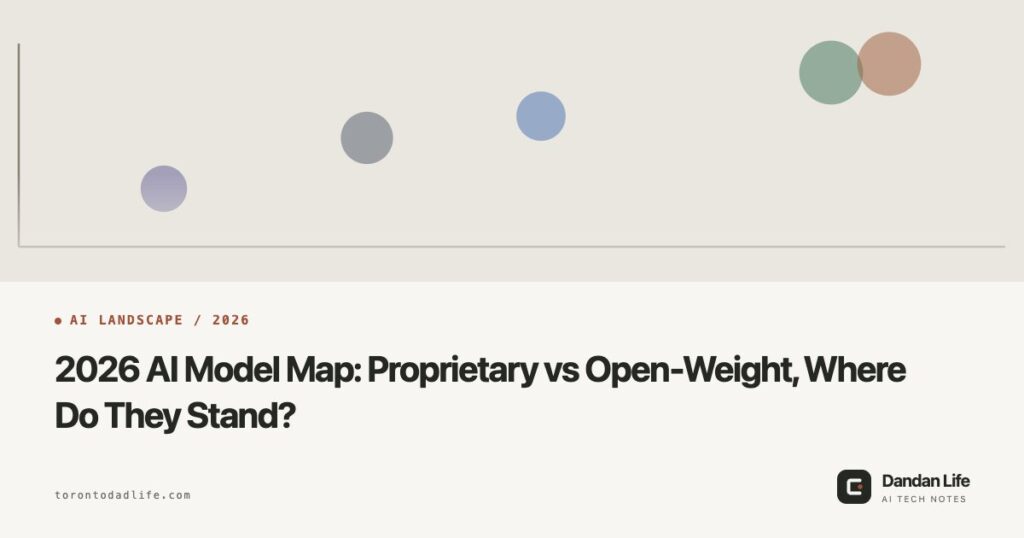
Illustrative model-family categories. Position and size do not compare performance or price.
- Major models fall into two groups: models whose weights stay private and are offered through apps and APIs (OpenAI’s GPT-6 Astra, Anthropic’s Claude Fable 5.1, Google’s Gemini 3.8 Flash, and others) and open-weight models you can also download and run yourself (DeepSeek-V4.1-Flash, Google’s Gemma 4, Meta’s Muse Glimmer, and others).
- API prices per million tokens differ by tens of times between models, but a gap in token price is not the same as a gap in the cost of finishing a task.
- The question isn’t “which is best” but “which fits my work.”
Comparing the Big Three: Weights, Access, and Price
OpenAI, Anthropic, and Google build the GPT, Claude, and Gemini model families. The cards below line up one representative model from each company on the same rows. Treat them as a map of models with different purposes and tiers, not a performance ranking. Prices come from each company’s official price list as of October 6, 2026, and the strengths are what each company highlighted in its announcement. Pros, cons, and benchmarks for each model are covered in the linked articles.
Not published (OpenAI’s open-weight line is the separate gpt-oss family)
ChatGPT and Codex, OpenAI API (model ID gpt-6-astra)
$10 input · $50 output per 1M tokens (requests up to 272K input tokens)
Computer use, alignment, cybersecurity
Not published
Claude apps (Pro, Max, Team, Enterprise), Claude Code, Claude API, AWS, Google Cloud, Microsoft Foundry
$10 input · $50 output per 1M tokens
Demanding reasoning, long-horizon agent work, coding
Not published (Google’s open-weight line is the separate Gemma family)
Gemini API and Google AI Studio, Google Cloud (model ID gemini-3.8-flash)
$0.75 input · $3.75 output per 1M tokens (introductory pricing through Dec 31, 2026; $1.50 · $7.50 from 2027)
Low latency at high volume, 1M-token context, agent work
Price sources (checked Oct 6, 2026): OpenAI · GPT-6 Astra model page · Anthropic · Claude Fable · Google · Gemini API pricing
The board kept moving outside these cards. On September 22 Anthropic released Claude Opus 5.5 at $4 input and $20 output per million tokens, and says it performs at the level of Fable 5.1 on most work. On September 29, at DevDay, OpenAI introduced GPT-6.1 Sol, which it says delivers near-Astra intelligence at one-fifth of Astra’s standard token prices ($2 input, $10 output). Google announced Gemini 4 Argon on September 30, but as of October 6 it is open only to a limited group, such as selected cyber-defense partners, and is not yet in the public API model list. Notice the pattern: Anthropic and OpenAI both shipped models that sell close-to-flagship performance at a lower token price.
A Model Map by Weights and Access Path
“Paid models vs free models” is a confusing split. Open-weight models still cost money through an API, and running them yourself means paying for hardware and operations. So this article looks at whether the weights are published and how you access the model as two separate questions.
Private-weight models
Used only through the company’s apps and APIGPT-6 Astra (OpenAI), Claude Fable 5.1 (Anthropic), Gemini 3.8 Flash (Google), Grok 4.7 (xAI), Muse Spark (Meta)
The company’s apps and subscriptions, its API, and in some cases cloud marketplaces
A subscription or an API price per million tokens
The company runs the servers. Your data is processed on its servers, so check its terms and settings for retention and training use.
Open-weight models
Weights can also be downloaded and self-hostedDeepSeek-V4.1-Flash (DeepSeek, MIT), Gemma 4 (Google, Apache 2.0), Muse Glimmer (Meta, Apache 2.0), gpt-oss (OpenAI, released 2025, Apache 2.0)
An API from the developer or a cloud provider, or download and run on your own servers
Token prices through an API; GPUs, power, and staff time when self-hosted
Self-hosting means you handle security patches, updates, and monitoring. Web search, tool connections, and log shipping also need checking if data must stay in-house.
Licenses reflect each model card as of October 6, 2026. Check the license text for commercial use and redistribution terms.
Model cards and licenses: DeepSeek-V4.1-Flash (MIT) · Gemma 4 (Apache 2.0) · Muse Glimmer 30B (Apache 2.0) · gpt-oss-120b (Apache 2.0) · OpenAI gpt-oss announcement (Aug 5, 2025)
The Open-Weight Chase: How to Read Vendor Scores
Some announcements show open-weight models matching or beating proprietary ones on certain agent and coding tests. DeepSeek, for example, released DeepSeek-V4.1-Flash on September 10, 2026, and its model card lists a Terminal-Bench 2.1 score of 90.6%. That is higher than Claude Opus 5 (89.1%) and GPT-5.6 Sol (88.8%) in the same table.
Scroll a little further down the same table, though, and the story changes. On the harder Terminal-Bench 4.0, V4.1-Flash scored 31.2%, far behind Claude Opus 5 at 51.8%. Even the 90.6% comes from DeepSeek’s own agent tool; on the same model card, the score ranged from 84.1% to 90.6% depending on which agent tool was used. Read vendor scores together with the tests they chose and the conditions they used, and recheck them against independent evaluations and your own tasks where you can.
Sources: DeepSeek announcement (Sep 10, 2026) · the DeepSeek-V4.1-Flash model card, evaluation results (Terminal-Bench 2.1 and 4.0) and the Terminal-Bench 2.1 table by agent tool (maximum reasoning effort; three runs per task in the agent-tool table)
When to Choose What
- Private-weight models (apps and APIs): When you need to start without anyone managing servers, or when features tied to a company’s apps and tools, such as computer use or multimodal input, are central. Check safety features and data handling in each company’s settings and terms; the model category alone doesn’t tell you.
- Open-weight models: When you need direct cost control, data can’t leave your servers, you need to fine-tune, or you want to avoid lock-in to one company. Check each model’s license for commercial use.
- Both: Build the prototype on an API, then compare an open-weight model’s API or self-hosting costs as usage grows.
What Changed in 2026
Companies releasing both private and open models
Publication differs by model, even within one company. Meta keeps the weights of Muse Spark, which powers the Muse app, private, but on August 10, 2026 it released the weights of Muse Glimmer, a model of about 30 billion parameters, under the Apache 2.0 license. Google offers Gemini as a private model while publishing a separate open family, Gemma; the latest, Gemma 4, came out in April 2026 under Apache 2.0. OpenAI released the open-weight models gpt-oss-120b and gpt-oss-20b under Apache 2.0 on August 5, 2025. Alibaba went a step further: on August 12 it published the weights of the base model behind its flagship API model, Qwen3.8-Max, under its own license. So check openness and licensing by exact model, not by company. Even within Qwen 3.8, the 27B model is Apache 2.0 while the Max-class open model has a custom license.
API prices differ by tens of times
DeepSeek’s current API model, DeepSeek-V4.1-Flash (API name deepseek-flash), costs $0.15 to $0.30 per million input tokens (cache miss) and $0.60 to $1.20 per million output tokens; the lower figure is the off-peak rate and the higher one the peak rate. GPT-6 Astra’s standard API price is $10 input and $50 output per million tokens. Dividing the unit prices gives a gap of about 33 to 67 times for input and about 42 to 83 times for output.
The cost of finishing a task, however, is not set by unit price alone, because models use different numbers of tokens to get the same job done. Anthropic says Opus 5.5’s token prices are 20% lower than Opus 5’s, and because it also uses fewer tokens, typical workloads cost 40% less. A cheap model that needs several retries can end up costing more. Compare what it costs to finish one of your own tasks, not the price sheet.
input/output per 1M tokens
through Dec 31, 2026
peak is 2x
Sources (checked Oct 6, 2026): DeepSeek API pricing · OpenAI · GPT-6 Astra · Anthropic · Claude Fable · Google · Gemini API pricing
Sources
- OpenAI · GPT-6 Astra model page (pricing, requests above 272K tokens)
- Anthropic · Claude Fable (pricing, availability)
- Google AI for Developers · Gemini API pricing (Gemini 3.8 Flash introductory price)
- DeepSeek API Docs · Models & Pricing (off-peak and peak rates)
- Hugging Face · DeepSeek-V4.1-Flash model card (MIT, evaluation results)
- Google · Gemma 4 announcement (Apache 2.0)
- Hugging Face · Muse Glimmer 30B model card (Apache 2.0)
- Meta Research · Introducing Muse Glimmer (Aug 10, 2026)
- Hugging Face · gpt-oss-120b model card (Apache 2.0)
- OpenAI · Introducing gpt-oss (Aug 5, 2025)
- DeepSeek · Introducing DeepSeek-V4.1-Flash (Sep 10, 2026)
- Anthropic · Introducing Claude Opus 5.5 (Sep 22, 2026; pricing and cost per task)
- OpenAI · Introducing GPT-6.1 Sol (Sep 29, 2026)
- Google · Gemini 4 Argon announcement (Sep 30, 2026)
- Hugging Face · Qwen3.8-2.4T-A95B model card (Qwen3.8-Max License)