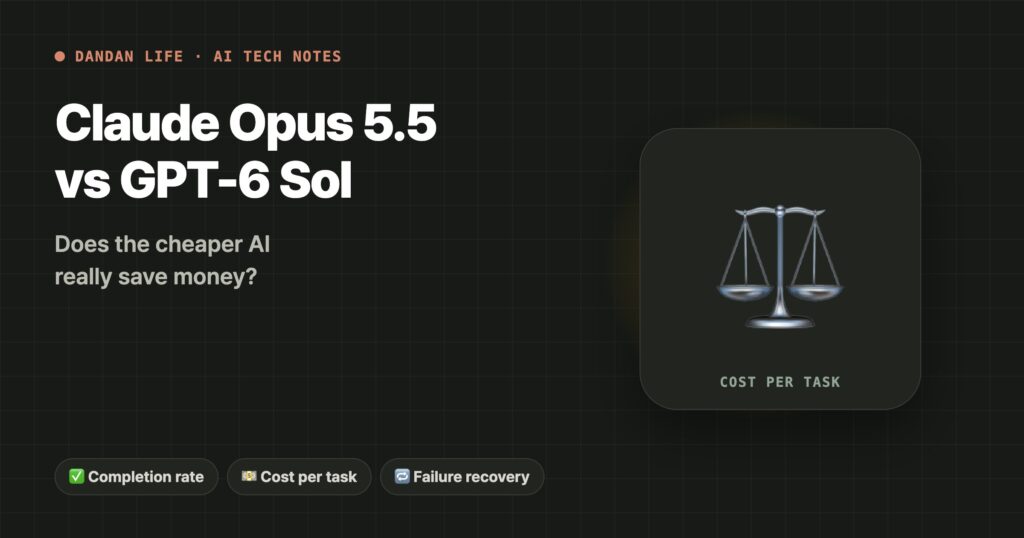
Claude Opus 5.5 vs GPT-6 Sol The cost of getting it done
If one AI charges half as much per token, does your bill drop by half? We weigh Claude Opus 5.5 and GPT-6 Sol on score and cost together, using Zapier’s AutomationBench leaderboard of September 23. Later changes are added with their conditions spelled out: the revised Opus figures, GPT-6.1 Sol (September 29) and Claude Sonnet 5.5 (September 28), all checked October 6.
Public-source analysis · Edited by Dandan Dad · Editorial policy
- Claude Opus 5.5
- GPT-6 Sol
Imagine hiring two digital workers. One finishes four out of ten complex workflows and costs $1.28 per job. The other finishes about a third and costs 27 cents. Which one would you hire?
Anthropic’s Claude Opus 5.5 and OpenAI’s GPT-6 Sol arrived on the same day, September 22, 2026. This is not simply a heavyweight versus a budget contender. It is a clash between two ways of buying useful work: pay more for a better chance of crossing the finish line, or pay less so you can run far more attempts. The answer depends on what a miss breaks.
The finish line is not a chat bubble
Zapier’s AutomationBench 1.0.6 creates simulated businesses, hands agents multi-app jobs, then checks the world they leave behind. It doesn’t score how persuasive the final message sounds. It checks whether the right CRM record changed, the right people got email, and the wrong people did not. Its private evaluation spans more than 600 tasks and 47 tools across sales, marketing, operations, support, finance and HR.
On that one leaderboard, Opus 5.5 at max effort completes 40.0% of tasks at $1.28 per task. Sol at xhigh completes 33.2% at $0.27. (Effort is the setting that decides how long a model thinks before it acts.) Opus buys 6.8 percentage points of extra completion; Sol costs about 4.7 times less per attempt. If the task is “sort drafts into folders,” you might prefer many cheap runs. If it is “route a deal announcement without leaking it to the wrong team,” one failed attempt might cost more than the entire model bill.
Those are the values we checked on September 23, 2026, when this article was written. Two days later the table had changed. On September 25 it listed Opus 5.5 (max) under a “default fallbacks” condition, where refused steps are rerun on Anthropic’s default fallback model, at 42.47% and $1.44 per task. Sol (xhigh) was unchanged at 33.2% and $0.27, and both entries still read the same on October 6. We could not confirm whether the earlier Opus figure used the same condition, so the math here keeps the original snapshot and reports the newer one separately.
Divide the average cost per task by the completion rate and you get what one successful task cost inside this evaluation: about $3.20 for Opus and $0.81 for Sol on the original snapshot, or about $3.39 for Opus under the September 25 default-fallback figures. That is a cost-efficiency metric for the benchmark, not the price of getting one real job done. Real deployments add retries, human review and cleanup, and those costs depend on what failed and how hard the task was. A wrong email cannot be retried away.
Then the board moved again. On September 29, at DevDay 2026, OpenAI released GPT-6.1 Sol at the same $2 input and $10 output per million tokens. In the AutomationBench 1.0.6 chart in its launch post, 6.1 Sol at xhigh completes 35.5% of tasks at $0.25 each. Opus 5.5 at xhigh scores 35.77% at $0.89: nearly the same completion rate for less than a third of the cost. At low, medium and high effort, 6.1 Sol likewise matches or slightly beats Opus at a third of the cost or less. Two caveats. These 6.1 Sol scores come from OpenAI’s own runs, and as of October 6 Zapier’s public leaderboard does not list 6.1 Sol yet. And at each model’s best setting the order holds: 6.1 Sol tops out at 36.1% (max, $0.30), still short of Opus 5.5 max at 42.47%.
Anthropic added a twist of its own. Claude Sonnet 5.5, released September 28, carries the same token prices as Sol, $2 and $10. On the same Zapier leaderboard it completes 44.75% at max effort for $1.14 per task, finishing more than Opus 5.5 max (42.47%, $1.44) while spending less (both under default fallbacks, checked October 6). On this benchmark, at least, the pricier model did not finish more work even within one vendor’s lineup.
A million-token price tag is not an invoice
At standard API rates, Opus 5.5 costs $4 per million input tokens and $20 per million output tokens. GPT-6 Sol costs $2 and $10. On identical uncached token counts, Sol is half the price, and both price lists were unchanged when we rechecked them on October 6. Here is a deliberately artificial 250,000-input, 50,000-output job.
Real agents reread their instructions, files and history. Opus 5.5 and GPT-6 Sol both charge $0.20 per million cached-input tokens (GPT-6.1 Sol charges $0.10), so heavy cache reuse shrinks the gap on the input side. If 200,000 of those 250,000 input tokens hit cache, the same hypothetical job becomes $1.24 on Opus and $0.64 on Sol, before the one-time cost of writing to cache. Actual bills depend on cache hit rate, output length, tool calls, retries and mode. OpenAI also specifies a long-context pricing step: past 272K input tokens, higher input, cache and output rates apply to the entire Sol request, not just the overflow. Anthropic bills Opus 5.5’s full million-token window at standard rates.
Both have giant windows, one million tokens for Opus and 1.05 million for Sol, and both allow up to 128K output tokens. A huge window is useful. It is not an excuse to dump a repository into every request without measuring the bill.
The launch graphs are not the duel you think they are
Read the labels under each company’s chart. Anthropic’s launch table places new Opus 5.5 against GPT-5.6 Sol, the previous generation, on several coding benchmarks. OpenAI’s launch article often compares new GPT-6 Sol with Claude Opus 5, not 5.5. Put those screenshots together without reading the labels and you can manufacture a “direct comparison” that nobody actually ran. OpenAI did add Opus 5.5 (with fallbacks) to its charts in the GPT-6.1 Sol launch post on September 29.
New Opus against the older Sol generation in several published tests.
New Sol against an older Opus generation in several published tests.
AutomationBench supplies a genuine same-version cross-vendor snapshot. Yet it remains one simulated tool environment, with effort settings that differ by model. Anthropic reports strong Opus 5.5 coding and research numbers, including 66.4% on Terminal-Bench 4.0, but its comparison table does not include GPT-6 Sol. OpenAI reports Sol’s improvements in factuality and coding against previous models and older Claude versions. Neither set of internal tests settles which of these two new models is more factual in your workflow.
What you inherit when you pick a model
Opus 5.5 is positioned for long-running coding agents and knowledge work. Anthropic says it costs 40% less to run than Opus 5 on typical workloads, with output more than 30% faster and cache reads 60% cheaper. Those are vendor-reported comparisons to Opus 5, not measured advantages over Sol. Opus also brings safeguards and integration changes: adaptive thinking cannot be disabled, and forcing a specific tool call now returns an error. Test the API migration, not only the prompt.
GPT-6 Sol offers six reasoning-effort levels, from none to max, and tool support through the Responses API, including search, code execution and computer use. OpenAI says its API token prices are 50% lower than the temporary discounted GPT-5.6 Sol rates, and it highlights improved prompt caching for agents. Moving to GPT-6.1 Sol? It drops the none setting and runs from low to max only. As of October 6, GPT-6 Sol stays in the API with no shutdown date, and OpenAI’s help center lists both GPT-6 Sol and 6.1 Sol as ChatGPT Work and Codex models that are not available in regular Chat. Check the product surface before promising your team a button that is not there.
Choose a first experiment, not a permanent winner
High volume, low consequence? Start with Sol (today, GPT-6.1 Sol). Cap retries, log cache hits, and inspect the actual final state. Savings are real only when the verification pipeline is cheap enough.
Long, interdependent, costly to repair? Start with Opus, and run Sonnet 5.5 alongside it; it scored higher on the same leaderboard. A higher score on one workflow benchmark earns a trial, not blind authority. Put human approval before sending, deleting or paying.
Somewhere between? Run both on the same 20 representative tasks. Track success, latency, total bill, retry count, human correction time and irreversible mistakes. The most expensive failure case often matters more than the average score.
The real race: cost per verified outcome
The newest models are not just competing on raw intelligence. Both launches emphasized cheaper inference and better caching. That tells us where the market is moving: from “How impressive was the answer?” toward “Did it produce exactly the end state that was requested, and what did a verified result cost?” On this evaluation (AutomationBench), Opus finished more tasks and Sol cost less per task. Your task, error budget and audit trail decide which one wins.
Since late September, the conclusion needs one addendum. If OpenAI’s numbers hold, GPT-6.1 Sol matches Opus 5.5 at xhigh effort and below for a third of the cost or less. Opus 5.5 at max still leads Sol when you need the highest completion rate, but Sonnet 5.5 now beats it on the same table for less money. Whether the cheaper AI saves you money is a question your own 20 tasks answer, not the model names.
A 20-task test plan
- Freeze the input, success criteria and allowed tools for each real task.
- Record reasoning effort and run each model at least twice per task.
- Grade persisted results, not confident completion messages. Include repair time.
- Keep human approval for high-stakes actions regardless of the winner.
Editorial note, September 23, 2026: This analysis uses the vendors’ launch posts and model docs plus Zapier’s public leaderboard. We did not conduct an independent paired deployment test. Update, September 25, 2026: Zapier’s leaderboard now lists Opus 5.5 (max) at 42.47% and $1.44 under a default-fallback condition, so the body notes both the original snapshot and the condition difference. Update, October 6, 2026: Added GPT-6.1 Sol (released September 29; scores from OpenAI’s launch post, not yet on Zapier’s leaderboard) and Claude Sonnet 5.5 (released September 28; Zapier leaderboard), and rechecked both vendors’ price lists: standard rates for Opus 5.5 and GPT-6 Sol are unchanged. USD prices are standard API rates per million tokens and can vary with cache, context length, mode, tools and region.
Sources
- Anthropic · Introducing Claude Opus 5.5 (Sep 22, 2026)
- Anthropic · Opus 5.5 model documentation
- Anthropic · Claude Sonnet 5.5 model documentation
- OpenAI · Introducing GPT-6 Sol and Luna (Sep 22, 2026)
- OpenAI · GPT-6 Sol API documentation
- OpenAI · Introducing GPT-6.1 Sol (Sep 29, 2026)
- Zapier · AutomationBench leaderboard and methodology (v1.0.6)