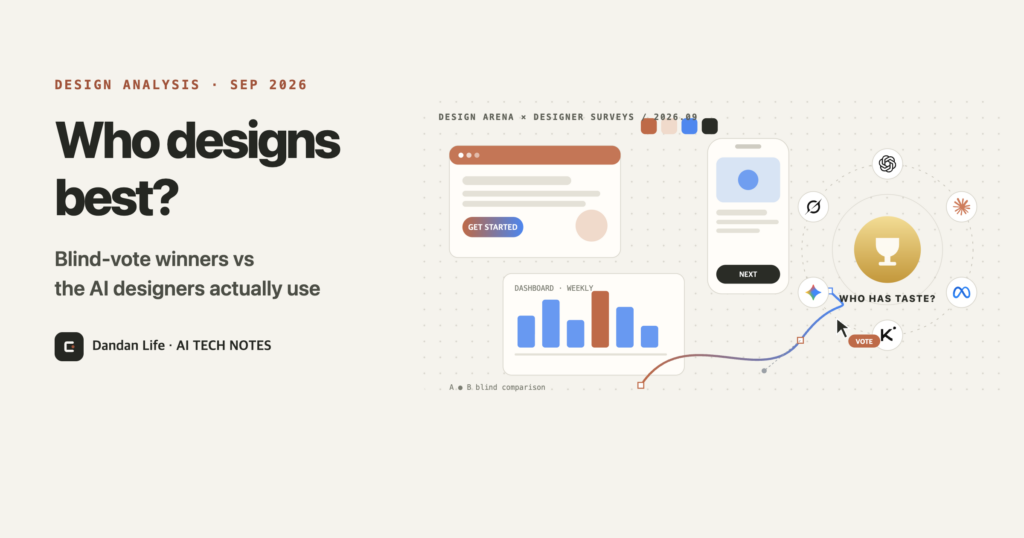
Who Designs Best? The Vote Winner vs the Designer’s Pick
Say you need an AI to mock up a landing page. Leaderboards built from millions of blind votes crown a different winner in every category. Ask 900+ working designers what they use, and yet another AI comes out on top. Which one should you trust? The two datasets were collected at different times and answer different questions, so let’s follow the gap, number by number.
Public-source analysis · Edited by Dandan Dad · Editorial policy
- Claude
- ChatGPT · GPT
- Muse Spark
- Kimi
- Gemini
- Grok
- Figma
Give the same design brief to several AIs at once, hide who made what, and let people pick the better one. Do that millions of times. Is the AI that wins those votes the one sitting on a designer’s desk?
Short answer: no. On September 24, 2026, OpenAI models led four of eight blind-vote categories, Meta models led two, and Anthropic and xAI models one each. Yet in a Q1 2026 designer survey, the most-used general AI was Claude at 78%, while ChatGPT, the leader a year earlier, slid to 65%.
The leaderboard kept moving. By October 6, Claude Opus 5.5 had taken #1 in 3D and data visualization, bringing Anthropic’s category wins to three. This piece reads the September 24 snapshot and flags what has changed since.
(Design Arena)
(54% in 2025)
(Q1 survey; ChatGPT 65%)
#1 beats #8
1. How does taste become a number?
Design Arena calls itself the largest crowdsourced benchmark for AI-generated design. Think of it as a blind taste test: the same prompt goes to several models, the results appear side by side with names hidden, and users vote for the better one. Votes from millions of users in 190+ countries are turned into an Elo rating, the same system used in chess.
The key idea: a rating gap is a win probability. A 100-point gap means the higher model wins about 64% of the time; 50 points, 57%; 25 points, 54%. Try it yourself:
Expected win rate from Design Arena overall (Text-to-HTML) Elo, September 24. Formula: 1 ÷ (1 + 10−gap/400)
Play with it and the picture sharpens. Pit September 24’s overall #1, Kimi K3 (1378), against #7, Claude Opus 5 (1331), and the leader’s expected win rate is only about 57%. In ten matchups, #7 would win about four. “Number one” sounds bigger than it is.
2. Category leaders: every task has a different winner
Beyond the overall board, Design Arena ranks models by category: websites, UI components, data visualization, 3D, mobile apps, image-to-website, slides, and image generation. Here were the category leaders on September 24:
OpenAI took four categories (UI component, data viz, 3D, image). Meta’s Muse Spark 1.3 led websites and image-to-website. Claude Fable 5.1 led slides, and Grok 4.6 led mobile apps, though only 5 points ahead of #2 Claude Fable 5 (1302 vs 1297). Scores are comparable only within a category, since each one has different models and votes. Tap the tabs to see each category’s top eight:
Three things stand out:
- The UI-component pack is tight. #1 GPT-6 Astra (1376) and #8 GPT-5.6 Sol (1350) are 26 points apart, so the leader’s expected win rate is just 53.7%. That is an expectation from the ratings, not a statistical test.
- 3D and slides had clear leaders. GPT-6 Astra led 3D by 50 points; Claude Fable 5.1 led slides by 34.
- Chinese models are all over the top ranks. Moonshot’s Kimi K3, the overall #1 on September 24, plus Xiaomi MiMo, Zhipu GLM and Alibaba Qwen made several top-eight lists.
3. Images: an OpenAI sweep
Text-to-image is the clearest race. Both the independent Artificial Analysis image arena and Design Arena’s image board put OpenAI’s GPT Image 2.5 on top, and both still did on October 6.
The interesting part is what’s missing. Midjourney is nowhere near the top of either arena. On Artificial Analysis, its best entry, Midjourney v7 Alpha, sat at #113 on October 6. Yet designer tool guides still call it the “aesthetic benchmark.” Blind votes judge one image; designers pay for taste that holds across a whole moodboard.
4. Survey: the AI designers actually use (Q1 2026)
Now look at the designer’s desk: “AI in Design 2026” from Designer Fund and Foundation Capital, which surveyed 900+ designers in 60+ countries. The survey ran in Q1 2026, about six months before the September 24 Design Arena snapshot.
The order flipped in a year. In this survey, the share using Claude rose from 52% to 78%, above ChatGPT (88% → 65%). Gemini was third at 48%; Perplexity fell from 34% to 13%.
Designers using AI at least weekly jumped from 54% to 91%, and the average number of AI tools per designer went from 3 to 7.
A second survey points the same way. In UX Tools’ “State of Prototyping Spring 2026” (1,478 designers and builders), Claude (50.8%) was the most-used weekly tool after Figma (82.6%).
ChatGPT (48.2%) ranked #3, and Claude Code (38.4%) #4, ahead of FigJam. Five of the top ten weekly tools are AI.
Source: UX Tools State of Prototyping Spring 2026 open data (1,478 respondents, multi-select). Bar length is relative to #1 Figma.
Blind-vote category leaders
Category wins across 8 Design Arena categories (Sep 24)What designers actually use
General AI usage share (AI in Design 2026, Q1 survey)5. Why the vote winner isn’t the daily driver: three possible explanations
The two datasets answer different questions. A blind vote asks “which result do you like better?” A survey asks “what do you actually use?” These data alone cannot prove why the answers differ, but they point to three plausible explanations.
Design work expanded toward code
In AI in Design 2026, 76% of respondents have used an AI coding tool like Claude Code, Codex or Cursor. 65% use Claude Code, and half (50%) have shipped code to production.
Figma’s 2026 AI report shows designers participating in development nearly doubled, from 21% to 41%, in a year. What matters now is one flow from mockup to code, not one pretty comp.
Models live inside tools
As of October 6, Figma Make’s model picker lists GPT-6.1 Sol, Claude Opus 5.5 and Gemini 3.8 Flash, among others. In tools like this, the model is just one menu item.
Designers often don’t pick a model first. They pick a workbench they open every day, then use the models inside it.
Repeatable quality over a single strong result
80% of designers say reliably high-quality output is what makes a tool stick. 62% call inconsistent output their biggest challenge.
Blind votes compare one result. Real work has to hit the same brand rules a hundred times in a row.
Product direction after the survey. After the Q1 survey closed, Anthropic launched Claude Design on April 17, 2026 as a research preview powered by Claude Opus 4.7, pitching design-system support and handoff to Claude Code. So Claude Design did not cause the Q1 usage numbers; it shows where products went afterwards.
Top two rows: AI in Design 2026. Bottom four: UX Tools State of Prototyping Spring 2026.
6. Voices from the field: praise and pain
Quotes from design leaders featured in the report share one theme: first drafts got dramatically faster, but adjusting spacing, fonts and brand rules exactly as intended is still human work.
Fine grain control is the biggest gap. It’s the tuning. It’s the ‘I know what I want in my head, but you’re just not giving me what I want.’ So I need to go into Figma and tell you what I want and then put that back.
Shali Nguyen
Head of Consumer Experience Design, DoorDash
We use Figma as a scalpel now: pull an area out for specific cuts and push it back into the coded prototype.
Mark Boyes-Smith
Head of AI Design, Miro
Figma has shifted from being the primary design tool to a canvas for quick exploration and polishing details as input for Claude Code.
Phil Vander Broek
Head of Design, AI, Superhuman
Our team built ProtoDash, an AI-powered product playground with Stripe’s design system baked in. Now anyone can build a realistic prototype in minutes.
Katie Dill
Head of Design, Stripe
We have an org-wide skill library in Claude, where I installed a visual brand skill… It caught on like wildfire.
Jessica Rosenberg
Head of Brand, AirOps
In Figma’s “State of the Designer 2026” (906 designers), 91% say AI tools improve their designs and 89% say they work faster. Yet designers most often define craft as visual polish (58%). Speed went to AI; the bar for polish stayed with people.
7. So what should you use? Picks by task
Combining blind-vote rankings with real-world usage, here is a starting point, not a final answer. It is based on the September 24 rankings, with October 6 changes noted where a leader changed. Running the same brief through two or three models is still the surest test.
The takeaway. Blind votes measure preference for one output; surveys show the tools designers use in their everyday workflow. In the September 24 blind votes, OpenAI and Meta models led several categories; by October 6, Claude Opus 5.5 led two. In the Q1 2026 survey, Claude was the AI most designers said they use. When choosing a tool, ask how well it fits your workflow before you ask who is #1.
Caveats
- Arena voters aren’t only professional designers, and sample sizes and confidence intervals differ by category.
- Elo scores can only be compared within a category. Each category has different models and votes, so absolute scores across categories say nothing about quality or variance.
- The two datasets come from different times: the designer survey from Q1 2026, the blind votes from September 24 (partly rechecked October 6). Claude Design (April 17) is not reflected in the survey.
- Surveys can skew with recruitment channels. Anthropic is a partner of AI in Design 2026 (the report says it was run independently).
- Models change every few weeks. Claude Sonnet 5.5 arrived on September 28, so expect this table to keep moving.
Read this as a framework for judging, not a fixed ranking.
FAQ
Which AI model is best at design?
It depends on the task. On Design Arena as of October 6, 2026, Muse Spark 1.3 leads websites, GPT-6 Astra leads UI components and image-to-website, Claude Opus 5.5 leads 3D and data visualization, Claude Fable 5.1 leads slides, Grok 4.6 leads mobile apps, and GPT Image 2.5 leads images. Opus 5.5 also tops the overall (text-to-HTML) board, flagged as a preliminary result.
Which AI do working designers use most?
In AI in Design 2026 (surveyed in Q1 2026): Claude 78%, ChatGPT 65%, Gemini 48%. In the UX Tools survey, Claude (50.8%) was the #2 weekly tool after Figma.
How should I read Elo gaps?
A 100-point gap means about a 64% win rate for the higher model; 50 points, 57%; 25 points, 54%. Gaps of 20–30 points at the top are close to a coin flip. Compare Elo scores only within the same category, not across categories.
Why isn’t Midjourney in the rankings?
It is not near the top of the Artificial Analysis or Design Arena image boards. On October 6, the best Midjourney entry on Artificial Analysis, v7 Alpha, ranked #113. Designer tool guides still recommend it as an aesthetic reference for moodboards and style exploration.
KEEP READING
- Claude Opus 5.5 vs GPT-6 Sol: The cost of getting it done
- Anthropic Claude: Fable 5.1 and Sonnet 5, Two Pillars of the Agent Era
- GPT-6 Astra: The Reality of “The Most Aligned Model”
- Meta Muse: From AI That Answers to AI That Does the Work
Updated weekly: AI Usage Limits & Pricing Tracker →
Sources
- Design Arena · Leaderboards (checked Sep 24 and Oct 6, 2026)
- Design Arena · About & Methodology
- Artificial Analysis · Text to Image Leaderboard
- Designer Fund & Foundation Capital · AI in Design 2026: Tools
- Artificial Studio · AI in Design Report 2026 summary (2025 values)
- UX Tools · State of Prototyping Spring 2026
- Figma · State of the Designer 2026
- Figma · 2026 AI Report
- Figma Help · Select an AI model in Figma Make
- Anthropic · Introducing Claude Design (Apr 17, 2026)
- Anthropic · Introducing Claude Opus 5.5 (Sep 22, 2026)
- Claude Help Center · Release notes (Claude Sonnet 5.5, Sep 28, 2026)
- Google · Gemini API release notes (Nano Banana 2.1, Oct 6, 2026)
- Devlin Peck · AI in Design 2026: Best Tools