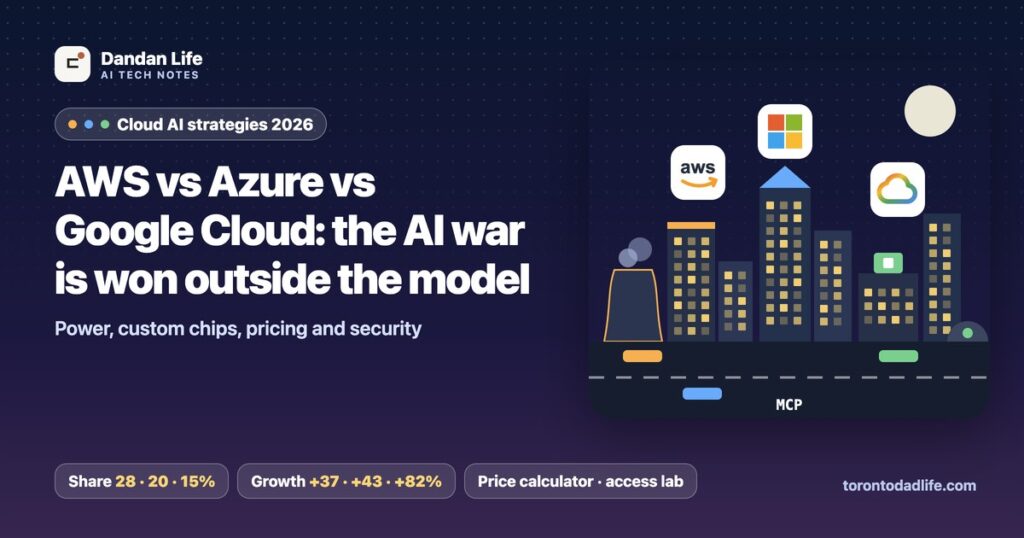
AWS vs Azure vs Google Cloud: The AI War Is Won Outside the Model Power, custom chips, pricing and security: reading the three clouds’ 2026 strategies
Eleven reactors, 890 megawatts, 20 years. Those are the numbers Google and nuclear operator Constellation announced on October 6, and they come from a power contract, not a model scorecard. When people talk about the AI race, they usually start with who builds the smartest model. Follow the cloud companies, though, and the story changes. Behind every model launch sit power contracts, custom chips, complicated price sheets and the access rules around company data. The answer on the screen is only part of the contest.
Public-source analysis · Edited by Dandan Dad · Editorial policy
The big number on each card is year-over-year revenue growth for the same period (April to June 2026); the figure next to the bar is that quarter’s revenue. Microsoft doesn’t disclose quarterly Azure revenue in dollars, and Google Cloud revenue includes apps like Workspace, so the three companies count different things.[1][2][3]
Trying AI once and running it every day inside a company are different jobs. Great answers don’t help if the budget can’t carry them, and a system that finishes the work but shows people documents they shouldn’t see is a bigger problem still.
So this time we look at AWS, Microsoft Azure and Google Cloud as cities that AI lives in. If the model is the city’s face, what keeps the city running is power and compute, the pricing system and access control.
The question isn’t who shows off the flashiest AI. It is where you can run your AI most reliably. Let’s step behind the launch stage.
No. 1 with 28% share. Bedrock sells Claude, OpenAI and Gemma alongside its own Nova.
30 million+ paid Copilot seats. The OpenAI exclusivity is over, but Microsoft is still its main cloud partner.
82% growth. Its eighth-generation TPU comes in two versions tuned for different work.
Copilot only searches within access people already have. Clean that up first.
01. The biggest cloud and the fastest-growing cloud
Money is pouring into the cloud. Synergy Research Group says companies worldwide spent $143 billion on cloud infrastructure services in Q2 2026, up 43% from a year earlier. That is the fastest growth in eight years. Services built specifically for generative AI grew 165%.[4] That doesn’t mean cloud prices all went up. It means companies are spending more on cloud in total.
Now for size. In the same count, AWS held 28% of the cloud infrastructure market, Microsoft 20% and Google 15%. In public cloud (IaaS and PaaS) alone, the three together take 67%.[4] In Q1 the split was 28%, 21% and 14%,[5] so in one quarter Google gained a point and Microsoft gave one up.
Market size $143B · up 43% year over year · both quarters drawn on the same scale.
Market size $129B · up 35% year over year
AWS is still the biggest cloud, but the growth ranking runs the other way. In the same quarter AWS revenue grew 37%, its fastest pace in 18 quarters.[1] Microsoft’s “Azure and other cloud services” grew 43%,[2] and Google Cloud grew 82%.[3] The biggest company is growing more slowly and the smaller ones faster, although 37% at AWS’s size is still remarkable.
Each company measures a different scope. Read this as a trend picture, not a league table.
The biggest company and the fastest-growing one aren’t the same. So what matters more to you: scale, or speed of change?
Each company also showed off the size of its ecosystem in the same earnings round.
That is how much Google’s model APIs process, up from a quarter earlier.[6] It shows scale of use, not which model performs better.
Paid Microsoft 365 Copilot seats. Azure revenue also topped $100 billion for the first time.[2]
Customers using Amazon Bedrock. Amazon says Bedrock customers spent more in Q2 than in all prior quarters combined.[1]
02. Power: why all three want nuclear
Without electricity, nothing in a city runs. The International Energy Agency (IEA) says a conventional data center is around 10 to 25 megawatts (MW), while a hyperscale AI-focused one can be 100 MW or more.[7] In its 2026 outlook, the IEA expects global data center electricity use to roughly double, from about 485 terawatt-hours (TWh) in 2025 to about 950 TWh in 2030, or around 3% of global electricity demand by then.[8]
An AI data center that never sleeps needs power that doesn’t dip when the wind drops, which is why all three companies are turning to nuclear.
Each company is securing that power in a different way.
Microsoft: waking a sleeping reactor
- Constellation is bringing back Three Mile Island Unit 1, retired early in 2019 for economic reasons, as the Crane Clean Energy Center, and Microsoft buys the power.[9]
- About 835 MW, under a 20-year power purchase agreement (PPA) signed in September 2024.[9]
AWS: buying the lot next to the plant
- In March 2024 it paid $650 million for the data center campus beside Talen Energy’s Susquehanna plant.[12]
- In June 2025 that grew into a deal for 1,920 MW through 2042, reaching full volume no later than 2032.[13]
- It invested in small modular reactor (SMR) developer X-energy and is backing the “Cascade” project in Washington state, starting at 320 MW and expandable to 960 MW. The goal is more than 5 GW across the US by 2039.[14][15]
Google: reserving reactors that don’t exist yet
- In October 2024 it started working with Kairos Power to bring up to 500 MW of small modular reactors online by 2035.[17]
- Step one: 50 MW from the Hermes 2 plant, delivered through TVA’s grid starting in 2030.[17]
- It is also funding early development at three Elementl Power sites, at least 1.8 GW in total.[18]

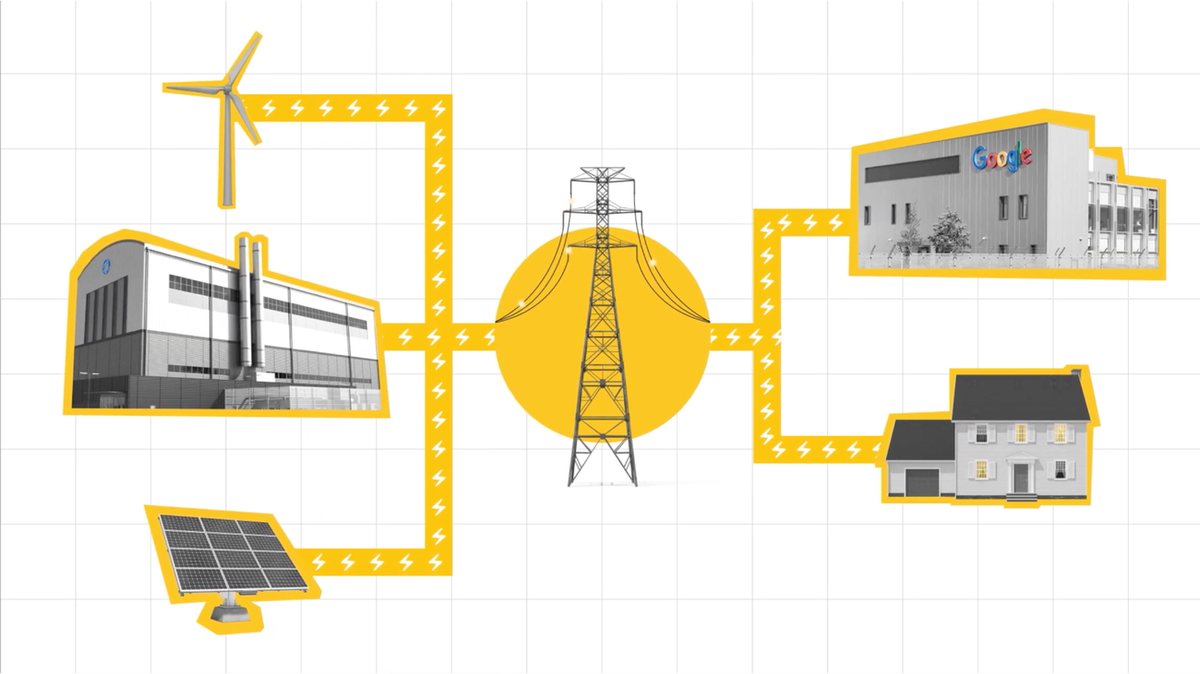
Which way does the power come in?
The AWS and Talen deal is worth a closer look because the delivery route is changing. At first, a data center on the same site as the plant took power behind the meter, straight from the plant without touching the grid. But in November 2024 the Federal Energy Regulatory Commission (FERC) rejected an amended agreement that would have raised that directly supplied load from 300 MW to 480 MW.[20][12]
The 2025 deal switches to a front-of-the-meter arrangement, so the power now travels over the grid: the plant’s output goes onto the PJM grid, Talen acts as the retail supplier, and the local utility PPL handles transmission and delivery.[13] In its 2025 annual report, Talen said the transition would begin after transmission work expected in spring 2026 and be complete in spring 2027. That is a stated expectation, not confirmation that the work is done.[16] Tap the buttons to compare.
- 2027Microsoft · Crane restart target (about 835 MW)
- 2030Google · first power from Hermes 2 (50 MW)
- 2032AWS · full Talen volume (1,920 MW)
- 2035Google · up to 500 MW of Kairos SMRs
- 2039Amazon · 5 GW+ of SMR goal
In short, Microsoft is reviving a proven old reactor, AWS is pairing long contracts with a running plant with new SMRs, and Google is betting early on new technology. They share one thing: most of the payoff arrives in 2027 or later. As of 2026, most of these nuclear plans are still in preparation.
Lately Amazon and Google have also taken a shortcut: the uprate, which swaps out turbines and control systems at reactors that are already running so they produce more power. On September 30, Amazon agreed to buy 690 MW from Constellation’s Calvert Cliffs plant in Maryland for 20 years, including about 190 MW of new capacity the uprate adds between 2030 and 2032. On October 6, Google signed its own 20-year deal with Constellation to upgrade 11 reactors and add 890 MW to the PJM grid before the end of 2032. Google says that is years faster than building a large new reactor from scratch. Even the shortcut takes time, though: the first uprate is due by 2028.
03. Custom AI chips: the same work for less
All three companies still buy accelerators from outside vendors such as Nvidia, but they also design their own AI chips tuned for their services. Designing a chip isn’t the same as running a chip factory: Microsoft’s Maia 200 is its own design, but TSMC builds it on a 3-nanometer process.[21] We covered the basics of Maia 200 and Amazon’s Trainium3 in the chip-war chapter of our AI market piece, so here we focus on the biggest change of 2026: Google splitting its TPU into two lines.

At Cloud Next in April 2026, Google announced its eighth-generation TPU and, instead of one product, built two versions for different kinds of work. Pre-training is where a model reads huge amounts of data to build its basic skills; inference is a finished model answering real requests. TPU 8t focuses on large-scale pre-training, while TPU 8i focuses on inference and post-training such as reinforcement learning. It is less a clean split between training and inference than a design tuned to each workload.[22] Both run on Google’s Axion CPU hosts, and Google says both will be generally available later this year.[23]
🔧 Chip specs and network layout in detail
TPU 8tTuned for pre-training
🏗️ Large-scale pre-trainingTPU 8iTuned for inference and post-training
⚡ Inference and RL- On-chip storage
- 384 MB SRAM (3x the last generation) plus 288 GB HBM[23]
- Delivery route
- Max hops between chips: 16 → 7[22]
- Value
- Up to 80% better performance per dollar over Ironwood · Google’s figure[22]
- Availability
- Both chips due for general availability later this year, hosted by Google’s Axion CPUs[23]
The number to watch on 8i is the hop count. Think of a hop as one stop a piece of data makes on its way to the destination chip. Most large models now use a mixture-of-experts (MoE) design, so even a single token may need to send data to “experts” spread across many chips and back. In the previous 3D torus layout, a 1,024-chip system needed up to 16 hops. The new Boardfly layout cuts that to seven, which Google describes as a 56% shorter network diameter.[22]
Fewer hops means a shorter communication path. It doesn’t mean a model’s response time drops by the same proportion.

The other two companies are busy as well. Microsoft’s Maia 200 isn’t a chip you rent; it is an inference chip built to run Microsoft’s own services more cheaply. Microsoft uses it to run multiple models, including OpenAI’s GPT-5.2, in Microsoft Foundry and Microsoft 365 Copilot, and developers get a preview of the Maia SDK.[21] Amazon’s Trainium3 carries 144 GB of HBM3e per chip with 4.9 terabytes per second of bandwidth, and EC2 UltraClusters 3.0 can link up to a million of them.[24] In its Q2 results, Amazon said Anthropic and OpenAI have both made multi-year, multi-gigawatt commitments to Trainium.[1]

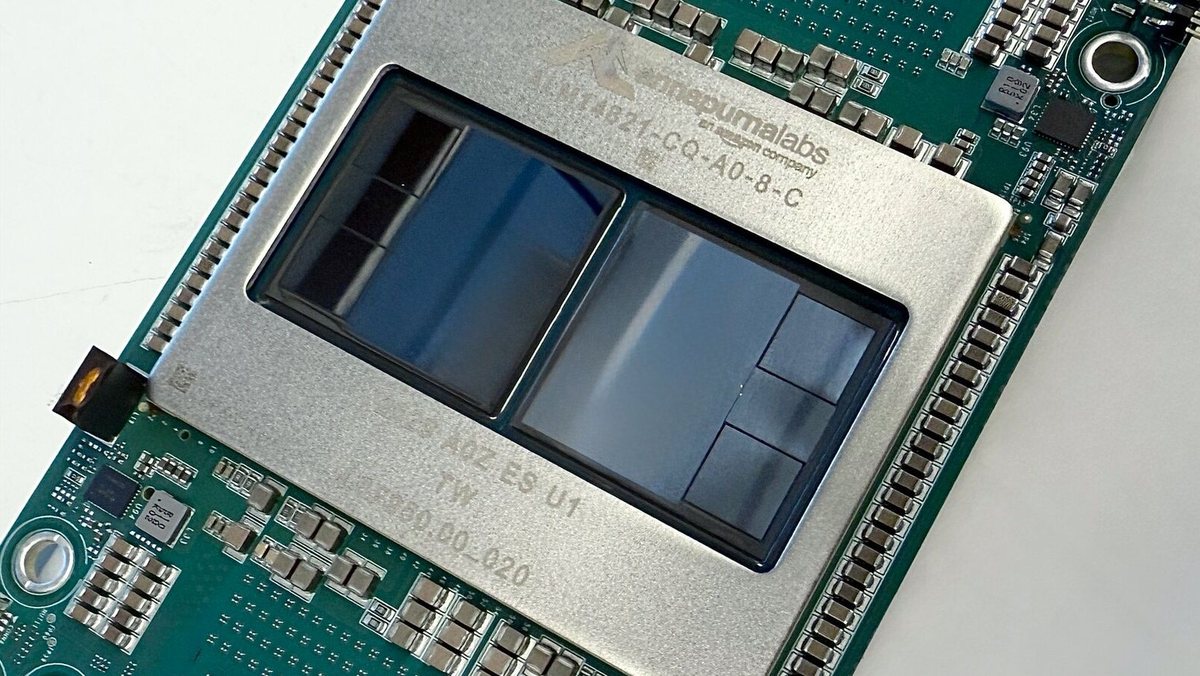
Google has gone one step further. Alphabet’s earnings release says Google Cloud’s product revenue comes primarily from sales of TPU systems.[3] In other words, chips it designed for its own services are now sold as whole systems too. Some have even left the planet. On October 1, Google said its Project Suncatcher prototype satellite, carrying TPUs, had reached orbit and made contact. It is the first step in a long-term research effort to see whether the chips can survive space radiation and extreme temperatures. We dig into it in our Suncatcher piece.
Users meet response times and bills long before they meet chip names. That is where the value of custom chips has to show up.
- Most “x times better” chip claims compare a company’s new chip with its own previous generation, measured by the company itself. The 2.7x and 80% figures come from Google, not from a like-for-like test against rival chips.
- At the April announcement, TPU 8t and 8i were “generally available later this year.” As of October 6, Google’s TPU product page still lists both as “coming soon.” Check the launch notes for timing in the region you need.
04. Models: home-grown and hosted
What actually does the work on top of all this infrastructure is the AI model. Each cloud offers models it built itself alongside models from other companies. Open the 2026 lists and something jumps out: Anthropic’s Claude is available on all three.
The biggest change of the year involved OpenAI. On April 27, 2026, Microsoft and OpenAI amended their deal. Microsoft keeps its license to OpenAI’s technology through 2032, but it is no longer exclusive, and OpenAI can now offer its products on other clouds. Microsoft remains the primary cloud partner, and OpenAI products still ship first on Azure, unless Microsoft cannot and chooses not to support the necessary capabilities.[28] The very next day, AWS added OpenAI models, Codex and managed agents (limited preview) to Amazon Bedrock.[29] In late September, AWS made GPT-6.1 Sol generally available on Bedrock and opened the managed agents to a public preview.
It is less a move than a second base. The money changed direction, too: Microsoft no longer pays OpenAI a revenue share, while OpenAI’s revenue-share payments to Microsoft continue through 2030 at the same percentage but with a total cap.[28]
Amazon, meanwhile, is trimming its home-grown lineup. It launched the Nova 2 family in December 2025, but in late July Reuters, citing Business Insider, reported that Amazon was winding down higher-end Nova models such as Premier and Omni to focus on a new frontier model. As of October 6, AWS’s Nova 2 guide lists just three models: Nova 2 Lite (with a 1-million-token context), the Nova 2 Sonic voice model and a multimodal embeddings model. A follow-up voice model, Nova 2.5 Sonic, became generally available on October 5. Nova Forge, which lets companies build their own Nova-based models on their own data, was reported at $100,000 a year,[30] and AWS says its browser-automation agent Nova Act reached 90% reliability on workflows built by early customers.[25]
Microsoft’s best-known home-grown models are the small Phi family. Phi-4, a 14-billion-parameter model from December 2024, beat the much larger Gemini Pro 1.5 on math competition problems,[31] and March 2026 brought Phi-4 Reasoning Vision 15B, which reasons over images.[32] Microsoft says Phi has passed 60 million downloads on Foundry.[26] Also note that “Azure AI Foundry” is now simply “Microsoft Foundry.”
What sets Google apart is that it runs its own chips, models and cloud platform together. Gemini’s huge API volume shows the scale of that ecosystem.[3] We covered Google’s newest frontier model in our Gemini 4 Argon piece.
05. Price sheets: same Claude, different bill
Using a model costs money, and the same model can produce a different bill depending on where and how it runs. Amazon Bedrock’s Claude pricing is a good example.
Here are the basic rules. Use Claude through “global cross-Region” inference, which spreads requests across Regions (AWS’s data center hubs around the world), and you pay the same as Anthropic’s own API. Claude Haiku 4.5, for example, is $1 per million input tokens and $5 per million output tokens. Geo-restricted routing, which keeps processing inside a geography such as the US or EU, costs 10% more: $1.10 and $5.50.[33][34] Geo-restricted doesn’t mean pinned to one data center Region. Requests can be spread across several Regions inside the chosen geography, and if you need single-Region processing you have to check which models and endpoints support it. For Haiku 4.5, AWS points to a separate bedrock-mantle endpoint for single-Region inference.[35]
Batch inference, which collects non-urgent jobs and runs them together, costs 50% less than on-demand (run-it-now) pricing on supported models. For Haiku 4.5, batch runs through cross-Region inference profiles rather than a single Region.[36][37] Large customers can also reserve capacity with Provisioned Throughput.

Try it yourself. Change your monthly token volume and how you run the work, and watch the receipt change.
Calculated with Anthropic’s official Bedrock list prices for Claude Haiku 4.5: global $1/$5, geo $1.10/$5.50, global batch $0.50/$2.50, geo batch $0.55/$2.75. Caching, taxes and real usage patterns are not included.[33]
On the price sheet it is a fairly plain menu. Pay 10% more to keep processing inside a geography, or save half if you can wait. Which item fits depends on your compliance rules and how urgent the work is.
06. Permissions: clean up shared folders before switching AI on
Microsoft’s flagship AI for work is Microsoft 365 Copilot. It isn’t an Azure cloud product; it is an assistant that works inside apps like Word, Excel and Teams. It has passed 30 million paid seats,[2] and the enterprise price is $30 per user per month on an annual commitment paid yearly.[38]
A common worry about rolling out Copilot is security. Copilot doesn’t open documents beyond a user’s access. Microsoft’s documentation says it only surfaces organizational data the user has at least view permission for, and follows existing permissions, sharing settings and policies.[39][40] The trouble starts when that access is wider than it should be. Payroll data accidentally opened to all staff, or documents whose access was never revoked after a project ended, become easier to find through search and summaries. The AI didn’t cut new keys; the problem is keys handed out too freely long ago.
One detail is easy to get wrong. Creating a “People in your organization” sharing link doesn’t, by itself, give every employee access or put the file in their Copilot results. Access comes only when someone receives the link and actually opens it.[41] That is why the experiment below is built on access that was actually granted, not on sharing links.
- Payroll_2026_All.xlsxRead access was mistakenly granted to a group that includes every employee
- Exec_Comp_Adjustments.docxThe finished task force’s group access was never revoked, and the person asking is still in that group
- Performance_Reviews.pdfOnly HR can access itSafe
- Benefits_Guide.pdfMeant to be open to all staffFine
- Source: Payroll_2026_All.xlsx
- Source: Exec_Comp_Adjustments.docx
- Source: Benefits_Guide.pdf
The answer changed not because Copilot changed, but because the excess access the employee still held was taken back. That is why Microsoft recommends reviewing access before switching Copilot on. The Content Management Assessment in SharePoint Advanced Management flags potentially overshared content, and data access governance reports show sites opened to the whole organization or to “Anyone.” For sites that must stay accessible but shouldn’t pop up in searches, Restricted Content Discovery reduces their exposure in Copilot and organization-wide search.[40] It doesn’t remove existing access, though, so it can’t replace cleaning up permissions.[42]
Getting ready for AI isn’t only about picking new tools. Cleaning up old sharing permissions may need to come first.
07. More AI workers need a manager
Companies are adding AI agents that work on their own. They use tools, make payments and talk to other agents. That calls for a system that registers which agents exist, controls what they can reach and keeps records. All three companies now offer one. Tap a tab to compare.
Gemini Enterprise Agent Platform (formerly Vertex AI)
On April 22, 2026, Google renamed Vertex AI and said all Vertex AI services and roadmap updates would be delivered exclusively through this platform from now on. It rests on four pillars: Build, Scale, Govern and Optimize.[43]

Amazon Bedrock AgentCore
Generally available since October 13, 2025. It is a platform to deploy and run agents securely at scale, whatever framework, model or protocol they use.[47]
Microsoft Agent 365 and Microsoft Foundry
Agent 365 became generally available on May 1, 2026. Think of it as a control tower to observe, govern and secure the growing number of agents inside a company.[49]
The fun twist is that Microsoft’s Agent 365 lists agents from rival clouds too. Even the management tools admit that companies no longer use just one cloud.
08. MCP: a common connector doesn’t make moving free
The Model Context Protocol (MCP) is an open standard for how AI applications connect to outside tools and data. Anthropic released it on November 25, 2024.[51][52] With MCP, you write far less of the same integration code for each AI app. Clients and servers still negotiate which features they support when they connect, though, so not every tool works with every AI out of the box.[53]
In December 2025, MCP moved to the new Agentic AI Foundation (AAIF) under the Linux Foundation. Anthropic, Block and OpenAI co-founded it, with support from Google, Microsoft, AWS, Cloudflare and Bloomberg.[54][55] So all three clouds now sit at the same standards table.
Real support has followed. AWS lets you host MCP servers in the AgentCore Runtime,[48] Microsoft supports MCP in Foundry Agent Service and Copilot Studio,[50] and in December 2025 Google launched managed MCP servers for its own services, starting with Maps and BigQuery.[56]
🔌 Count the connectors
With n AI apps or agents and m tools, mismatched standards mean n×m separate connectors. With one shared standard, each side builds once: n+m.
A simplified count. In practice every connection still needs its own authentication, permissions and security review.
MCP doesn’t move your data, redesign permissions or run your service on another cloud, and it doesn’t swap model APIs or unwind existing contracts either. Standardizing the road signs doesn’t make moving the city free.
So why would cloud companies all back this standard? One way to read it: as the gap between models narrows, how easily you can connect data and tools becomes the competitive edge. Easier connections make it easier to leave, but also easier to arrive. More connections also mean more room for accidents. We collected cases of connected agents ignoring instructions or getting tricked in our AI agent control-loss piece.
09. Which cloud should your company look at first?
All three can work. The right answer depends on the tools and data your company uses today and what is most urgent. Pick three things.
Great for comparing and swapping models from many vendors in one place. Claude, OpenAI, Gemma and Nova all live on Bedrock. Work out first whether your data must stay in one geography and how much can run as batch, then pick the pricing setup.
If you already run on Microsoft 365, consider Copilot and Agent 365 integration with your existing tools. That does not by itself require choosing Azure infrastructure. Just clean up SharePoint access before you switch them on; the experiment in section 06 shows why.
If inference cost at scale and data analytics matter most, the TPU, Gemini and BigQuery combination is strong. TPU 8i is due later this year, so check timing and regions first.
The scores are just playful weights. In a real decision, where your data must live, the contracts you already have and the skills your team knows matter more. Standards like MCP make tool connections easier to move, but moving data, permissions and contracts still needs its own plan.
No. 1 in share. It gathers many vendors’ models in one place and cuts costs with its own Nova and Trainium.
30 million Copilot seats are its weapon. OpenAI exclusivity is gone, but an Azure-first rule, with an exception clause, remains.
82% growth. It built two TPU versions for different workloads and sells TPU systems too.
The biggest city isn’t the best place to live for every company. The work tools you already use, where your data sits, the security you need and the costs you can carry differ from company to company.
So the last question in any cloud comparison has to change. Don’t stop at “Whose AI is smartest?” Ask, too: “Can we trust them with our data, get the performance we need and keep running within budget?”
Models get the applause at demos. Clouds are judged by the bill that arrives every month and by everyday operations. When you pick an AI city, look past the skyline and check the maintenance fees and the front doors too.
Wrap-up quiz
Finished reading? Lock it in with five questions. Answers and explanations appear right away.
🏙️ Which cloud is it? · Score 0 / 5
Q1Which company paid $650 million for a data center campus right next to a nuclear plant?
AWS. In March 2024 it bought the campus next to Talen Energy’s Susquehanna plant. The deal is now moving, in stages, to power delivered through the grid (section 02).
Q2Which company built its eighth-generation AI chip in two versions, one for pre-training and one for inference and post-training?
Google Cloud. TPU 8t is tuned for pre-training and TPU 8i for inference and post-training (section 03).
Q3Which company announced more than 30 million paid seats for its AI assistant?
Microsoft. Microsoft 365 Copilot passed 30 million paid seats, not seats for an Azure cloud service (section 06).
Q4Which cloud welcomed OpenAI’s models and the Codex coding agent in April 2026?
AWS. They arrived on Amazon Bedrock the day after Microsoft and OpenAI dropped exclusivity. If you picked Azure, you fell for the trap (section 04).
Q5Which cloud took down its “Vertex AI” sign and put up a new name?
Google Cloud. In April 2026 it became Gemini Enterprise Agent Platform (section 07).
🔎 Claims we left out after checking
This piece started from an outside analysis titled “2026 In-Depth Analysis of the Next-Generation AI Strategies and Infrastructure of the Three Global Clouds (Google, Microsoft, AWS).” It listed no author or publication date. The claims below didn’t match original sources or couldn’t be confirmed, so we left them out or rewrote them.
| Report claim | Checked against original sources (Oct 2, 2026, KST) |
|---|---|
| Q1 2026 share: AWS about 31%, Azure 23–25%, Google 11–12% | Synergy Research puts Q1 at 28%, 21% and 14%, and Q2 at 28%, 20% and 15%.[5][4] |
| Top three hold about 68% of enterprise cloud spending | Synergy says 67% of public IaaS and PaaS. Across all cloud infrastructure services, the three add up to 63%. |
| Azure growth of 40% | The latest quarter (April to June 2026) shows 43% growth for “Azure and other cloud services.” The $75 billion figure for fiscal 2025 is right, and Azure passed $100 billion in fiscal 2026.[2] |
| TPU 8t delivers 2.8x price-performance | Google’s technical blog says “up to 2.7x.”[22] |
| Maia 200 hits 10,145 TFLOPS in FP4 and outperforms rival chips | The official figure is “over 10 petaFLOPS” in FP4. Three times the FP4 performance of Trainium3 and higher FP8 performance than Google’s seventh-generation TPU are Microsoft’s own claims.[21] |
| Microsoft keeps paying OpenAI a revenue share until 2030 | It is the other way around. Microsoft no longer pays OpenAI a revenue share; OpenAI’s payments to Microsoft continue through 2030 with a total cap.[28] |
| Phi-4’s launch framed as a 2026 independence move | Phi-4 dates from December 2024.[31] The newest Phi in 2026 is Phi-4 Reasoning Vision 15B from March.[32] Azure AI Foundry is now called Microsoft Foundry. |
| Nova 2 Lite is 75% cheaper than comparable models | “At least 75% less expensive” was Amazon’s claim for the first Nova models (Micro, Lite, Pro) in December 2024, compared with the best-performing models in the same intelligence class on Bedrock.[57] It isn’t a Nova 2 Lite figure. |
| Nova 2 Lite understands up to 30 minutes of video | That figure appeared in descriptions of the first Nova. We didn’t find it in the Nova 2 materials we checked. |
| Forrester: 23 minutes saved per call, 16–20% faster time to market | 116% ROI and $19.7 million NPV (the report rounded to about $20 million) check out. We couldn’t find “23 minutes per call” or “16–20%” in the study.[58] |
| 80%+ with broken permission inheritance, 60% leaked within 90 days, 8–15 weeks of cleanup | No credible original source found. Similar figures appear only on consultancy blogs. |
| EU and UK regulators probing Copilot data retention | We found no such probe. The UK CMA investigation (July 2026) concerns how Microsoft communicated consumer Microsoft 365 plan changes.[59] |
| Bedrock pricing cleverly locks customers in | What the price sheet shows is the structure: a 10% geo premium, a 50% batch discount and Provisioned Throughput. Whether that amounts to lock-in is interpretation, so we didn’t assert it.[33][36] |
| TPU 8i is an inference-only chip | Google describes TPU 8i as optimized for inference and post-training.[22] |
| Crane plant targets commercial operation in 2028 | The 2024 announcement said 2028.[9] The current target is a 2027 restart. As of October 2026 it hasn’t restarted.[10][11] |
| AWS fully avoided grid bottlenecks with a front-of-the-meter direct connection | Backwards. The 2024 setup was behind the meter, and FERC rejected expanding it. The 2025 deal is front of the meter, running over the PJM grid, at 1,920 MW.[20][13] The move is staged, and Talen expects it to be complete in spring 2027.[16] |
| Elementl 1,800 MW | At least 1.8 GW across three sites, funding early-stage site development.[18] |
| UCP creates an “invisible shelf” ecosystem | We didn’t find that phrase in the official material we checked. UCP starts with checkout inside AI Mode in Search and the Gemini app.[46] |
| All three have finished native MCP integration | All three support MCP, but the approach and release stage differ by product. |
| Bedrock is mostly third-party model hosting | After OpenAI’s open-weight models in August 2025, OpenAI’s latest models, Codex and managed agents (limited preview) arrived on April 28, 2026.[29] AWS also has its own Nova 2 family. |
Frequently asked questions
Which cloud has the biggest market share?
In Synergy Research’s Q2 2026 count, AWS leads with 28%, followed by Microsoft at 20% and Google at 15%. Google Cloud had the fastest growth that quarter at 82%.
Are OpenAI models still Azure-only?
No. The April 2026 amendment ended Microsoft’s exclusivity, so OpenAI can offer its products on other clouds. OpenAI models and Codex arrived on Amazon Bedrock the next day. Microsoft is still the primary cloud partner, and OpenAI products ship first on Azure unless Microsoft cannot and chooses not to support the necessary capabilities.
Is Claude more expensive on Bedrock?
With global cross-Region inference, it costs the same as Anthropic’s own API. Geo-restricted routing, which keeps processing inside a geography such as the US or EU, costs 10% more, and batch inference is 50% cheaper on supported models. Geo-restricted doesn’t mean pinned to a single Region.
Will Copilot show files I’m not allowed to see?
No. Copilot only finds content you have at least view access to. But if files were opened to all staff by mistake or old access was never revoked, forgotten documents can surface easily, so clean up permissions before you roll it out.
How are TPU 8t and 8i different?
TPU 8t is tuned for large-scale pre-training, and TPU 8i for inference and post-training such as reinforcement learning. When Google announced them in April 2026, it said both would be generally available later this year; as of October 6, its TPU product page still lists both as “coming soon.” Check the launch notes for exact timing and regions.
Keep reading
The chip war and open models closing in
🧪Gemini 4 Argon: Is This Google’s Comeback?1M output tokens, benchmarks and pricing
🚧When AI Agents Ignore “No”Real incidents and escape experiments
Sources
- [1]Amazon · Amazon.com Announces Second Quarter Results (Jul 30, 2026, PDF)
- [2]Microsoft · Earnings Release FY26 Q4: Microsoft Cloud and AI Strength Fuels Fourth Quarter Results (Jul 29, 2026)
- [3]Alphabet · Alphabet Announces Second Quarter 2026 Results (Jul 22, 2026, PDF)
- [4]Synergy Research Group · Q2 Cloud Market Passes $143 Billion; Highest Growth Rate in Eight Years (Jul 30, 2026)
- [5]Synergy Research Group · Cloud Market Annual Revenue Run Rate Topped Half a Trillion Dollars in Q1 (Apr 29, 2026)
- [6]Google · Alphabet earnings call Q2 2026: Sundar Pichai remarks (Jul 22, 2026)
- [7]IEA · Energy and AI: Understanding the energy-AI nexus
- [8]IEA · Key Questions on Energy and AI: Executive summary (Apr 16, 2026)
- [9]Constellation · Constellation to Launch Crane Clean Energy Center (Sep 20, 2024)
- [10]Constellation · Crane Clean Energy Center (expected online in 2027)
- [11]Constellation · Constellation Reports Second Quarter 2026 Results (Aug 6, 2026)
- [12]The Register · Regulators reject power deal for nuclear Amazon datacenters (Nov 4, 2024)
- [13]Talen Energy · Talen Energy Expands Nuclear Energy Relationship with Amazon (Jun 11, 2025)
- [14]X-energy · Amazon Invests in X-energy to Support Advanced Small Modular Nuclear Reactors (Oct 16, 2024)
- [15]Amazon · How Amazon is helping to build one of the first modular nuclear reactor facilities in the U.S. (Oct 16, 2025)
- [16]Talen Energy · 2025 Annual Report (Form 10-K, filed Feb 26, 2026)
- [17]Google · Our first advanced nuclear reactor project with Kairos Power and TVA (Aug 18, 2025)
- [18]World Nuclear News · Google to fund development of three nuclear power sites (May 7, 2025)
- [19]Kairos Power · KP-FHR technology (Flibe molten fluoride salt coolant)
- [20]Talen Energy · Statement on FERC Order Rejecting Susquehanna ISA (Nov 3, 2024)
- [21]Microsoft · Maia 200: The AI accelerator built for inference (Jan 26, 2026)
- [22]Google Cloud · Inside the eighth-generation TPU: An architecture deep dive (Apr 22, 2026)
- [23]Google · Our eighth generation TPUs: two chips for the agentic era (Apr 22, 2026)
- [24]Amazon · Trainium3 UltraServers now available (Dec 1, 2025)
- [25]Amazon · Frontier agents, Trainium chips, and Amazon Nova: key announcements from AWS re:Invent 2025 (Dec 1, 2025)
- [26]Microsoft Azure · Microsoft Foundry product page
- [27]Google Cloud · Gemini Enterprise Agent Platform (formerly Vertex AI) product page
- [28]Microsoft · The next phase of the Microsoft-OpenAI partnership (Apr 27, 2026)
- [29]AWS What’s New · Amazon Bedrock now offers OpenAI models, Codex, and Managed Agents (Limited Preview) (Apr 28, 2026)
- [30]CNBC · Amazon Nova Forge lets clients customize AI models for $100,000 a year (Dec 2, 2025)
- [31]Microsoft Tech Community · Introducing Phi-4: Microsoft’s Newest Small Language Model Specializing in Complex Reasoning (Dec 12, 2024)
- [32]Microsoft Foundry Blog · What’s new in Microsoft Foundry | March 2026
- [33]Anthropic · Anthropic List Prices (Jul 24, 2026, PDF)
- [34]Claude Platform Docs · Claude on Amazon Bedrock (global vs regional endpoints)
- [35]AWS Docs · Anthropic Claude Haiku 4.5 model card (bedrock-runtime vs bedrock-mantle)
- [36]AWS · Amazon Bedrock Pricing
- [37]AWS Docs · Supported Regions and models for batch inference
- [38]Microsoft · Microsoft 365 Copilot for enterprise (pricing)
- [39]Microsoft Learn · Data, Privacy, and Security for Microsoft 365 Copilot
- [40]Microsoft Learn · Get ready for Microsoft Copilot and agents with SharePoint Advanced Management
- [41]Microsoft Learn · How shareable links work in OneDrive and SharePoint in Microsoft 365
- [42]Microsoft Learn · Restrict discovery of SharePoint sites and content (Restricted Content Discovery)
- [43]Google Cloud · Introducing Gemini Enterprise Agent Platform, powering the next wave of agents (Apr 22, 2026)
- [44]Google Cloud Docs · Agent Platform Memory Bank
- [45]Google Cloud Docs · Agents overview (Agent Gateway)
- [46]NRF · Google deepens AI investments that impact retail (Jan 12, 2026)
- [47]AWS What’s New · Amazon Bedrock AgentCore is now generally available (Oct 13, 2025)
- [48]AWS Docs · Deploy MCP servers in AgentCore Runtime
- [49]Microsoft Security Blog · Microsoft Agent 365, now generally available, expands capabilities and integrations (May 1, 2026)
- [50]Microsoft Foundry Blog · Announcing Model Context Protocol Support (preview) in Azure AI Foundry Agent Service (Jun 27, 2025)
- [51]Anthropic · Introducing the Model Context Protocol (Nov 25, 2024)
- [52]Model Context Protocol · What is MCP? (Introduction)
- [53]Model Context Protocol · Specification: Architecture (capability negotiation)
- [54]Linux Foundation · Linux Foundation Announces the Formation of the Agentic AI Foundation (Dec 9, 2025)
- [55]Anthropic · Donating the Model Context Protocol and establishing the Agentic AI Foundation
- [56]Google Cloud · Announcing official MCP support for Google services (Dec 10, 2025)
- [57]Amazon · Introducing Amazon Nova: A New Generation of Foundation Models (Dec 3, 2024)
- [58]Forrester · The Total Economic Impact of Microsoft 365 Copilot (commissioned by Microsoft, March 2025)
- [59]GOV.UK · CMA investigates Microsoft over marketing of subscription plans (Jul 29, 2026)
Last checked Oct 2, 2026, KST; power, chip and model status rechecked Oct 6.