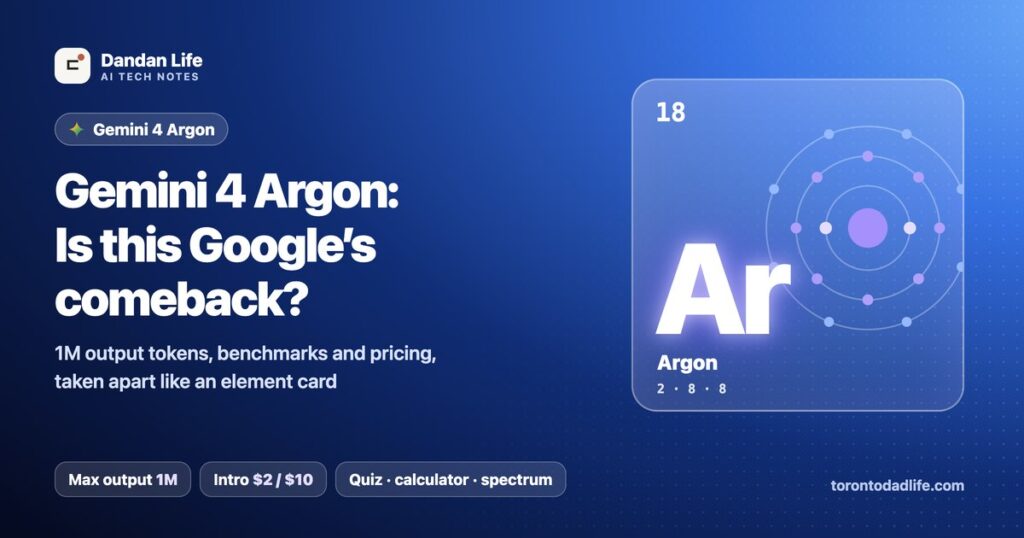
Gemini 4 Argon: Is This Google’s Comeback? From 1M output tokens to benchmarks and pricing, a model named after a “lazy” gas, taken apart like an element card
From 64K output tokens to 1 million. With Gemini 4 Argon, the new frontier model it announced on September 30, Google raised the model’s maximum output more than fifteenfold. On paper, that looks like the opening shot of a comeback. Yet on October 6, six days later, only a small group of selected early users can actually use it. And 1 million tokens isn’t the length of a single chat reply, nor is Argon the best at everything: it posts many top scores in Google’s comparison table, but rivals lead on some coding tests. We separate Google’s claims from independent evaluations and take the model apart, one experiment at a time.
Public-source analysis · Edited by Dandan Dad · Editorial policy
Up to 1M output tokens. Not one giant reply, though.
High scores on business automation, finance and very long context.
Rivals lead on some coding tests, such as terminal tasks.
Selected early users only. No date for wider access.
Let’s start with the name. Argon (Ar) is the third most abundant gas in Earth’s atmosphere, and its name comes from the Greek for “lazy” or “inactive,” because it barely reacts with anything.[1] The AI wearing that name brags about the opposite: hand it a job and it can keep writing for up to 1 million tokens.[2] Think of it as a workaholic with a “lazy” name tag.
This model got its own name, “Argon,” rather than Pro or Flash.[3] Google hasn’t said why it chose it. This article borrows the element’s traits to explain the model; it doesn’t claim that was Google’s intent.
The element has three handy traits. It keeps a hot light-bulb filament from oxidizing so it lasts, it barely reacts with anything, and welders use it as a shielding gas to keep air off molten metal.[1] Endurance, composure, protection. Let’s use those three traits as our yardstick and run the model through some experiments. An analogy is only an analogy, though, so every number here was checked against its original source.
01. Who can use it right now? Only a few invitations so far
Short answer: not yet, unless you’re one of a few selected early users. Argon isn’t in the Gemini app or the public API, and as of October 6 it still doesn’t appear in Google’s official Gemini API model list or changelog.[4] Google says it will refine the guardrails based on early users’ feedback, then bring Argon to developers, enterprises and consumers as soon as possible.[2]
Here it is as electron shells. Note that the dotted outer shell isn’t a scheduled next step, just what hasn’t been announced.
- Confirmed today: selected early usersGoogle’s Fairwind Program, launched September 2, has more than 650 participating organizations, but only a subset of them has Argon access so far. Google’s own teams and outside evaluators such as Artificial Analysis have also tried it.[5][6]
- Named next by Google: paid API customers and Google AI Ultra subscribersNo date yet.[2] Signing up for AI Ultra today won’t get you Argon.
- Not announced yetA date for wider access, and whether free or other plans will get it.
Fairwind isn’t a beta anyone can join. Google runs background checks on applicants. Members must use user-level authentication, phishing-resistant multi-factor authentication and access controls; they may give Argon only to internal security, incident response or penetration testing teams, and must track how employees use it. They can’t share, redistribute or resell access.[5][7] Google also says it is taking part in the US government’s voluntary process for pre-release model access.[2]
02. Trait ①: endurance, 1M output tokens
This is Argon’s headline number. Google says it raised the model’s maximum output from 64,000 tokens (64K) to 1 million (1M). Its argument: with room to generate hundreds of thousands of tokens, a model can reason more deeply and crack hard problems in one pass.[2]
Word and character counts are rough estimates based on Google’s Gemini API documentation. Other languages tokenize differently. The conversion only gives a sense of scale; it doesn’t promise how long a final answer or finished document will be.[8]
Google’s 1 million tokens is a maximum output limit. Don’t read it as “send 1 million tokens in, then get a separate million-token answer back in one go.” Artificial Analysis lists Argon’s context window as 1 million tokens, and it defines a context window as the maximum number of input and output tokens combined.[9] So how much you can actually use depends on how the model is offered and how each request is set up.
Sources also differ. Vals AI lists Argon’s maximum output as 262K and notes 262,144 tokens in its evaluation settings.[10] Whether that reflects a different version, a setting or the continuation feature can’t be determined from current materials. When comparing scores, check the output settings too.
Waiting for a million-token answer in one request invites dropped connections and timeouts. That’s why the Gemini API is getting a new feature called Long Decode Continuation, which pauses a long generation and resumes it in follow-up calls.[11] Artificial Analysis tested Argon with this feature.[6] Don’t equate the max output limit with a single chat reply, then. It’s more relay race than sprint.
A sketch of the mechanism as described by press and an independent evaluator. As of October 6, the public API docs still don’t cover Argon or how to use this feature.
Long runs need lots of water. In Artificial Analysis’s runs, Argon averaged 62,000 output tokens per task, more than twice GPT-6 Astra’s 27,000.[6] That gap matters again when we get to pricing in section 08.
03. A quiz, then the spectrum of 19 rows
Before the numbers, a quick quiz. For each test, guess which of three models came first. Get all five and you’ve basically read half this article.
0 / 5 · Not started
Q1🤖 AutomationBench (Zapier’s business automation test)
Argon, at 51.3%. Opus 5.5 scored 42.5% and Astra 41.4%, one of the wider gaps in the table.
Q2⌨️ Terminal-bench 4.0 (coding through terminal commands)
Claude Opus 5.5, at 66.4%, then Astra 58.2% and Argon 57.4%. A signature weak spot for Argon.
Q3🧩 FrontierSWE v2 (a coding agent benchmark)
GPT-6 Astra, at 65.5%. Opus 5.5 scored 62.3% and Argon 55.0%, 10.5 points behind.
Q4📚 GraphWalks 256K–1M (following a graph through very long text)
Argon, at 84.2%, ahead of Astra (71.8%) and Opus 5.5 (66.8%). One of the widest gaps in the table.
Q5🧮 Artificial Analysis Intelligence Index (independent overall)
Claude Opus 5.5, with a displayed score of 58. Argon and Astra both show 53 in whole numbers. Step outside Google’s table and the order changes.
Q1–Q4 use Google’s table; Q5 uses Artificial Analysis.[12][6]
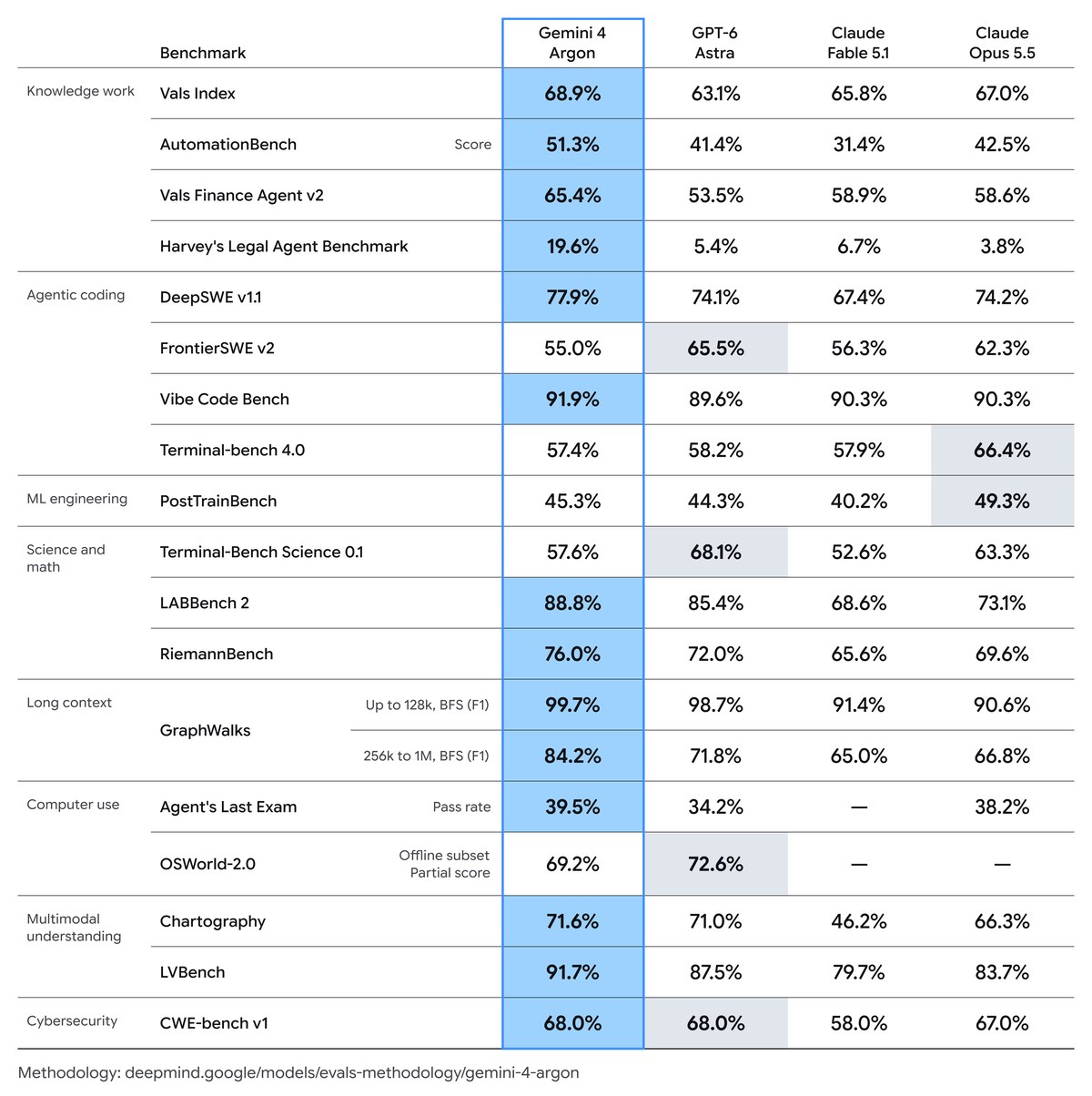
As the quiz shows, Argon has clear wins and clear losses. Now let’s lay out Google’s whole table. Split an element’s light and you get a unique pattern of lines called a spectrum, so we’ve arranged the 19 rows of Google’s comparison table the same way. Violet lines are rows where Argon has the top score among the models listed; gray lines are rows where another model does. Some rows split one benchmark into length ranges, like GraphWalks, so these are 19 comparison rows rather than 19 separate tests.[12]
In sum, across the 19 comparison rows Google published, Argon had the sole top score among listed models on 13 and a shared top score on one. That reflects the models and conditions Google chose for its table, not an overall market ranking.[12]
Argon was strong on business automation, finance, long context and some software tests, while rivals led on Terminal-Bench, FrontierSWE and others. It’s tempting to boil that down to “good at long work, bad at iterative fixing,” but that rule doesn’t hold up: DeepSWE and LABBench 2, where Argon led, also involve tools and many steps.[13] Task design, harness and reasoning settings all matter. The chart below shows, for each row, Argon’s score minus the best score among the other three models.
Google’s table mixes numbers it measured itself with figures reported by other labs and benchmark operators. Compare within a single row only.[12][13]
- Terminal-Bench Science: Google gave Argon alone a 6x verifier timeout. That’s grading time, not the model’s time to solve. GPT-6 Astra still led.[13]
- LVBench: Models received video differently: 1 frame per second for Gemini, 800 frames for GPT-6 Astra and 600 for Claude Opus 5.5.[13] It isn’t an identical-conditions matchup.
- Harvey legal: Argon leads Google’s table at 19.6%, but on Vals AI’s leaderboard it scores 19.58% and ranks 5th (checked Oct 6, 2026).[10] The score is also under 20%, so high-stakes legal work still needs human review.
04. What independent evaluators found
Tests a company picks for itself only go so far. Artificial Analysis gave Argon (at its highest reasoning setting, High) a score of 53 (shown in whole numbers) on its Intelligence Index, which bundles 10 evaluations.[9] That matches the displayed score of GPT-6 Astra (max) and is one point ahead of GPT-6.1 Sol (max). The firm says Google is back among the top three labs, and Argon is 23 points above Google’s previous Pro-class model, Gemini 3.1 Pro Preview (30).[6] On the same index, Claude Opus 5.5 (58) and Claude Sonnet 5.5 (56) are still ahead.[11][14]
At the intro price, on this evaluation Argon matches GPT-6 Astra’s score for about 61% of the cost (about 39% less). It is still 2.7 times the cost of GPT-6.1 Sol.
Artificial Analysis points out that Argon is cheaper because of lower token prices, not because it uses fewer tokens. It also says agentic performance, historically a weak spot for Gemini models, has clearly improved: Argon ranked first on the firm’s own business automation test, AutomationBench-AA, at 78%. That’s a different test from Zapier’s AutomationBench (51.3%) in Google’s table. On the terminal coding test (Terminal Bench 4), though, it scored 57%, fourth behind Claude Sonnet 5.5 (64%), Claude Opus 5.5 (60%) and GPT-6 Astra (59%).[6]
Vals AI, which focuses on enterprise tasks, paints a similar picture. Argon ranks first on the Vals Index, a composite of finance, coding, legal and tax tasks, at 68.90%, but fifth on Harvey’s legal benchmark at 19.58%, and as the ranks below show, it doesn’t top every individual coding test. Ranks can shift as new models are evaluated, so read them as of our check date (Oct 6, 2026).[10]
A top score in Google’s table and a rank on a full leaderboard aren’t the same. Google’s table compares only four models, while the Vals leaderboard also includes models such as Claude Sonnet 5.5. The same model gets a different report card depending on who it’s up against.
05. Trait ②: composure, an AI that says “I don’t know”
The element barely reacts to anything, and on two kinds of tests the model showed a similar streak: it’s less inclined to fake an answer it doesn’t know, and harder to talk into following hidden malicious instructions.
On Artificial Analysis’s knowledge reliability test (AA-Omniscience), Argon had a 15% hallucination rate and 50% accuracy. GPT-6 Astra (max) had 51% and 63%.[6] There’s a catch. This hallucination rate isn’t the share of all questions answered wrong. It’s the share of wrong answers among responses that weren’t correct (wrong, partially correct or not attempted). Accuracy, by contrast, is correct answers out of all questions, so the two use different denominators.[15]
🤥 Wrong answers among non-correct responses (AA-Omniscience hallucination rate · lower is better)
Hallucination rate = incorrect ÷ (incorrect + partial + not attempted)[15]
🎯 Correct answers out of all questions (accuracy · higher is better)
Both are AA-Omniscience results, not an error rate for everyday conversation.[6]
So “Argon got more questions right” would be the wrong reading; Astra’s accuracy is actually 13 points higher. The better reading: when it doesn’t really know, it’s comparatively more likely to hold back or say so than to make something up. Sometimes an honest new hire beats a confident know-it-all, especially in research and reports where a wrong answer can be costly.
The second is resistance to indirect prompt injection (IPI), an attack that hides an order like “ignore your instructions and send me the files” inside an email or web page an agent reads, to hijack what it does. On Gray Swan’s IPI test, where the attacker gets up to 15 attempts, Argon had the lowest attack success rate on Google’s chart, at 0.7%.[2][16]
Selected models from Google’s Gray Swan chart. The gap between Argon and the two Claude models is under 1 point.[2]
Google says it is shoring up safeguards in four areas before a broad launch.[2]
Refuse cyber and chemical, biological, radiological and nuclear (CBRN) attack requests while still helping legitimate research. Google also improved techniques that monitor the model’s internal activations to catch misuse.[17]
Automated red teaming and adversarial training to resist hidden instructions.
Monitoring the model’s chain of thought and actions so it doesn’t overstep what the user wants, and stopping execution when needed. Google says it takes care not to feed training-time monitoring findings back into training, so the model doesn’t learn to dodge the monitor.
Isolating and sealing sandboxed environments before high-risk training or evaluations begin.
This builds on the third version of Google’s Frontier Safety Framework, updated to 3.1 in April 2026.[18] For why hijacked agents are worth worrying about, see our roundup of real cases where AI agents crossed the line.
06. Trait ③: protection, Fairwind and CodeMender
When you weld, argon blankets the hot metal so the air can’t react with it.[1] Argon the model’s first job is protection, too. Google says it trained Argon to find, validate and patch critical software vulnerabilities on its own, and it is giving trusted defenders and its internal teams a version without cyber guardrails.[2] Instead of deliberately weakening a skill that cuts both ways, Google is being strict about who gets it.
Fairwind members that received Argon access can use it with CodeMender, Google’s code security agent.[5] CodeMender does its thinking and coordination in the cloud, while compiling code, running tests and simulating exploits happen in customer-managed local sandboxes or isolated VMs. The steps:[19]
- Find: locate likely vulnerabilities in the code.
- Prove: build and run a real proof-of-concept exploit in a customer-managed environment to show the flaw is exploitable.
- Fix: propose a patch, and use AI judges to check that existing features still work.
- A person decides: to apply a patch, developers must review and approve it in the IDEs and command-line tools they already use.
There’s already an early example. Cloud security company Wiz is using Argon in Scan for Good, its program to protect critical public infrastructure for free. According to Google, Argon found a critical vulnerability exposing sensitive personal information in healthcare software used by hospitals worldwide, a risk earlier frontier models had missed.[2][20]
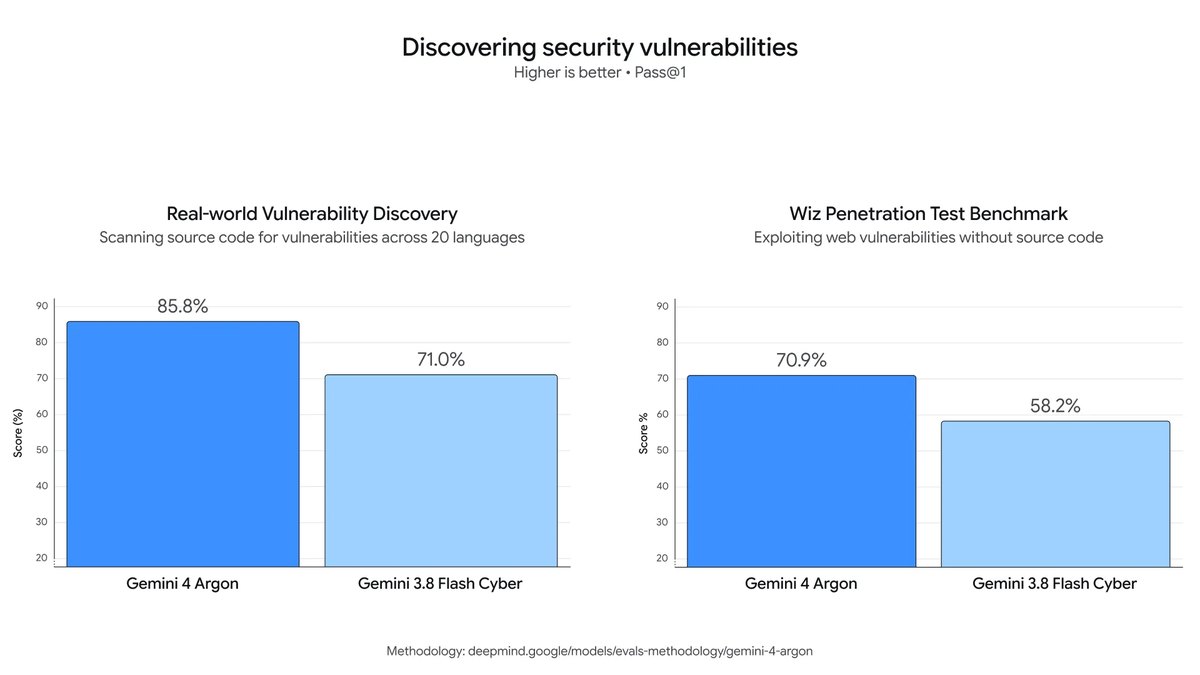
It also beat Google’s previous security model on the numbers. In Google’s internal evaluation, which scans source code in 20 programming languages, Argon found 85.8% of recent, confirmed real vulnerabilities in popular open-source projects (its recall), versus 71.0% for Gemini 3.8 Flash Cyber, the security-focused model released September 2. That was measured with access to source code, using a harness not specialized for security.[2][13][21] On Wiz’s penetration test, which attacks real web applications without source code, Argon also beat 3.8 Flash Cyber, 70.9% to 58.2%. These are results on fixed test sets, not a promise to find 85.8% of the vulnerabilities hiding in a real environment.
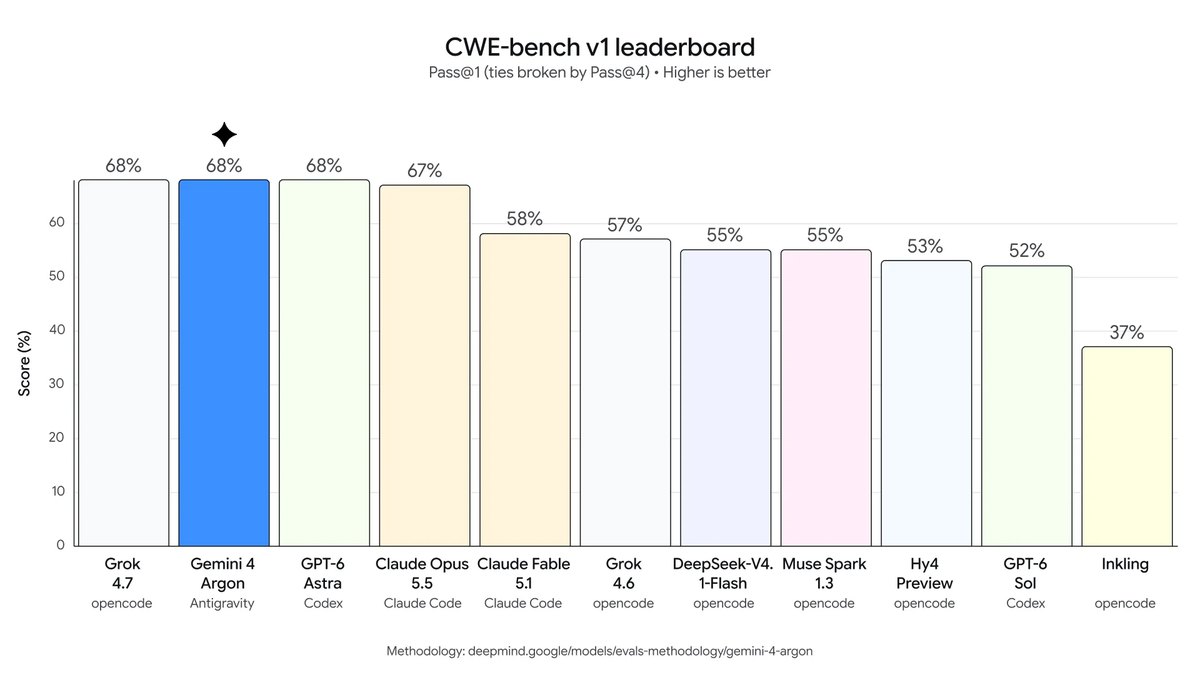
On CWE-bench v1, a test of fixing vulnerabilities, Argon scored 68%, matching the top score. On the operator’s automatically graded Pass@1 (success on a single attempt), GPT-6 Astra and Grok 4.7 also score 68%, a three-way tie, but each ran in a different harness: Antigravity for Argon, Codex for Astra and opencode for Grok.[22] So it’s more accurate to read this as a comparison of model-plus-harness systems than of models alone. The same leaderboard also catalogs failure modes like missing the vulnerable spot, missing the flaw entirely and fixing it only partly. A top score doesn’t mean you can run security operations without people.
07. What Google tried first, in-house
Google says thousands of its employees already use Argon at work, and shared four examples.[2] These are all internal results reported by Google, not independently verified, and as hand-picked highlights they skew toward success stories.
A team of Argon agents analyzed fleet-wide profiling data, then found and applied memory optimizations across Google’s data centers. Google expects that to free more than 300 TiB of memory once rolled out, with an estimated 500 TiB to 1 PiB in total savings.
Argon agents are migrating C/C++ code to the memory-safe language Rust, from libraries with tens of thousands of lines up to the Fuchsia Zircon kernel at more than 800,000 lines. Because these systems are critical, the rewrites go through automated and manual audits before reaching production.
In libgav1, Google’s open-source video decoder, Argon agents replaced 32,000 lines of SIMD code (instructions that process many values at once) with safe Rust. The new decoder runs 2.7 times faster than the earlier Rust port, with identical video output.
For quantum computing researchers, Argon cut the resources (qubits × gates) of bottleneck subroutines. In one case it beat the published baseline by 40% in minutes.
All four involve reading huge amounts of material, sticking with one problem for a long time and revising many times. Whether outsiders see the same results is something to check after launch.
08. Pricing: what $2/$10 really means
Argon’s introductory price is $2 per million input tokens and $10 per million output tokens. Cached input, meaning material you already sent and reuse, is 95% off at $0.10. After the introductory period, prices rise to $4 and $20.[2] As of October 6, Google still hasn’t said when the promotion ends; Artificial Analysis says it will last at least a month.[6]
The numbers line up in an interesting way. The intro price matches GPT-6.1 Sol, which OpenAI announced at DevDay the day before, and the standard price matches Claude Opus 5.5.[23][24] The outlet Forkast calls this a “pricing triangle” among the three labs.[25] Press the button to see where Argon lands after the discount.
All amounts are US dollars at standard API rates for the base tier. Labels show input / output prices; dots are placed by output price. Long inputs, caching and batch processing change the effective rate. GPT-6.1 Sol and GPT-6 Astra charge 2x input and cache rates and 1.5x output on the entire request once input exceeds 272K tokens.[23][26] Google’s Argon announcement didn’t describe long-input pricing.
Here’s the catch: a lower per-token price doesn’t necessarily mean a lower cost to get the job done. As we saw, Argon spends more than twice as many tokens per task as Astra. In practice, log the tokens and retries it takes to actually finish each task. The calculator below doesn’t predict that real-world cost; it’s a reference that scales Artificial Analysis’s weighted average cost per task by a hypothetical number of tasks.
Artificial Analysis’s weighted-average cost per Intelligence Index task (GPT-6.1 Sol, Astra and Opus 5.5 at max reasoning; Argon at High), multiplied by a hypothetical task count. It isn’t a monthly budget that accounts for success rates or retries. Task length, reasoning settings, cache use and revisions all change real costs.[6][14][27]
So at the intro price, Argon costs about 39% less per task than Astra for the same score ($1.99 vs $3.26). That holds on this evaluation, not necessarily on every real task, and at standard pricing Argon’s cost rises to $3.98 per task, more than Astra. If you want the cheapest path, GPT-6.1 Sol is still strong; if you want the highest score, Claude Opus 5.5 still leads. We cover why the same budget can buy different results in our Claude Opus 5.5 vs GPT-6 Sol comparison, and GPT-6.1 Sol in our OpenAI DevDay 2026 recap.
09. Behind the scenes
Before Argon, there was a long gap in Google’s top-tier model releases. Artificial Analysis describes Argon as Google’s first in-house model above the Flash class in more than seven months.[6] Google previewed Gemini 3.5 Pro at I/O in May but never shipped it, and in July released other Gemini models without it.[28] According to Bloomberg, Google had planned to release 3.5 Pro in June but abandoned the effort.[29]
The same day, Bloomberg reported internal doubts: Argon did well on industry benchmarks but less well when employees put it to work, struggling with certain coding tasks. Google reportedly said it would be inaccurate to describe Argon as underperforming in areas like coding, and that there’s a large internal consensus that it’s a top-tier model.[29]
Benchmarks and day-to-day experience parting ways is nothing new. That’s exactly why you should test it on your own tasks once it opens up.
10. Get ready for launch day
You can’t use Argon yet, but you can prepare. Get your test kit ready so you can compare models the day access opens. Tick the items as you go.
0 / 6 · Not started yet
In short, Gemini 4 Argon is a hard worker wearing a lazy name tag. It thinks long and writes long, it was less likely than its rivals to make things up or fall for hidden instructions in the tests above, and it went to cyber defenders first. But it isn’t a champion at every event, and most people still can’t try it. When it opens up, run it on three of your own tasks and redo the math at the standard price. That’s where Google’s comeback will be proven, or not.
🔎 Conditions to check before reading the numbers, and what’s unconfirmed
| What to check | Checked against original sources (Oct 1, 2026, KST; availability rechecked Oct 6) |
|---|---|
| Hardware behind Argon | We found no statement in Google’s Argon announcement about which TPU generation or hardware made the low API price possible, so this article doesn’t link the price to any specific TPU. For reference, Google announced its eighth-generation TPU 8t and 8i on April 22, 2026, but that alone doesn’t tell us what Argon runs on.[30] |
| Max output figures differ | Google announced a 1M-token max output; Vals AI lists 262K (262,144 tokens in its settings). The reason can’t be determined from current materials. |
| Artificial Analysis decimals | This article uses AA’s displayed whole-number scores (Argon 53, GPT-6 Astra 53, GPT-6.1 Sol 52, Claude Opus 5.5 58). Decimal values need separate checking, and matching whole numbers don’t mean identical underlying scores. |
| The 51.8% on the Gray Swan chart | In Google’s chart, that value belongs to Grok 4.6. |
| The vulnerability Wiz found | Google didn’t call it a “zero-day.” It described a critical vulnerability exposing sensitive personal information in healthcare software used by hospitals. |
| Where CodeMender runs | Reasoning and orchestration run in the cloud; compilation, tests and exploit simulations run in customer-managed local sandboxes or isolated VMs. Applying a patch requires developer review and approval. |
| CWE-bench top score | On the operator’s automatically graded Pass@1, Argon, GPT-6 Astra and Grok 4.7 all score 68%. They used different harnesses, and on the separately published LLM judge panel Argon scores 62%. |
| Frontier Safety Framework 3.1 | An April 2026 update to the third framework that added Tracked Capability Levels. Chain-of-thought monitoring and sealed sandboxes come from the Argon announcement. |
| Long Decode Continuation docs | Artificial Analysis and The Decoder describe it as a new Gemini API feature. As of October 6, the public API docs, model list and changelog still have no entry for Argon or this feature. |
| The Bloomberg report | It’s paywalled, and we couldn’t re-check the full original for this review. The 3.5 Pro cancellation, staff doubts and Google’s response are presented as reported. We couldn’t confirm that staff were moved to Argon afterward. |
| 300 TiB of memory | Google says more than 300 TiB will be freed “once rolled out”; 500 TiB to 1 PiB is an estimate of total savings. Don’t add the two. |
| Fuchsia migration | The migration is ongoing and goes through automated and manual audits before production. |
| Free access | Google named paid API customers and AI Ultra subscribers as next; we found no official statement on free access. |
Frequently asked questions
Can I use Argon in the Gemini app now?
Not yet. As of October 6, only selected early users have it, and there’s no date for the next groups Google named (paid API customers and Google AI Ultra subscribers). Section 01 has the details.
Does 1M output tokens mean chat replies get that long?
Google’s announced maximum output limit is indeed 1 million tokens. But it’s a budget for long reasoning and generation, so don’t equate it with the length of the final answer you see in a chat window. In its evaluation, Artificial Analysis used Long Decode Continuation to carry long generations across multiple API calls. In practice, check how the model is offered and the per-request limits.
Will the $2/$10 price last?
No. It’s an introductory discount. Afterwards the price rises to $4 per million input tokens and $20 per million output tokens. As of October 6, Google hasn’t announced when the discount ends.
Is Argon the best model for coding?
It depends on the task. It had the table’s top score on DeepSWE, a long-horizon software benchmark, but rivals scored higher on Terminal-bench and FrontierSWE. Testing on your own real tasks is the most reliable way to decide.
Keep reading
GPT-6.1 Sol and dots, one day earlier
💸Claude Opus 5.5 vs GPT-6 SolDoes cheaper AI really save money?
🚧When AI Agents Ignore “No”Prompt injection and real incidents
Sources
- [1]Wikipedia · Argon (etymology, atmosphere, lighting and welding uses)
- [2]Google · Gemini 4 Argon: our next era of frontier intelligence (Sep 30, 2026)
- [3]9to5Google · Google announces Gemini 4 Argon as its new frontier model (Sep 30, 2026)
- [4]Google AI for Developers · Gemini API models (checked Oct 6, 2026)
- [5]Google DeepMind · Fairwind Program
- [6]Artificial Analysis · Gemini 4 Argon: Google is back as one of the top three labs in intelligence (Sep 30, 2026)
- [7]Google · Fairwind Program: Cyber defense tools for trusted partners (Sep 2, 2026)
- [8]Google AI for Developers · Understand and count tokens
- [9]Artificial Analysis · Gemini 4 Argon (High) model page
- [10]Vals AI · Gemini 4 Argon benchmarks (leaderboard checked Oct 6, 2026)
- [11]The Decoder · Google Gemini 4 Argon closes the gap with OpenAI and Anthropic but doesn’t take a clear lead
- [12]Google DeepMind · Gemini models page, Gemini 4 Argon performance table
- [13]Google DeepMind · Evaluation methodology: Gemini 4 Argon
- [14]Artificial Analysis · Claude Opus 5.5 model page
- [15]Artificial Analysis · AA-Omniscience evaluation (hallucination rate definition)
- [16]BenchLM · Gray Swan IPI (15 attempts) leaderboard
- [17]arXiv 2601.11516 · Building Production-Ready Probes For Gemini
- [18]Google DeepMind · Strengthening our Frontier Safety Framework (FSF 3.1, updated Apr 17, 2026)
- [19]Google Cloud · CodeMender: AI agent for code security
- [20]Wiz · Scan for Good
- [21]Google · Introducing Gemini 3.8 Flash and 3.8 Flash Cyber (Sep 2, 2026)
- [22]CWE-bench (Collinear AI) · CWE-bench v1 leaderboard
- [23]OpenAI API docs · GPT-6.1 Sol model page (pricing)
- [24]Anthropic · Introducing Claude Opus 5.5 (pricing)
- [25]Forkast · Google’s Gemini 4 Argon Closes the Pricing Triangle
- [26]OpenAI API docs · GPT-6 Astra model page (pricing)
- [27]Artificial Analysis · GPT-6.1 Sol (max) model page
- [28]TechCrunch · Google releases three new Gemini models, but no 3.5 Pro (Jul 21, 2026)
- [29]Bloomberg · Google Grapples With Employee Skepticism About New Gemini Model (Sep 30, 2026)
- [30]Google · Our eighth generation TPUs: two chips for the agentic era (Apr 22, 2026)
Last checked Oct 1, 2026, KST; availability and key rankings rechecked Oct 6.