Can Tighter Exam Proctoring Stop AI Cheating?Korea’s tax exam case and exam-day measures show the limits of proctoring and detection.

Illustration made with an AI image tool. The specks flowing from the glasses to the cloud stand for questions being photographed and sent to AI; the rings near the proctor stand for detection signals.
The top scorer on South Korea’s certified tax accountant exam confessed to cheating with AI. It happened in an exam room with proctors watching. Would tighter proctoring stop it from happening again?
Ahead of the national college entrance exam, the government announced measures that include inspecting glasses and putting stickers over buttons. But each check finds different things. And even after a suspicious device or signal turns up, someone still has to confirm whether cheating actually took place.
Using the real case, public demos and the exam-day measures, I looked at what each check can find. Then I looked at why an alarm needs a follow-up check before anyone is judged.
3-minute summary
- The real case
- The tax exam’s top scorer admitted using a miniature camera, a smartphone and generative AI, and police confirmed he also brought in a modified calculator. The devices he handed over did not include AI glasses.
- Demo versus real exam
- A demo in which AI glasses answered 160 past questions in 49 minutes was done with no proctors, on published questions. It shows how fast answers come back, not that the same would happen in a real exam room.
- What the checks find
- Glasses inspections, button stickers, metal detectors and signal checks each look for different things. Devices that are visible or transmitting are easier to find; devices that are hidden or switched off can be missed.
- If you remember one thing
- An alarm is a signal to check further, not a verdict. Exams need both checks that find hidden devices and a process for establishing the facts once suspicion arises.
This explainer summarizes news reports, official announcements and research published up to November 17, 2026. I did not take an exam with smart glasses myself. Numbers that companies report about themselves are labelled. The tax exam top scorer is referred to as “Han” rather than by full name. Many sources are in Korean and are marked as such.
01What is confirmed about the real case?
On November 15, Han, who placed first on Korea’s 63rd certified tax accountant exam, appeared on his lawyer’s YouTube channel and admitted cheating on both rounds of the exam with a miniature camera, a smartphone and generative AI. He said he did the same on round one of the CPA exam.[1] It was four days before the College Scholastic Ability Test (CSAT, or Suneung), the national college entrance exam.
The previous two years’ top finishers averaged in the 80s in round one. Han averaged 99.375.[3]
His seats stand out too. In round one he sat in the middle of the second row, in round two in the middle of the front row, right in front of the desk where the two proctors stood.[1] There was reportedly no CCTV covering the room.[4]
A sketch based on news reports, not the actual floor plan. The number of desks is arbitrary.
The investigation is ongoing. On November 17 police questioned Han as a suspect on charges of obstructing official duties by deception and obstructing business. According to combined reports, he hid a smartphone on his body and brought in a calculator, which the exam allows, after modifying it. He is believed to have read the answers on a miniature monitor rather than hearing them through an earpiece. The evidence he handed over did not include AI glasses or earphones.[5] Police said it is true that he brought in a modified calculator, but that “he did not receive answers through the calculator.”[6] Some accounts said he read answers off the calculator’s screen; that does not match what police said. There is no basis for saying the real case involved AI glasses. The widely shared claim that “110,000 won buys all the gear” came from an internet user, and it has not been confirmed that this gear was what he used.[7]
Confirmed
- He admitted using a miniature camera, smartphone and generative AI
- He brought in a modified calculator (confirmed by police)
- Same method on round one of the CPA exam
- Front seats, two proctors, no CCTV in the room
Still unknown
- What the calculator and the miniature monitor each did
- Whether the phone was used inside or outside the exam room (forensics under way)
- Whether the “110,000 won kit” matches his gear
- Whether anyone helped (he says he acted alone)
In this case, three things got past the exam’s existing controls: a smartphone hidden on the body, a calculator that was allowed in but had been modified, and photographing the questions right in front of two proctors.
Similar cheating has been caught in other exams. Korea’s national certification exams caught 12 smart-glasses cheating cases this year, and the government is now reviewing all 528 exams it ran this year.[8] One broadcaster counted at least 20 AI cheating cases this year once language tests, law school admissions and university entrance exams are included.[9]
Full timelineJune to Nov 19
- JuneYouTuber Techmong scores 96 on 30 CSAT math questions in 18 minutes with AI glasses[10]
- Oct 25“AI inspectors” dedicated to spotting smart glasses deployed in national certification exams[11]
- Nov 13Techmong posts a perfect score on this year’s tax exam questions with AI glasses[12]
- Nov 14Celebrity tutor Kang Sung-tae warns “the CSAT will be breached too”[13]
- Nov 15Tax exam top scorer confesses; presidential office holds emergency meeting[1][14]
- Nov 16Review of all 528 exams announced; prime minister convenes ministries. Police trace an anonymous “I used AI on the CSAT” post (unverified)[8][15][16]
- Nov 17Han questioned by police as a suspect; modified calculator confirmed[5][6]
- Nov 17Prime minister’s address: devices collected, button stickers, push for a 10-year ban[17]
- Nov 192027 CSAT at 1,312 test sites nationwide[17]
02How do the AI-glasses demos differ from a real exam?
Much of the worry came from demo videos published separately from the real case. Here are the results in one place. The exams, devices, AI models and the testers’ skill all differ, so this is not a leaderboard.
CSAT math, 30 Qs
About 18 min. Rokid glasses with their built-in Gemini. The one miss was a blurry photo, not a wrong answer.[10]
Tax exam session 1, 80 Qs
About 20 min with Gemini 3.1 Pro. Reported as enough to clear the session-1 pass mark.[18]
Tax exam round 1, 160 past Qs
49 min, 100 in all four subjects. Rokid glasses connected to Claude.[19][20]
CSAT math, 30 Qs
About 50 min with glasses costing roughly 900,000 won. Questions shown on a monitor; result was grade 2.[20]
Bar exam, 19 Qs
Battery died after about 34 min. 26% correct on a clumsy first attempt.[21]
Medical licensing, 20 Qs
10 min, 65% correct once they got used to the device.[21]
Techmong answered 160 questions in 49 minutes, an average of 18.4 seconds each. Session 1 took 32 minutes for 80 questions (24 seconds each); session 2, with the AI set to reason less, took 17 minutes for 80 (about 12.8 seconds each).[19][20][7] The clock below replays that pace at 60× speed.
The timer starts when this box is on screen.
Dark squares are session 1 (public finance and tax law); light squares are session 2 (accounting and commercial law). Each session’s reported time is divided evenly across its questions.
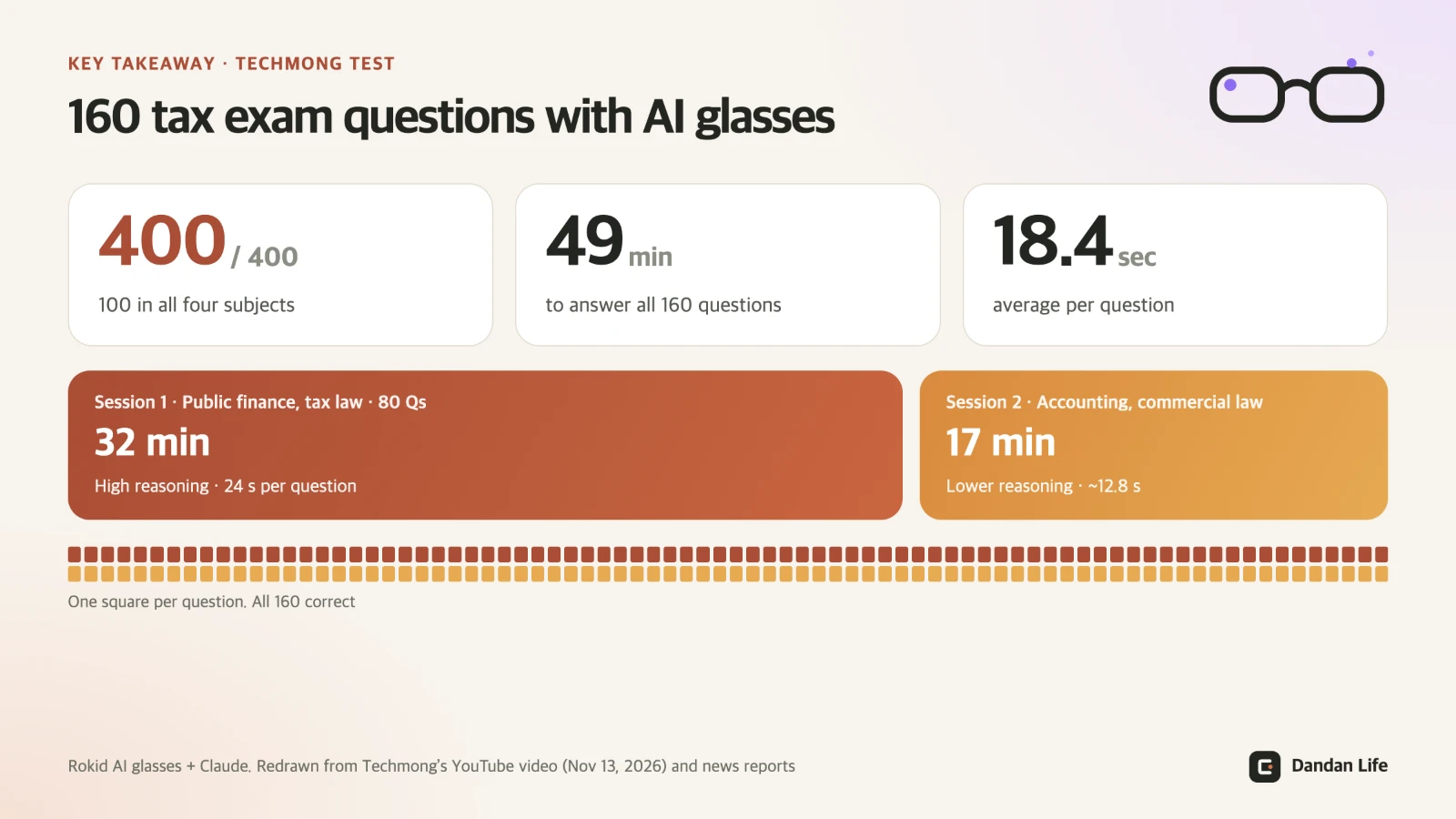
The demos and a real exam room are different settings. Here is how they compare on time, accuracy and proctoring.
| Factor | What the demos showed, and how a real exam differs |
|---|---|
| Time | Techmong’s demo averaged 18.4 seconds per question. The real round one gives 80 minutes for 80 questions in each session, about one minute per question.[22] On speed alone, the answers come back within the time limit. |
| Accuracy | Results varied widely with the device, the AI model and how practised the operator was. News1 reporters got 26% on bar exam questions on their first try, and the battery died after about 34 minutes. Once they were used to the device, they got 65% on medical licensing questions.[21] |
| Proctoring | The demos were done with no proctors, on questions that were already public, wearing the glasses openly. In a real exam room the device has to be brought in hidden and operated unnoticed in front of proctors. |
It is the connected AI model, not the glasses, that produces the answer. On past or mock questions from some professional exams, AI models have scored very highly. But the number of questions, test conditions and marking differ, so these scores cannot be compared directly with real candidates.
AI scores on professional examspapers, news and company claims marked
2026 CSAT (out of 450)
CFA Level I (mock)
Medical ethics, 130 items
US bar exam (percentile)
Reports of the same CSAT experiment put the score at 433 or 435.5.[24][25] The CFA figure is the Level I result from an experiment using 980 mock-exam questions.[26] In the medical ethics study the human average was about 71%, but the authors say it is unclear how that was calculated, so they made no statistical comparison.[27] OpenAI said GPT-4 scored “around the top 10% of test takers” (about the 90th percentile) on a simulated bar exam;[28] a later peer-reviewed re-evaluation re-estimated it at about the 62nd percentile against first-time takers (about the 42nd on essays).[29]
The bar exam case shows that the comparison group matters as much as the score. The same result can rank very differently depending on who it is compared with.
So a demo score does not translate directly into risk in a real exam room. What the demos do show is that once a question is photographed and sent, the answer already comes back fast enough. The remaining question is whether exam-room checks can catch the device being brought in and used.
03What can glasses checks and detectors actually find?
The government announced its measures on November 17, two days before the CSAT. But each check finds different things. Here are this year’s exam-day checks sorted by type, with what each one finds and what it can miss.
| Check | What it finds | What it can miss |
|---|---|---|
| Device collection and emergency alert | All electronic devices are collected before session 1 and bags are left in the hallway. An emergency text alert is sent just before the exam to catch phones that were not handed in.[17] | Devices carried on the body have to be found by other checks. Han reportedly hid his smartphone on his body.[5] |
| Glasses inspection | Before session 1 every test-taker puts their glasses on the desk for inspection, and glasses are checked again each session.[17] AI glasses on the market tend to give themselves away with a camera, an indicator light or a display (ITSub video, 4:52).[30] | The indicator light alone is not enough. Meta says its capture LED turns on when photos or videos are saved, but its AI features, which use the camera to understand what is in front of you, do not use the LED signal.[31] The devices Han handed over did not include AI glasses either.[5] |
| Button stickers and clothing checks | Stickers go over every button, and sleeves and collars are checked. The target is miniature cameras hidden in clothing. Belongings are rechecked before session 3.[17] | The education ministry itself said miniature cameras are not easy to tell apart by appearance.[32] The measures included nothing specific for rice-grain earpieces.[33] |
| Metal detectors | Hallway proctors use them on students returning from the bathroom, and for a follow-up check when something looks suspicious.[32][17] | Not every student is screened. Proctors also have no way to search a student’s body directly.[32] |
| Signal checks | About 8,400 extra device-check staff and hallway proctors inspect smart devices, make spot checks for phones that were not handed in, and look for unusual communication signals inside test sites.[17] School and nearby public Wi-Fi is cut.[34] | A handheld radio detector reacts only when a device is on and transmitting. In ITSub’s test it went quiet once the AI glasses were switched off (video, 9:01).[30] Jamming is not allowed under Korea’s Radio Waves Act.[34] |
On November 16 the education ministry said radio detectors and thermal cameras could not be applied across all CSAT sites this year.[35] It added that thermal cameras sense heat, so it would be hard to tell whether a miniature camera itself is warm.[32] A detector that reads Bluetooth Low Energy and Wi-Fi traffic patterns is being considered for next year’s CSAT.[36] ITSub pointed to non-linear junction detectors (NLJDs), which can find electronics even when they are off, as an alternative.[30]
Even permitted items now need checking. The tax exam allows calculators, and Han used that to bring in a modified one.[5] ITSub suggested that exam bodies hand out calculators they have inspected themselves.[30] The CSAT bans all electronic devices in principle, including watches with a digital display.[37]
Signal checks assume something is transmitting. Run the AI on the device itself and there is less signal to catch. Kang Sung-tae said the app he is building does all of its processing on the phone.[13] ITSub noted that this is still hard in practice, but that on-device AI models are improving quickly.[30] Korea’s education minister admitted that “our technology cannot keep up with some of it right now”.[38]
There are also limits on how much stricter the checks can get. Korea’s education minister said checking every student’s belongings would currently require every student’s consent.[39] Refusing a proctor’s request to verify identity or check belongings, however, is itself treated as cheating.[37]
For cheating that exam-day checks miss, the government’s answer is investigation and punishment after the exam. Of these, the longer ban requires a change in the law.
Rule changes being pursuedneeds the National Assembly
- Raise the exam ban for cheaters from one year to ten
- Discuss with the National Assembly applying it retroactively to this year’s exam[17]
After the examfollow-up investigation
- A reporting centre and post-exam score analysis
- Checking AI-service and telecom records for suspicious numbers, with help from global tech firms
- Criminal complaints for serious cases (obstructing official duties by deception, punishable by up to five years in prison)
- Admission cancelled or expulsion for those who got in by cheating[17]
Online exams, responses in other countries and contact lens technology are collected below.
Online exams: cheating tools you can’t see on screen (try it)Cluely · AutoSAT
Cluely is the best-known example. Proctoring companies describe it as a see-through window that floats over the screen with answers. It runs on keyboard shortcuts, so no app switch is logged, and the window does not show up in screen shares or recordings.[43][44]
- Option 1
- Option 2
- Option 3
- Option 4
Why: option 3 meets every condition
- Option 1
- Option 2
- Option 3
- Option 4
A simplified sketch of how proctoring companies describe it. Not a screenshot of the actual app.
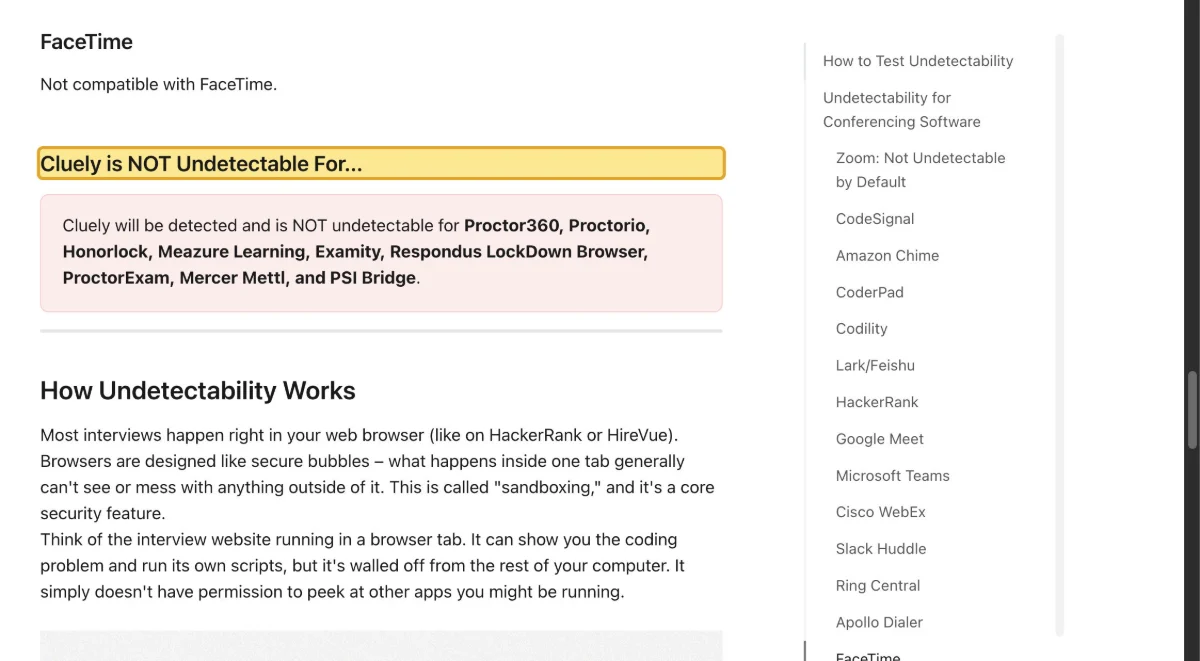
The thing to check is the condition attached to the word “undetectable”. Cluely’s website says it does not show up in screen shares or recordings.[45] Its help centre, however, says it is “NOT Undetectable For” proctoring tools such as Proctorio, Honorlock and Respondus LockDown Browser.[46]
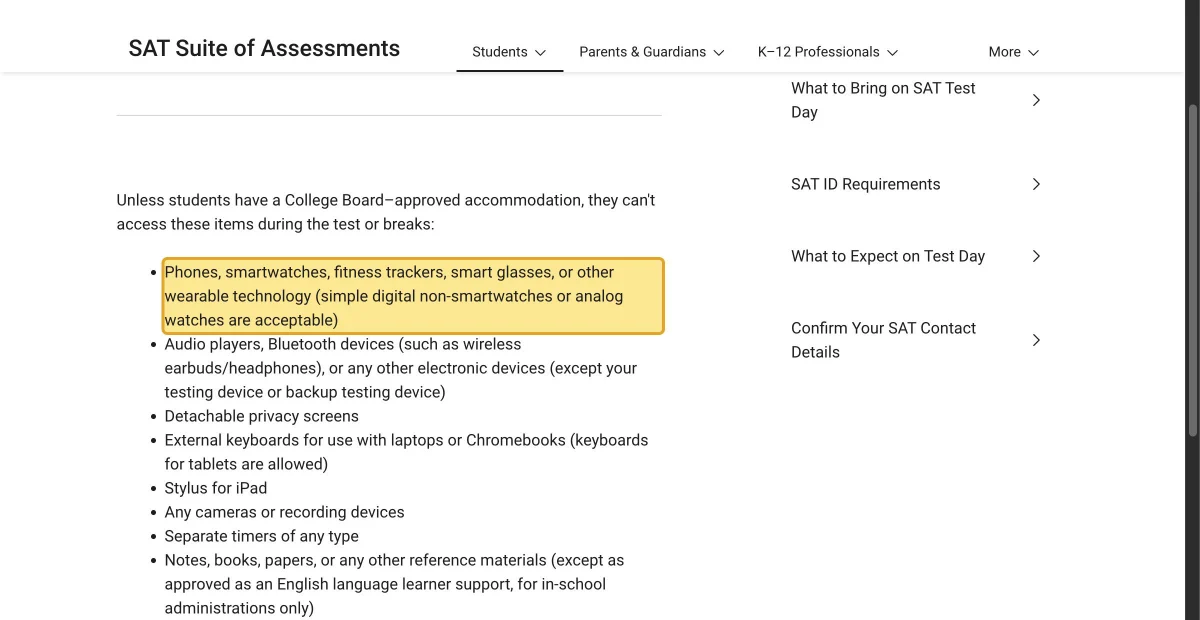
In the US, a program called AutoSAT, sold for $499.99, got around Bluebook, the SAT’s lockdown app, by sending on-screen questions to an AI chatbot. At least four students used it on the March international SAT, and the College Board sued its developers on April 30.[47][48][49] The College Board’s banned-device list names smart glasses alongside phones and smartwatches.[50]
Country-by-country responsesKorea · China · US & Canada · EU & UK · Taiwan & India
- CSAT: this year’s exam-day operations and the rule changes being pursued are in the table above.[17]
- Certification exams: 221 “AI inspectors” started on October 25 and 106 more joined on the 31st.[11] A detector that reads Bluetooth Low Energy and Wi-Fi traffic patterns is being considered for next year’s CSAT.[36] For this year, the education ministry said radio detectors, metal detectors and thermal cameras could not be applied across the board.[35]
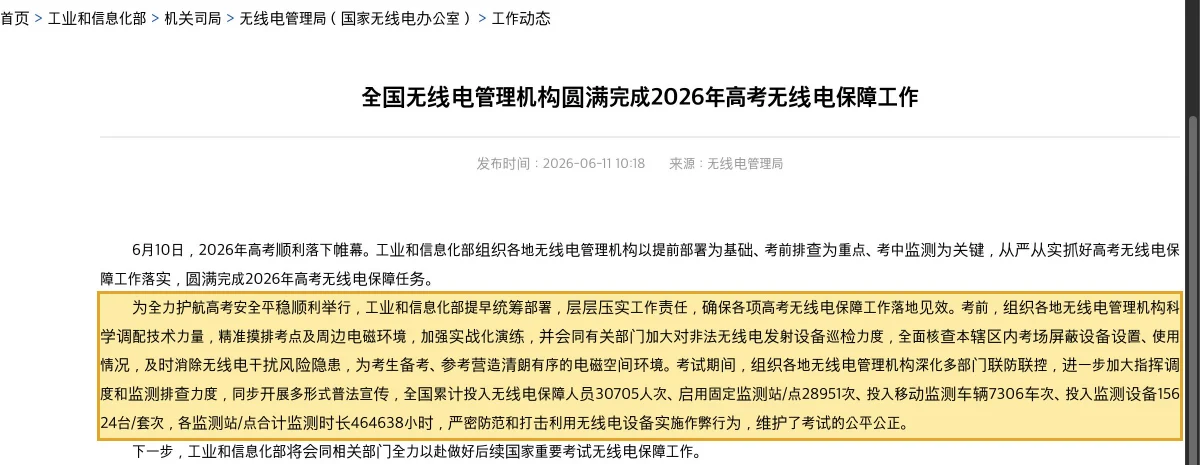
- Radio monitoring: during June’s gaokao, the Ministry of Industry and Information Technology logged 7,306 deployments of mobile monitoring vehicles and 15,624 deployments of monitoring equipment. These are deployment counts, not the number of vehicles.[51]
- Entry screening and AI cameras: Nanjing installed 65 smart security gates at 31 venues, and Guangdong rolled out an AI patrol system that flags unusual behaviour at 386 venues.[52] Some regions paused or turned down nearby cell towers.[53]
- AI companies: during the 2025 gaokao, Tencent, Moonshot AI and others restricted photo recognition or photo-based problem solving during exam hours.[53]
- Penalties: organizing cheating in state exams can bring up to seven years in prison.[54] The OECD’s AI incident log classifies the measures as preventive rather than a response to an incident; no AI cheating had been reported when it was logged.[55]
- Test makers: the College Board locks down computers with its own SAT app and lists smart glasses as a banned device.[50][49]
- Privacy rulings: in 2022 a US federal judge ruled that Cleveland State University violated a student’s Fourth Amendment rights by requiring a scan of the student’s room before an online test.[56] In Ontario, the Information and Privacy Commissioner found that parts of McMaster University’s use of online proctoring software did not comply with privacy law and made recommendations.[57]
- Universities: Princeton is ending 133 years of unproctored exams, with proctors in in-class exams from July 2026. The honor code itself stays.[58]
- EU AI Act: AI that infers emotions in educational settings has been banned since February 2025.[59]
- UK school exams (JCQ): guidance says hidden AI devices such as smart glasses must not be brought into exams.[60]
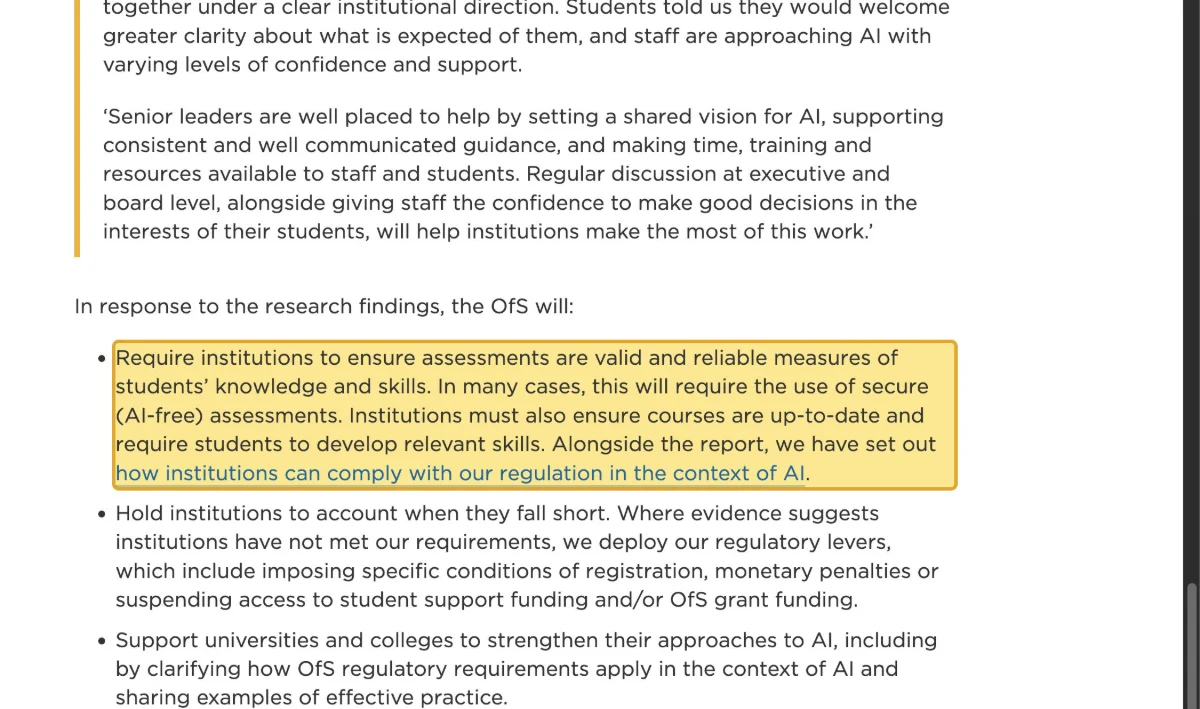
- UK universities (OfS): the Office for Students said that in many cases secure, AI-free assessments will be needed, and mentioned possible monetary penalties.[61]
- Taiwan: from August 1, 2027, simply wearing or carrying smart glasses in university entrance exams means a zero for that subject, even if they are left in the storage area while switched on.[62]
- India: 51,311 signal jammers were reportedly deployed for a re-run of the NEET medical entrance exam. I could not find the Indian government’s own figure.[49]
Keeping devices out relies on human eyes, cutting signals runs into law and disruption for neighbours, and changing exam formats takes years.
Contact lens technology in detailXPANCEO · MBC report
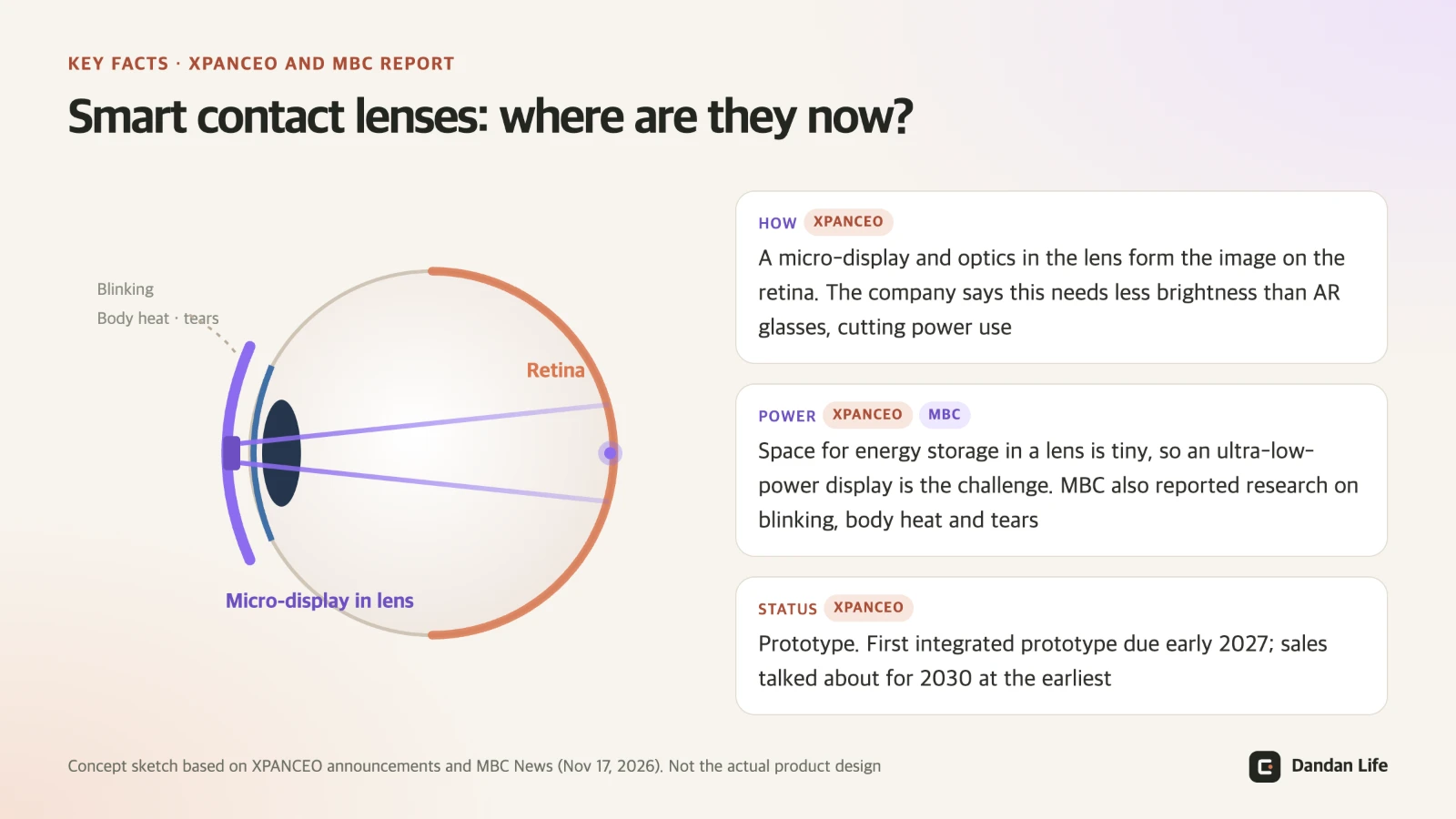
XPANCEO is developing contact lenses with a micro-display and optics built in. The company says that because the image is formed directly on the retina, it needs much less brightness than AR glasses, which cuts power use. It also says the space for storing energy inside a lens is extremely limited, so it has to design an ultra-low-power display from scratch.[63] MBC reported that the company is also exploring power from blinking, body heat and tears.[40] Its website cites 28 working prototypes and more than 50 patents applied for.[64]
04If an alarm goes off, is it cheating?
An alarm goes off during a check. Should that person be treated as a cheater straight away? Try changing the numbers yourself.
An alarm is a signal to check further. An alarm alone cannot establish that someone cheated. Apart from the number of test-takers, every value is an assumption and does not describe any real device. Red dots are the real cheaters among 100 alarms.
The default describes this situation: one in 1,000 test-takers cheats, the check catches 90% of cheaters, and it wrongly flags one in 100 honest test-takers. In that case only about 8 of every 100 people flagged are actually cheating. The rarer cheating is, the more a small false-alarm rate turns into a large number of wrong alarms.
Wrong alarms land on honest people. The government itself asked proctors not to harm students who wear ordinary glasses or medical devices.[15] Proctors worry about being sued if they mistake ordinary glasses for smart glasses.[38] The government has said teachers who proctor in good faith will not be held liable for unfair complaints or lawsuits.[17] Something similar happened outside the exam room. The first person ever to get a perfect score on the LEET, Korea’s law school admission test, rebutted unproven rumours and said he would solve the CSAT Korean-language section on a livestream.[66]
If cheating is missed
- People who prepared honestly lose out
- Exam results become harder to trust
If a wrong alarm is taken at face value
- An innocent person comes under suspicion
- The proctor carries the burden of the call alone
So what gets checked after an alarm matters as much as detection performance. Under the government’s plan, metal detectors are used when something looks suspicious, and specialist staff at exam headquarters help confirm and judge suspected cases.[17] A student suspected during the exam is, in principle, checked after that session ends, so as not to disrupt that student or those nearby.[39]
Checks after the exam raise the same question. The government said it will look at AI-service access records and telecom data for suspicious numbers.[17] How far those records may be examined needs rules of its own. In the US and Canada, intrusive remote proctoring has led to a court ruling and a privacy investigation.[56][57]
✓From inspection to verdict, it takes several stages of checking
Stopping AI cheating means designing two things together: checks that find hidden devices, and a process for establishing the facts once suspicion arises. That requires knowing what each check can find, and deciding in advance what gets checked next when an alarm goes off. Put in order, the stages in this year’s CSAT measures and the official notice to test-takers look like this.
- Before the exam: entry checksDevice collection, glasses inspection and button stickers screen out devices that are visible.[17]
- During the exam: checking anything unusualGlasses are checked each session and signals are monitored. If something looks suspicious, a metal detector is used and exam headquarters helps with the call.[17]
- After the exam: reviewing recordsTips to the reporting centre, score analysis, and access and telecom records for suspicious numbers are reviewed.[17]
- Verdict: the student’s statement and reviewThe proctor tells the student that cheating has been found, and the student writes a statement. For cases that do not fit the listed types, a cheating review committee decides whether the violation is serious or minor.[67]
Each of the four stages does a different job. Only when they connect can cheating be exposed and wrong suspicion corrected.
Where device checks cannot settle the question, having the test-taker explain their working or review a result is another option worth considering, depending on the kind of exam or assignment. The examples so far come from university courses and company hiring, though. They cannot simply be carried over to the CSAT or national certification exams, where very large numbers of candidates must sit under identical conditions.
How some courses and employers adjust assessmentuniversity courses · hiring
The right method depends on what is being assessed.
| Skill being assessed | Suitable approach |
|---|---|
| Basic knowledge and skills you must have without help | Check in a setting where AI use is restricted |
| Using tools effectively in real work | Set AI tasks with clearly defined tools and conditions |
| Understanding and verifying results | Assess explanation of the work, changed conditions and error analysis together |
- A Cornell biomedical engineering course does not grade homework itself. Instead, after submitting each of five problem sets during the term, students sit an oral exam of about 20 minutes with a TA or professor. The five oral exams together make up 20% of the final grade.[68]
- An MIT committee’s August report recommends assessments less vulnerable to AI, such as oral exams and assignments paired with in-class conversations.[69]
- Canva’s engineering team expects backend, machine learning and frontend candidates to use AI tools such as Copilot, Cursor and Claude in interviews. In return, it made the problems more realistic and ambiguous, and assesses how candidates break down requirements, make technical decisions, and find and fix issues in AI-generated code.[70]
Oral assessment has to be designed fairly too. It needs criteria that reward understanding rather than speaking skill, and alternatives for students who find spoken explanation difficult. In the Cornell course, examiners review each problem set and its key concepts together beforehand and build a shared rubric.[68]
A fair exam can explain the basis for its judgments
Keeping an exam fair means finding cheating and being able to explain that judgment with evidence.
When my child sits exams one day, I hope they are assessed on the work they put in, and given a chance to explain if a misunderstanding arises.
In one lineStopping AI cheating takes both checks that find hidden devices and a process for establishing the facts once suspicion arises.
Your turnIf you were suspected of cheating in an exam, what kind of checking process would you need before you could accept the outcome?
?FAQ
What if you bring smart glasses to the CSAT?
Smart glasses are a banned item. If you have brought them by necessity, switch them off and hand them to a proctor before session 1. Not handing them in, or having them during the exam, can be treated as cheating.[17] During the exam, simply wearing them counts as using them.[67]
Why not just jam the signals in exam rooms?
Jamming is not allowed under Korea’s Radio Waves Act. The government will cut only school and nearby public Wi-Fi and check access logs for private Wi-Fi.[34]
If you want to know why AI produces such convincing answers in the first place, these are good next reads.
Sources
- [1]Yonhap · Top scorer on tax accountant exam admits AI cheating (2026.11.15, Korean)
- [2]Yonhap · AI cheating right in front of proctors exposes gaps in national exams (2026.11.15, Korean)
- [3]Newsis · Tax exam top scorer’s 99.38 average draws AI-glasses suspicion (2026.11.12, Korean)
- [4]JoongAng Ilbo · Not AI glasses but a ‘third method’: the tax exam top scorer’s cheating (2026.11.16, Korean)
- [5]Newsis · Tax exam top scorer used a modified calculator and a monitor, says he acted alone (2026.11.17, Korean)
- [6]Newsis · Tax exam top scorer brought a modified calculator but did not receive answers through it (2026.11.17, Korean)
- [7]Maeil Business · National exams breached with gear costing about 110,000 won [VISUAL] (2026.11.15, Korean)
- [8]Newsis · 12 AI-glasses cases in national certification exams this year; all 528 exams under review (2026.11.16, Korean)
- [9]TV Chosun · At least 20 AI cheating cases caught this year, including hiring exams (2026.11.16, Korean)
- [10]Newsspirit · AI glasses score 96 on CSAT math in 18 minutes (2026.11.02, Korean)
- [11]Newsis · AI glasses caught again in national exam, first catch by new inspectors (2026.11.14, Korean)
- [12]YouTube, Techmong · Scoring 100% on the tax accountant exam with AI glasses (2026.11.13, Korean)
- [13]Korea Economic Daily · ‘The CSAT will be breached too’: Kang Sung-tae’s warning (2026.11.15, Korean)
- [14]Hankyoreh · Presidential office orders review of suspected AI cheating in national exams (2026.11.15, Korean)
- [15]Aju Business Daily · Government to collect all smart devices at CSAT, reviews Wi-Fi blocking (2026.11.16, Korean)
- [16]Kukmin Ilbo · Unverified online ‘I cheated with AI too’ posts spread; police tracing posters (2026.11.16, Korean)
- [17]Office for Government Policy Coordination (Korea.kr) · Prime Minister’s address on CSAT cheating (2026.11.17, Korean)
- [18]Asia Today · YouTuber clears session 1 pass mark on tax exam with AI glasses in 20 minutes (2026.11.13, Korean)
- [19]Topstar News · Techmong’s experiment: 400/400 on the tax exam, 160 questions in 49 minutes (2026.11.14, Korean)
- [20]Money Today · ‘Answer in 7 seconds’: AI glasses tests put exams on alert (2026.11.16, Korean)
- [21]News1 · We tried bar and medical licensing questions with smart glasses (2026.11.11, Korean)
- [22]Maeil Business · ‘Like running 100m in 5 seconds’: AI-glasses suspicion over tax exam top scorer (2026.11.12, Korean)
- [23]Yonhap · How well would AI-glasses cheating score? Gemini gets 83% of SAT items (2026.11.01, Korean)
- [24]AI Matters · AI models take the CSAT: GPT-5.1 first with 433 (2025.11.18, Korean)
- [25]AI Times · GPT-5 series scores 435.5 on this year’s CSAT (2025.11.18, Korean)
- [26]arXiv · Reasoning Models Ace the CFA Exams (2025.12.09)
- [27]JMIR Medical Education · Performance of GPT-4o and Claude in Medical Ethics Scenarios: Comparative Study (2026.07.23)
- [28]OpenAI · GPT-4 (2023.03.14)
- [29]Artificial Intelligence and Law · Re-evaluating GPT-4’s bar exam performance (2024.03.30)
- [30]ITSub (YouTube) · Ahead of the CSAT: AI cheating methods and how to stop them (2026.11.17, Korean)
- [31]Meta · Bystander Privacy: Evolving with the AI Glasses Landscape (2025.07)
- [32]Newsis · Q&A: no jamming at CSAT sites, limits on searches and entry time (2026.11.16, Korean)
- [33]Seoul Economic Daily · Korea Weighs 10-Year Exam Ban Over Cheating, but Checks Stay Manual (2026.11.17)
- [34]Yonhap Korean Center · Wi-Fi at CSAT sites to be cut; cheating to be traced to the end (2026.11.17, Korean)
- [35]Newsis · Education minister: postponing CSAT not under review (2026.11.16, Korean)
- [36]Financial News · How far can anti-cheating tech go? Radio detectors alone fall short (2026.11.16, Korean)
- [37]Ministry of Education · CSAT cheating rules (checked 2026.11.17, Korean)
- [38]Kyunghyang Shinmun · CSAT measures still depend on proctors’ eyes (2026.11.16, Korean)
- [39]News1 · Education minister to announce extra CSAT measures on Nov 17 (2026.11.16, Korean)
- [40]MBC News (YouTube) · Game changer AI contact lenses: ‘the age of exams is over’ (2026.11.17, Korean)
- [41]XPANCEO Newsroom · Ready-to-Deploy Industrial Applications of Smart Contact Lens Technology at MWC 2026 (2026.03.02)
- [42]CNET · Keep an Eye Out: Smart Contact Lenses May Arrive as Soon as 2030 (2026.10.08)
- [43]Schoolyear · How to block exam cheating tool Cluely AI (checked 2026.11.17)
- [44]Honorlock · What Is Cluely AI & How to Block It (2026.04.28)
- [45]Cluely · Undetectability (checked 2026.11.17)
- [46]Cluely Support · What apps are supported for undetectability? (checked 2026.11.17)
- [47]The Tatler (Lakeside School student paper) · SAT and AP exam answers sold nationwide (2026.06.02)
- [48]The New York Times · How the College Board Is Fighting A.I. Cheating on the SAT Tests (2026.11.06)
- [49]The Korea Times · US locks computers, China deploys AI cameras as countries battle exam cheating (2026.11.17)
- [50]College Board · SAT Prohibited Devices (checked 2026.11.17)
- [51]China MIIT · Radio regulators complete 2026 gaokao radio security work (2026.06.11, Chinese)
- [52]The Herald Business · How China stops AI cheating on its national college entrance exam (2026.11.16)
- [53]Seoul Economic Daily · Nations Deploy Signal Detectors, AI Curbs to Stop Exam Cheating (2026.11.16)
- [54]China Law Translate · People’s Republic of China Criminal Law Amendment (9) (2015.08.29)
- [55]OECD.AI Incidents Monitor · China Implements AI-Driven Security to Prevent Smart Glasses Cheating in Gaokao (2026.06.03)
- [56]AP · Judge rules video scan of room before online testing illegal (2022.08.23)
- [57]Information and Privacy Commissioner of Ontario · Privacy Complaint Report PI21-00001 (2024.02.28)
- [58]Princeton Alumni Weekly · After 133 Years, Princeton Is Going Back to Proctoring Exams (2026.05.12)
- [59]EU AI Act · Article 5: Prohibited AI Practices (checked 2026.11.17)
- [60]JCQ · AI Use in Assessments (Sep26 v5) (2026.10.29)
- [61]Office for Students · Universities should help students develop AI skills while protecting confidence in degrees (2026.11.11)
- [62]Taipei Times · Exam center tightens rules on smart glasses after cheating incident (2026.07.27)
- [63]XPANCEO Newsroom · XPANCEO and JBD Take AR to the Next Level with Custom Micro-Display for Smart Contact Lenses (2026.07.07)
- [64]XPANCEO · Homepage (checked 2026.11.17)
- [65]Aju Business Daily · Education minister on proctor indemnity; 551,864 CSAT applicants (2026.11.16, Korean)
- [66]Yonhap · Suspicion spreads to the first perfect scorer on the LEET (2026.11.16, Korean)
- [67]Chungbuk Office of Education (posted) · 2027 CSAT notice for test-takers (2026.10, Korean)
- [68]Cornell Center for Teaching Innovation · Using Oral Exams to Motivate and Assess Learning from Ungraded Homework in Engineering (checked 2026.11.17)
- [69]MIT · Report of MIT’s Ad Hoc Committee on AI Use in Teaching, Learning, and Research Training (2026.08.13)
- [70]Canva Engineering Blog · Yes, You Can Use AI in Our Interviews. In fact, we insist (2025.06.11)
I checked official documents and original reports first. Dates in brackets are publication dates; “checked” marks the day I verified the page. Figures that companies report about themselves (user counts, number of adopters, bandwidth savings, prototype counts) have not been independently verified. The investigation and government measures are still developing, so details may change. Screenshots are quoted for commentary; rights remain with their owners. Korean-language sources are marked “Korean”.