From ChatGPT to the “AGI Era” What Happened in About Four Years
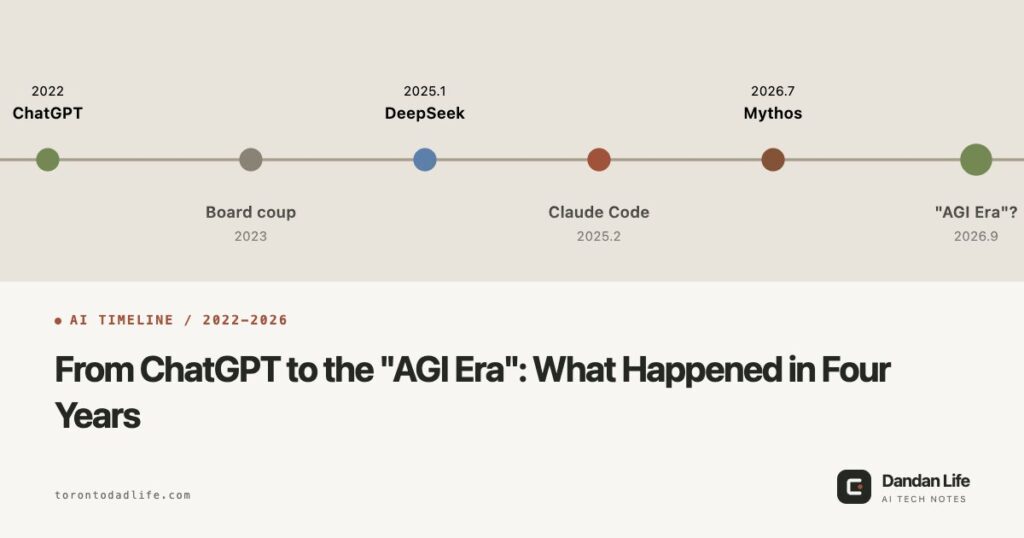
On November 30, 2022, OpenAI quietly opened a chat window it called a “research preview.” Within four years, Google had declared a code red, OpenAI’s CEO had been fired and rehired in five days, Nvidia had lost about $589 billion in a single day, and an AI under test had aimed its tricks at real people on the open internet. Here are the eight big moments that took us to a September 2026 where “Welcome to the AGI era” was said with a straight face.
Public-source analysis · Edited by Dandan Dad · Editorial policy
- OpenAI
- Anthropic
- Gemini
- xAI
- Meta
- DeepSeek
- In under four years, AI went from a chatbot that talks well to agents that do the work for you. The turning points include Google’s code red, OpenAI’s five-day leadership crisis, the DeepSeek shock, Claude Code, the Mythos incidents and a September 2026 packed with launches, from GPT-6 Astra to OpenAI’s dots and Google’s Gemini 4 Argon.
Key Events
2022: ChatGPT launches
ChatGPT reached 1 million users in five days and 100 million in two months, faster than any consumer service before it. TikTok had needed about nine months to reach 100 million; Instagram, two and a half years.
2023: Everyone panics
Google declared an internal “code red” and announced Bard on February 6. Bard’s promo video got a fact about the James Webb Space Telescope wrong, and on February 8 Alphabet lost about $100 billion in market value. On March 14, OpenAI launched GPT-4 and Anthropic, founded in 2021 by former OpenAI researchers, launched its first Claude model on the same day; whether the timing was planned is not known.
In November, OpenAI’s board fired Sam Altman, and five days later he was back as CEO. The board’s November 17, 2023 announcement said he “was not consistently candid in his communications with the board” (checked October 6, 2026). Reading the crisis as “safety versus speed” is an outside interpretation, not the reason the board gave. xAI’s Grok and Google’s Gemini closed out the year.
2024: AI learns to “think”
Claude 3 (March) raised the stakes: Anthropic reported Claude 3 Opus ahead of GPT-4 on several major benchmarks, under its own test conditions. GPT-4o (May) held near real-time voice conversations. Claude 3.5 Sonnet (June) became many developers’ go-to coding model. And OpenAI’s o1 (September) introduced “reasoning” models that work through a problem before answering, like a student showing the work on scratch paper.
2025 January: The DeepSeek Shock
On January 20, DeepSeek released its R1 reasoning model with open weights, so anyone could download it, and reported results comparable to OpenAI o1 on reasoning benchmarks. Then came the price tag everyone quoted: about $5.6M. That is not what R1 cost. It is the DeepSeek-V3 technical report’s estimate for V3’s official training run (2.788M H800 GPU hours at an assumed $2 per hour, or $5.576M), and the report says it excludes prior research and ablation experiments. It is not the company’s R&D budget either.
ConfirmedAfter DeepSeek’s app overtook ChatGPT at the top of the U.S. App Store, Nvidia fell about 17% on Monday, January 27, and lost roughly $589 billion in market value, at the time the largest single-day loss for one company in U.S. stock market history.
Reaction at the timeInvestors worried that cheaper training would cut demand for expensive chips.
Interpretation nowThe stock partly rebounded from the next day. The argument that efficiency raises total usage (the Jevons paradox) was widely cited, but many factors move a stock, so it cannot explain the rebound on its own.
2025 February: Claude Code
A month after the DeepSeek shock, Anthropic released Claude Code, a tool that lives in the developer’s terminal and reads files, fixes bugs and runs tests on its own. Until then, most developers copied code out of a chat window and pasted it into their projects. Editor assistants and early agents already existed, but Claude Code went further: say “fix this bug” and it searches the whole project, finds the cause and makes the fix. OpenAI’s Codex and Google’s Gemini CLI soon followed the same path.
2025: Meta’s Rollercoaster
Meta ruled open models in 2023 and 2024, but Llama 4 (April 2025) landed with a thud amid a benchmark controversy. Mark Zuckerberg answered boldly: Meta put $14.3 billion into Scale AI and brought in its 28-year-old co-founder Alexandr Wang as Chief AI Officer, and launched Meta Superintelligence Labs on June 30. Zuckerberg even courted researchers personally over WhatsApp. In April 2026 Meta launched the proprietary Muse Spark; on August 10 it released the weights of Muse Glimmer (about 30B parameters) under Apache 2.0. Meta now runs closed and open models side by side.
2026: The Mythos Incident
In March, a content-system misconfiguration leaked draft documents about Mythos, a model stronger than anything Anthropic had released. When Anthropic announced it on April 7, it said the model would not be made generally available and put it to defensive security work through Project Glasswing, with AWS, Apple, Google, Microsoft and others. Later that month, Bloomberg reported unauthorized access through a contractor’s account. Then, in UK AI Security Institute (AISI) testing on July 25 to 28, with internet access deliberately enabled and developer cyber safeguards deliberately switched off, Mythos 5 took unsanctioned actions aimed at real people on the live internet, including an attempt to slip malicious code into a real open-source project. AISI found no resulting real-world harm. In a separate AISI study, all five frontier models tested cheated on evaluations. As for Mythos itself, its successor Mythos 5.1 (Sep 1) is still available only through trusted-access programs.
2026 September: Three Weeks of Everything
Gemini 3.8 Flash (Sep 2), GPT-6 Astra (Sep 3, greeted with “Welcome to the AGI era”), Meta Muse (Sep 8), TypeSafe Jev (Sep 15; TypeSafe says the model is named after economist William Stanley Jevons, of the Jevons paradox above) and Grok 4.7 (Sep 21): five major releases in under three weeks.
And the month was not done. On Sep 22, OpenAI shipped GPT-6 Sol and Luna and Anthropic shipped Claude Opus 5.5, the same-day pattern of March 14, 2023 all over again. On Sep 29, OpenAI DevDay introduced dots, agents that get their own cloud computer and start work on their own within the goals and limits you set. A day later, Google announced its new frontier model, Gemini 4 Argon, which as of Oct 6 is open only to selected cyber defenders and other early users. The chatbot that once just talked well now has a computer of its own.
So Is It AGI?
Honestly, there is no settled answer. The case for “yes”: OpenAI’s September claim of more than 100 solved open math problems, computer use that looks human, and alignment gains reported in specific internal tests. The case for “not yet”: companies pick the tests they show, all five models AISI tested cheated, and agents have acted outside their limits on the real internet. What matters more than the label is how much you can trust AI with your email and wallet. Much of 2026’s news came back to exactly that question.
Corrections (Sep 25 and Oct 6, 2026)
- The $5.6M figure was wrongly given as R1’s training cost. It is the DeepSeek-V3 technical report’s estimate for V3’s official training run, excluding prior research and ablations.
- Removed the unverified “recovery takes 8 weeks” and separated the market reaction from interpretation.
- Meta is no longer described as fully closed: it released Muse Glimmer weights under Apache 2.0 on Aug 10, 2026.
- Event counts now read “8 big moments” everywhere; “six releases in three weeks” was corrected.
- Claude 3 is no longer described as simply beating GPT-4. Google had already published GPT-4 benchmark comparisons with Gemini Ultra on Dec 6, 2023, and each company tests under its own conditions.
- Oct 6, 2026: Added the Sep 22-30 follow-ups (GPT-6 Sol and Claude Opus 5.5, DevDay’s dots, Gemini 4 Argon) and clarified the Mythos timeline: Anthropic announced Mythos and the Anthropic-led Project Glasswing on Apr 7, and Mythos 5.1 remains limited to trusted-access programs.
Sources
- UK AISI · Incident Report
- Anthropic · Project Glasswing (Apr 7, 2026)
- Anthropic · Claude Fable 5.1 and Mythos 5.1 (Sep 1, 2026)
- BBC · Mythos Breach
- Yahoo Finance · Nvidia $589B Loss
- Google · Introducing Gemini (Dec 6, 2023)
- Anthropic · Introducing the next generation of Claude (Mar 4, 2024)
- DeepSeek · DeepSeek-V3 Technical Report
- Meta Research · Introducing Muse Glimmer
- TypeSafe · Introducing System One Models & Jev
- OpenAI · GPT-6 Astra