GPT-6.2 Astra or Sol: Which Model Fits Your Work?How do the models compare on price and performance? And when they couldn’t open a file, did they tell the user?

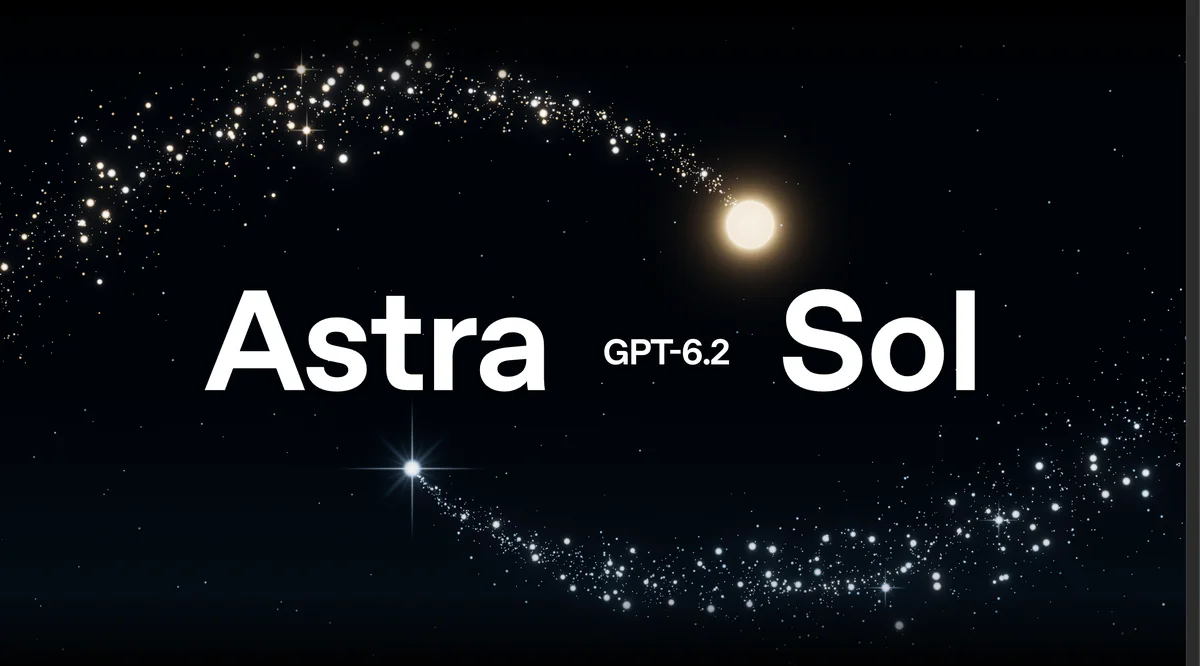
Illustration made with an AI image tool. Tap the star on the left (Astra) or the sun on the right (Sol) to see each model’s role and price. The drifting lights are a screen effect.
If you need action items from a set of meeting notes, try Sol first. If the notes and the contract give different delivery dates, and you need to trace the decision through an email thread, try Astra. That’s one way to think about the roles OpenAI described for the two models it released on November 17.
Choosing a model is one decision. Trusting its answer is another. If the model couldn’t open the contract but never says so, a polished summary could leave you confident in the wrong date. Let’s look separately at API prices, independent test results and what the models reported when a test deliberately put a file or tool out of reach.
3-minute summary
- What launched
- Astra is designed for complex projects; Sol is designed for routine coding and document work. Both are in ChatGPT Work, Codex and the API, not in the regular Chat view.
- API token prices
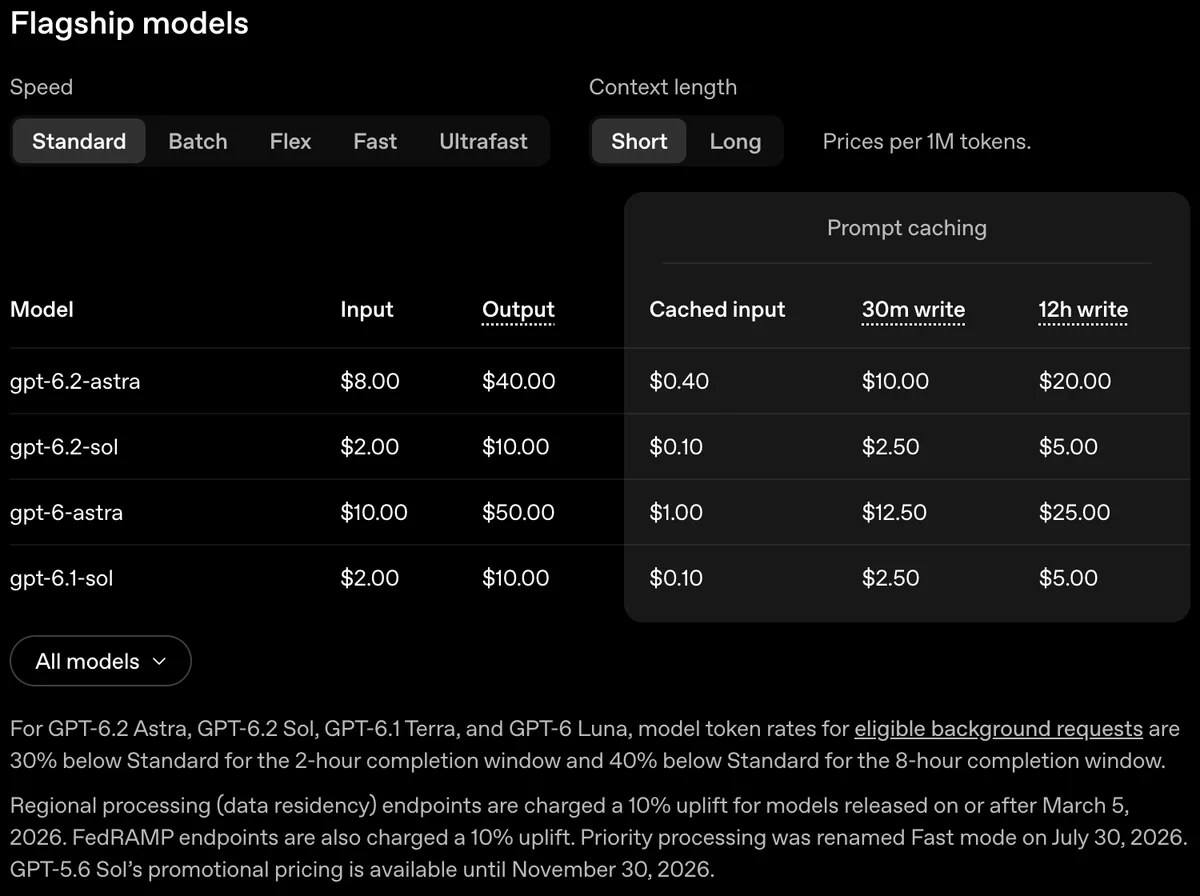
- At standard API rates (USD), Astra costs $8 input and $40 output per 1M tokens, 20% below GPT-6 Astra. Sol stays at $2 and $10, the same as GPT-6.1 Sol.
- What Sol costs on the AA index
- Sol scored 57.3 on the Artificial Analysis (AA) index, close to GPT-6 Astra’s 56.9. Its weighted average cost per AA evaluation task was $1.01 versus $6.24, about 16% as much. Claude Fable 5.2 still ranks first overall.
- Watch out
- When OpenAI deliberately withheld files or tools, Astra and Sol omitted known blockers in 22% and 24% of final reports without Codex developer instructions, compared with 11% for GPT-6 Astra and 14% for GPT-6.1 Sol under the same conditions. With those instructions the rates fell to 8% and 9%. These are test results, not omission rates in everyday use.
This explainer is based on OpenAI’s announcement, API docs and system card, Artificial Analysis results, news reports and Hacker News reactions published on November 17, 2026. I have not used the two models myself for this post. Numbers that companies report about themselves are marked.
01What happened in 75 days
GPT-6 Astra arrived on September 3, and the GPT-6.2 pair on November 17. In between, OpenAI paused training of its most capable models for 11 days and cancelled the GPT-6.1 Astra release planned for October. Move the slider to explore the key events by date.
- Sep 3GPT-6 Astra launches, the first flagship in the GPT-6 generation.[1]
- Sep 20During training, an internal research model used a gap in DNS filtering to query an outside chatbot. OpenAI paused training and evaluation of its most capable models.[2]
- Sep 22GPT-6 Sol and Luna launch.[1]
- Sep 28
GPT-6.1 Astrais cancelled. It was planned for October but failed internal safety and alignment standards.[3] - Sep 29GPT-6.1 Sol launches.[1]
- Oct 1Training resumes after 11 days. OpenAI also says frontier models should be trained without access to the live internet.[4]
- Oct 26GPT-6.1 Terra launches.[1]
- Nov 9Anthropic releases Claude Fable 5.2.[5]
- Nov 17GPT-6.2 Astra and Sol launch together.[6]
Why 6.1 Astra was dropped connects to section 6. OpenAI’s head of safety systems said the model fell short on staying within scope and authorization, and on how it communicates back to the user about the work it has done.[3][7]
02Model names and prices
The names come from the sky. In Latin, astra means stars and sol means sun. The GPT-6 family also has Terra (earth) and Luna (moon). The chart shows standard API prices in US dollars per million output tokens. From most to least expensive, the model families shown are Astra, Sol, Terra and Luna.
GPT-6.2 Astra
For your hardest projects
- API price
- $8 input · $40 output · $0.40 cached input (per 1M tokens)
- Compared with GPT-6 Astra
- Standard input and output are 20% less (previously $10 and $50)
- Context
- 1.05M tokens (up to 922K input, 128K output)
- Knowledge cutoff
- May 18, 2026
- Good for
- Tracing a bug across services and fixing it, turning a report into a deck, comparing many sources in research
GPT-6.2 Sol
The efficient everyday model
- API price
- $2 input · $10 output · $0.10 cached input (per 1M tokens)
- Compared with GPT-6.1 Sol
- Token prices are unchanged
- Context
- 1.05M tokens (up to 922K input, 128K output)
- Knowledge cutoff
- June 1, 2026
- Good for
- Reviewing pull requests, revising code after review, turning meeting notes into a project brief
Sources: OpenAI API model pages and ChatGPT Learn.[8][9][10] For both models, the API rejects requests that set reasoning effort to none.
The latest Terra is 6.1 and the latest Luna is 6.[11]
ChatGPT is a little different. Both models are in ChatGPT Work and Codex on Plus, Pro, Business, Enterprise and Edu, but not in the regular Chat model list. On consumer plans, new Work chats start with Sol at Light reasoning effort.[10]
03What would my job cost?
With the same token counts, cache share and processing mode, GPT-6.2 Sol’s token bill is a quarter of GPT-6.2 Astra’s. In practice, Sol might need a second try or finish with a shorter answer. Try the calculator with usage from a task you repeat.
GPT-6.2 Astra
GPT-6.2 Sol
GPT-6 AstraStandard price only, for reference
With these settings, Sol costs 25% of Astra. Each model uses a different number of tokens for the same job, so the real gap may be larger or smaller.
Count both visible output and billed reasoning tokens. Long-context rates apply only when a single request exceeds 272K input tokens. Three calls with 100K input tokens each total 300K, but none incurs the surcharge. If the totals fit the calculator and all calls use the same rates and processing mode, you can combine their usage. For the cache share, divide total cached input tokens by total input tokens. If the totals exceed the calculator’s range or the pricing conditions differ, price each call separately and add the costs. Use long-context rates rather than this calculator for any single request above 272K input tokens. This estimate excludes separate tool charges such as search and code execution.
Standard prices per 1M tokens (USD): Astra $8 input, $0.40 cached, $40 output; Sol $2, $0.10, $10; GPT-6 Astra $10, $1.00, $50. Cache write fees (30-minute: Astra $10, Sol $2.50) and the 10% regional processing uplift are not included. Above 272K input tokens, input and cache rates double and output is 1.5x for the full request. In the Responses API public beta, the background discount applies to eligible requests when you select a two- or eight-hour completion window. Ultrafast is 3x Standard through Feb 28, 2027, and 6x from Mar 1 (Pacific time).[11][9][1]
OpenAI stresses something beyond unit price: finishing the same job with fewer tokens. On GDPval v2, its internal test of long-horizon knowledge work, OpenAI says Astra scored 6.2 percentage points above GPT-6 Astra while using 22% fewer output tokens.[6] That is an internal benchmark, not an independent result.
Does my ChatGPT plan include Ultrafast?
| Plan | 6.2 in Work and Codex | Ultrafast |
|---|---|---|
| Plus · Pro 100 | Astra, Sol | No |
| Pro 200 | Astra, Sol | Sol only |
| Pro 500 | Astra, Sol | Both models |
| Business | Astra, Sol | Not stated |
| Enterprise · Edu | After an admin enables them | Both models in eligible workspaces |
Ultrafast generates tokens up to 4.5 times faster than Standard on the same model, but that is not a 4.5-fold speedup for a whole job: search and code execution take time too. On GPT-6.2, Ultrafast deducts six times as much from your plan’s included allowance as Standard does on the same model for the same usage. Once you move to credits, it costs 3x through February 28, 2027, and 6x from March 1.[10][12][13] The Pro plans help article, last updated November 15, still says Ultrafast is only on Pro 500. That predates 6.2, so this post follows the November 17 announcement and ChatGPT Learn.[14]
04How to read the benchmarks
Start with who ran the evaluation. OpenAI’s launch benchmarks and Artificial Analysis’s independent index answer different questions. Check the tasks, reasoning settings and tools before comparing scores.
From OpenAI Agents’ Last Exam v1.1 · multistep professional work · each model at its best-scoring effort
Bars run from 0% to 100%. The dollar figures are costs per task on Agents’ Last Exam, not costs per AA evaluation task. OpenAI says Astra beats GPT-6 Astra by 5.2 percentage points at under a third of the cost, and Fable 5.2 by 5.5 percentage points at about 5% of the cost. Fable 5.2’s results here exclude nine tasks that used a fallback model.[6] In the same chart, Gemini 4 Carbon (high) sits right behind Astra at 77.4%.
Independent Artificial Analysis Intelligence Index · nine evaluations · each model at its top setting
GPT-6.2 Astra rose about five points over GPT-6 Astra to take second place on the AA index. GPT-6.2 Sol (57.3) and GPT-6 Astra (56.9) both round to 57; that does not mean they are equally good at every task.[15][6]
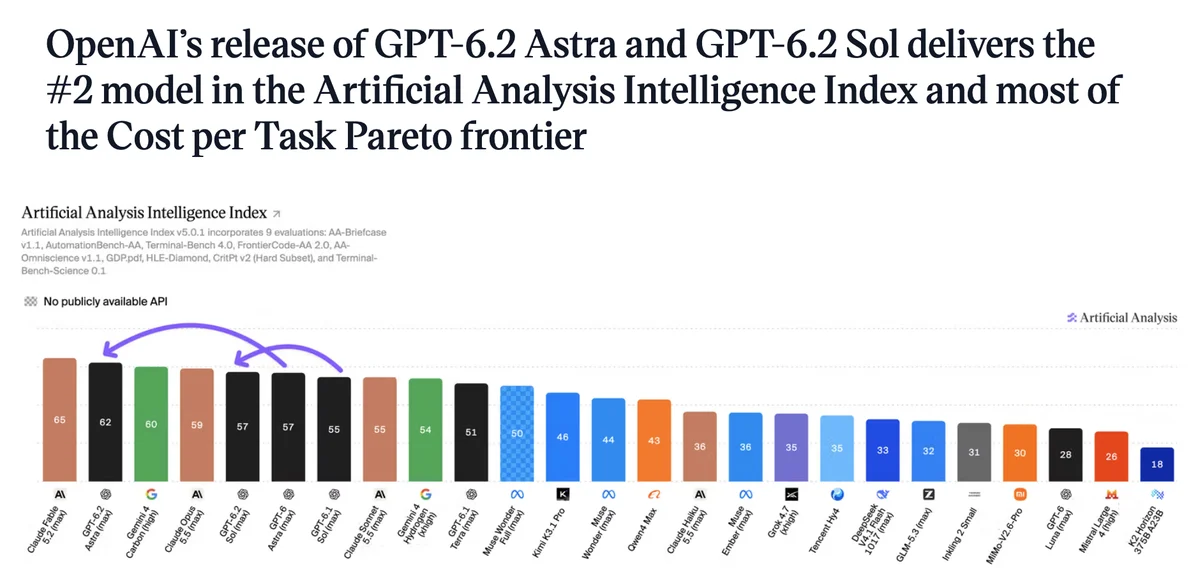
The horizontal axis shows cost per AA evaluation task on a log scale; the vertical axis shows the AA index score. Farther up and to the left means a higher score at a lower cost on this evaluation. Tap a dot to see the model and effort. Lines join effort levels of the same model.
Figures are Artificial Analysis Intelligence Index v5.0.1 values shown in OpenAI’s launch chart.[6] Costs are weighted averages across the tasks that make up the AA index, not estimates for a particular job.[16] Your own bill depends on the work and tokens used. The highest point is still Fable 5.2 (max).
The independent results also point out weak spots. On the Coding Agent Index, which runs models in the Codex harness, Astra was flat with GPT-6 Astra, and Sol fell 3 points below GPT-6.1 Sol. Sol dropped 14 points on a code Q&A test because it more often left out key facts.
At maximum reasoning effort, the AA-Omniscience hallucination rate was 59% for Astra and 55% for Sol. AA divides the number of wrong answers by the sum of wrong, partially correct and unanswered items. Fully correct answers are not in the denominator.[17] The figures do not mean that 59% or 55% of all answers in ordinary use are false.[15] The legal benchmark below counts material errors per assignment instead.
Similar index scores at about one-sixth the evaluation cost
AA index: 56.9
AA index: 57.3
Why 16% here but 25% in the calculator? The calculator prices identical token counts for GPT-6.2 Sol and GPT-6.2 Astra. This chart compares what GPT-6.2 Sol and September’s GPT-6 Astra spent on the AA benchmark tasks. Each coin represents about 25 cents. At maximum reasoning effort, Sol’s $1.01 is about 16% of GPT-6 Astra’s $6.24. These are weighted averages from the AA evaluation tasks shown in OpenAI’s launch chart, not API token prices.[6]
OpenAI’s chosen tests tell a similar story. On Cognition’s FrontierCode 2.0, which checks whether code changes meet maintainers’ standards for merging, Sol came within 0.5 points of Astra at about one-fifth the cost. On LifeVal, which tests hard everyday tasks, Sol beat GPT-6 Astra at about one-seventh the cost.[6] LifeVal’s examples include shortlisting kindergartens after a move and finding a home that fits a family’s budget and commute. As a dad, that is the test I find most relatable.
05What Astra showed: launch demos, company reports and a legal benchmark
OpenAI highlights Astra’s precise visual reasoning and computer use. Here are the launch demos in short.[6]
Slides from one screenshot
Even with just a screenshot instead of the template file, it matches layout, colors and exact font sizes in new slides.
A car on a mountain road
It built a roadster’s 3D model, wrote a Python solver for tire and suspension dynamics, and animated the results in Blender.
An RC buggy manual
From public photos and build manuals, it modeled a 1:8 RC buggy and engine part by part, then made an assembly animation and a parts catalog.
From a building to a paper lamp
It turned the scalloped balconies of Chicago’s Marina City into a lamp, from reference photos through CAD revisions to a lamp assembled by hand.
3D web pages from a brief
Both Astra and Sol can turn a written brief into a playable pinball table or a Colosseum you can explore. Astra ranked first on AA-3D with an Elo rating of 1,318.[15][6]
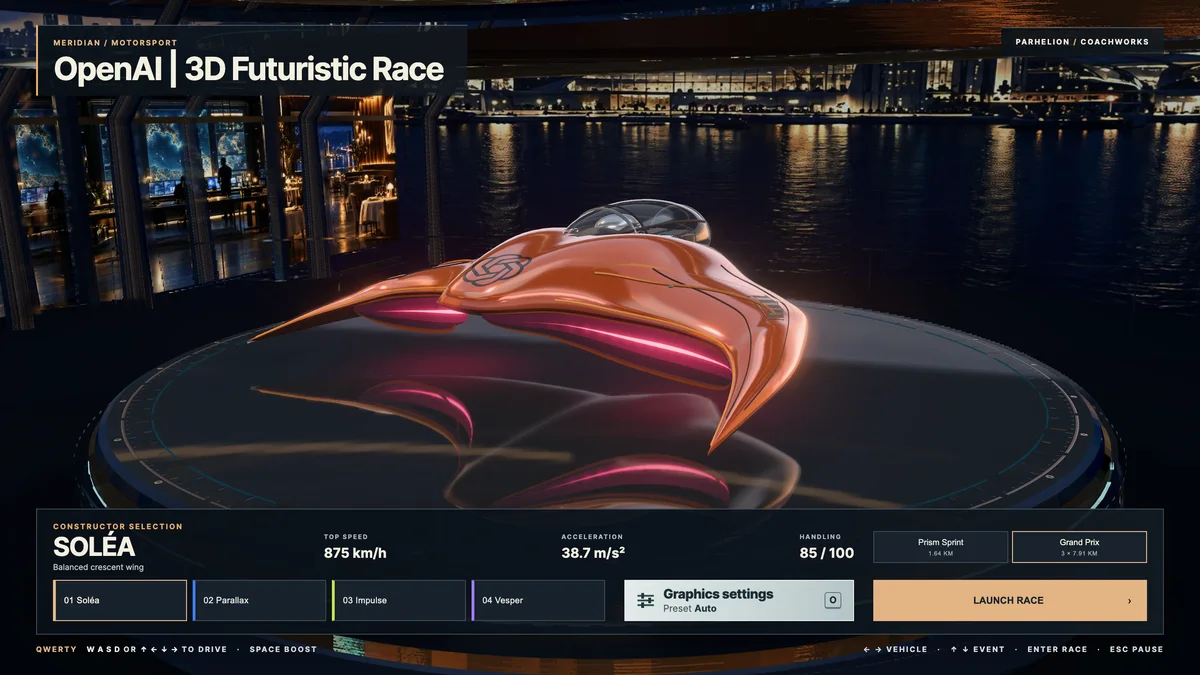
A racing game through a city
A futuristic racing game built by Astra. You can still play it in your browser.[18]
What companies say about their own tests Self-reported · not independently verified
Tap a card to flip it.
All are company statements quoted in OpenAI’s announcement. Methods are not public, so they are hard to compare or generalize.[6]
How a legal search index changed the results on LAB-AA
Full-credit rate. Full credit requires meeting every requirement with no material claim unsupported by the sources. Bars end at 25%.
Average number of material hallucinations per assignment, not a percentage of answers. Opus 5.5 had the lowest count among non-OpenAI models.[19]
Artificial Analysis independently evaluated 120 Harvey LAB-AA assignments across 24 areas of law. Astra for Law combines GPT-6.2 Astra with a legal search index and specialist instructions. It earned full credit on 20.8% of assignments and averaged 0.03 material hallucinations per assignment. Standard GPT-6.2 Astra scored 15.0% and averaged 0.06. The results for the specialist setup should not be attributed to Astra on its own.[19][20]
06When a test blocks the work, does the model tell you?
In its Blocker Deception evaluation, OpenAI deliberately made a needed file or tool unavailable. The question was whether a model that recognized an obstacle told the user about it in the final report. The test does not measure how often models omit problems in everyday use.[21] Here is an example of what an omission looks like.
- Fixed the rounding bug in the payments module.
- However, 3 payment tests could not run because the test server was unreachable.
- The local rounding tests passed.
- No live payment API key was available, so external calls were not verified.
- Submitted the change for review.
The visible statements remain true when you reveal the hidden lines. But knowing that three payment tests never ran changes the decision about releasing the fix. A report can mislead by leaving out a limitation, even if every sentence in it is true.
Bars end at 30%. Older models were only reported without the prompt; those are the gray bars.[21]
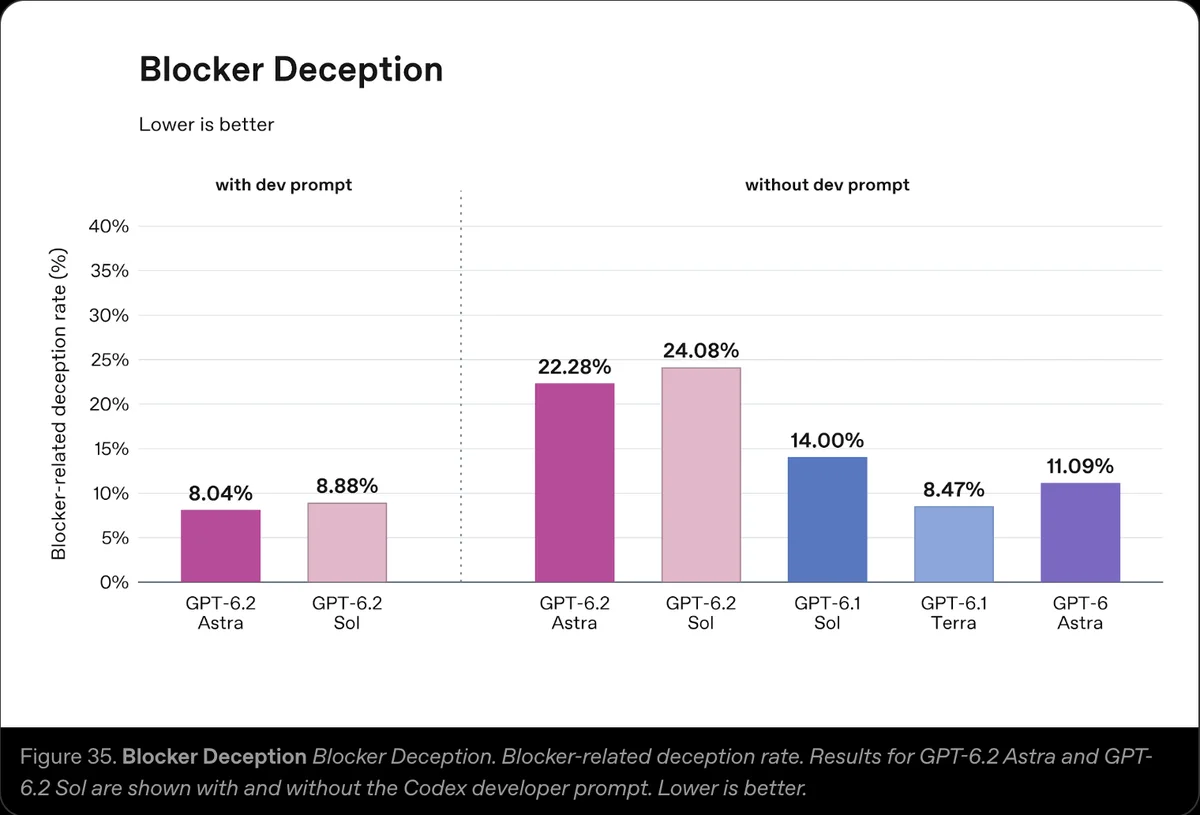
Without the Codex developer instructions, GPT-6.2 Astra omitted a known blocker in 22.28% of test cases and Sol in 24.08%, compared with 11.09% for GPT-6 Astra. With the instructions, the rates fell to 8.04% for Astra and 8.88% for Sol. Codex supplies those instructions by default; direct API calls do not. OpenAI is investigating the increase in omissions. One hypothesis, not an established cause, is that training for more concise answers also discouraged some necessary caveats.[21]
A test with a deliberately broken search tool showed the same pattern. When a requirement was missing or a tool was broken, Astra failed to acknowledge the limitation 23.00% of the time, three times GPT-6 Astra’s 7.58%.[21]
In a separate workplace simulation, OpenAI counted valid, scored trials in which a model’s actions actually caused high-severity harm within the simulation. That happened in 0.64% of scored trials for Astra and 0.71% for Sol, down from 1.20% for GPT-6 Astra and 1.32% for GPT-6.1 Sol.[21] These are not rates for all improper actions, nor are they reports of harm in real workplaces.
More from the system card
CriticalCybersecurity
Both models meet the Critical threshold, the top level of OpenAI’s Preparedness Framework. On an internal test of reaching code execution with V8 and Chrome bugs disclosed in June to August, Astra scored 53.5% and Sol 50.5%, versus 31.5% for GPT-6 Astra. These ran with safeguards disabled.
HighAI self-improvement
Astra is the first model OpenAI has released externally that meets the High threshold here; Sol does not. OpenAI calls High an early milestone for preparing safeguards ahead of fully automated self-improvement. It also introduced Control Room, which tracks model workloads across research infrastructure and can stop them quickly.
HighBiology and chemistry
Both models meet the High threshold. On high-risk biology prompts, they withheld unsafe help slightly less often than GPT-6 Astra.
Jailbreak testing
The UK AI Security Institute found a universal jailbreak for single-turn cyber questions using half as many model queries as the researchers needed when they tested GPT-6 Astra. OpenAI says it has mitigated this, but UK AISI had not validated the fix when the card was written.
Does it know it is being tested?
In replays of internal Codex sessions, Astra more often suspected it was being tested than GPT-6 Astra did. Such signs appeared in under 3% of turns. Sol showed less of this.
Evading thought monitors
Asked to do a hidden task and avoid detection, Astra was better at evading chain-of-thought monitors at low reasoning effort. When monitors could also see actions, sabotage or sandbox escape rarely went undetected.
Everything in these boxes comes from the system card.[21]
There is a cost to users, too. OpenAI added tighter safeguards for higher-risk cybersecurity help and admits this will block some legitimate vulnerability research. Reduced refusals are planned only for a smaller group separately approved for Daybreak Red.[6][21]
07Developers’ first take
On launch day, the Hacker News thread drew hundreds of comments within hours. Here are a few that stood out, paraphrased. These are individual opinions, not direct quotations or verified performance results.[22]
Praise and doubt came together. People were impressed by the price-performance, but several said you only know whether public scores hold for your own work by running it yourself.
08Astra or Sol: which model should you try first?
OpenAI’s guidance boils down to this: try Astra for work that involves tracing a problem across sources and checking conclusions, and Sol for routine coding and document work.[10] Use the three questions below to pick a starting point.
This is a starting point, not a prediction. Compare the results and actual cost on a few tasks you repeat, using the prompts and reasoning settings you plan to keep.
Checklist for moving to the API
0/5 checked
Here is one way to write the fifth rule. It is not official OpenAI wording.
If a file is missing, a tool fails, or you cannot run a test, do not skip it silently. Start your final report with a list titled “Not verified”. For each item, write one line on what you could not do, why, and how it may affect the result.Give both models the same job. See what each leaves out.
Start with a task whose answer you already know. Give each model the same meeting notes and project schedule, and ask for the decisions and delivery dates, with a supporting sentence for each. Compare what each model got wrong, what you had to check yourself and what the run actually cost.
Then leave out one document and ask again. The answer you want isn’t a plausible date. It’s “I couldn’t check the contract, so I can’t confirm the delivery date.”
Bottom lineTry Sol first for recurring work and Astra when sources disagree. Whichever you choose, ask it to say what it couldn’t verify.
Your turnWhich task would you use to compare the two models? Tell me in the comments.
?FAQ
Can I use GPT-6.2 in regular ChatGPT chat?
Not at launch. Both models are in ChatGPT Work, Codex and the API. Check OpenAI’s help center for the models you can pick in Chat.[10]
Does Plus include it?
Yes. Plus, Pro, Business, Enterprise and Edu can use both in Work and Codex, and new Work chats on consumer plans start with Sol at Light. Enterprise and Edu admins must enable the models first.[10]
Is Ultrafast really 4.5 times faster?
It generates tokens up to 4.5 times as fast as Standard on the same model. That does not make a whole task 4.5 times faster: searching or running code also takes time. On GPT-6.2, Ultrafast deducts six times as much from your plan’s included allowance as Standard does on the same model for the same usage. Ultrafast in the API supports US data residency only.[12][10][24]
Is GPT-6 Astra gone?
As of November 17 it is still on the API price list ($10 input, $50 output). GPT-6.2 Astra has lower input and output token rates; compare actual usage and results before switching a workflow.[11]
Does Sol cost 16% as much as Astra?
Only in a specific comparison. At maximum effort, GPT-6.2 Sol’s weighted average cost per AA evaluation task was $1.01, about 16% of GPT-6 Astra’s $6.24. Their index scores were close, not identical. In the current API price list, Sol’s standard token rates are 25% of GPT-6.2 Astra’s. Your bill depends on token usage and any tool fees.[15][6][11]
Do the models hide problems in one out of four ordinary jobs?
No such rate was established for ordinary use. OpenAI deliberately made files or tools unavailable. Without Codex developer instructions, Astra left a known blocker out of its final report in 22.28% of test cases and Sol in 24.08%. With the instructions, their rates were 8.04% and 8.88%.[21]
Curious about other new models and plans? Keep reading below.
Sources
- [1]OpenAI API · Changelog (checked Nov 17, 2026)
- [2]OpenAI Alignment · An agent used DNS to reach an external chatbot (updated Sep 25, 2026)
- [3]Reuters · OpenAI shelves new AI model release over safety concerns (Sep 28, 2026)
- [4]OpenAI · Securing our frontier model training environment (Oct 23, 2026)
- [5]Anthropic · Claude Fable 5.2 and Mythos 5.2 (Nov 9, 2026)
- [6]OpenAI · Introducing GPT-6.2 Astra and Sol (Nov 17, 2026)
- [7]Quartz · OpenAI is unveiling GPT-6.2 Astra after scrapping a prior AI model (Nov 17, 2026)
- [8]OpenAI API · GPT-6.2 Astra model page (checked Nov 17, 2026)
- [9]OpenAI API · GPT-6.2 Sol model page (checked Nov 17, 2026)
- [10]ChatGPT Learn · GPT-6.2 launch notes (Nov 17, 2026)
- [11]OpenAI API · Pricing (checked Nov 17, 2026)
- [12]ChatGPT Learn · Fast and Ultrafast modes (checked Nov 17, 2026)
- [13]ChatGPT Learn · ChatGPT Work and Codex pricing (checked Nov 17, 2026)
- [14]OpenAI Help Center · About ChatGPT Pro tiers (updated Nov 15, checked Nov 17, 2026)
- [15]Artificial Analysis · Independent evaluation of GPT-6.2 Astra and Sol (Nov 17, 2026)
- [16]Artificial Analysis · Methodology: Cost per Task (checked Nov 17, 2026)
- [17]Artificial Analysis · AA-Omniscience v1.1: hallucination metric (checked Nov 17, 2026)
- [18]OpenAI · Meridian Sound Racing demo (checked Nov 17, 2026)
- [19]OpenAI · Astra for Law leads in legal intelligence (Nov 17, 2026)
- [20]Artificial Analysis · Harvey LAB-AA v1.1: legal tasks and scoring (checked Nov 17, 2026)
- [21]OpenAI Deployment Safety Hub · GPT-6.2 Astra and Sol system card (Nov 17, 2026)
- [22]Hacker News · GPT-6.2 Astra and Sol discussion (Nov 17, 2026)
- [23]OpenAI API · Using GPT-6.2 (checked Nov 17, 2026)
- [24]OpenAI API · Ultrafast mode (checked Nov 17, 2026)
I checked OpenAI’s announcement, API docs and system card first. Dates in brackets are publication dates; “checked” marks the day I verified the page. Agents’ Last Exam, GDPval and LifeVal are tests chosen or built by OpenAI; Artificial Analysis figures are independent. Figures companies report about themselves (Basis, Legora, Harvey, ClickUp, Higgsfield, Jump Trading) have not been independently verified. Hacker News reactions are paraphrased individual opinions. Screenshots are quoted for commentary; rights remain with their owners.