Gemini 4 Carbon Explained: “Carbon” Lands 15 Days After Argon’s General Release. What Changed?First on 15 of 17, so why did its hallucination rate go up? Ten interactive tools for reading Google’s new frontier model
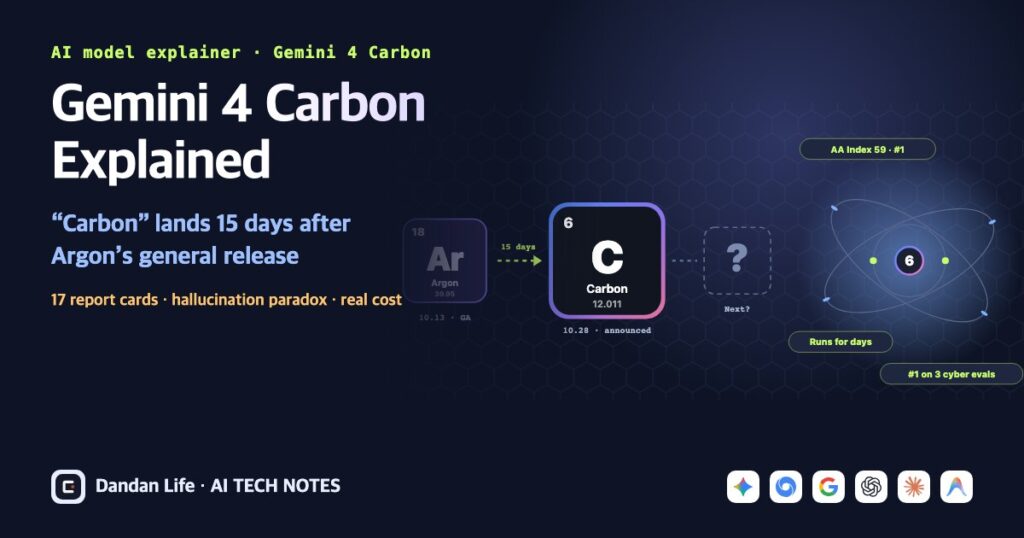
Argon had barely settled in when Carbon showed up. On October 28, 2026, 15 days after Gemini 4 Argon’s general release, Google announced its next frontier model, Gemini 4 Carbon (Argon was announced on September 30 and released generally on October 13). CEO Sundar Pichai posted on X: “I did say we’d be releasing our models periodically…” After element 18 (argon) came element 6 (carbon), so people read it as a periodic-table pun, and when Google’s Logan Kilpatrick replied “All elements right now!”, the pun became all but official.
The report card is even more fun than the name. This model came first on the overall index of the independent evaluator Artificial Analysis, yet on the same evaluator’s knowledge test it made up wrong answers more often than its predecessor. Both are true. In the five-model comparison table Google published, Carbon beat Argon on all 17 items and came first on 15. But its first word takes about as long as half-cooking a cup of instant noodles, and token prices alone don’t tell you what a job will cost. Learning how to read those high scores is what makes this model interesting.
I haven’t used Carbon myself yet. As of October 29, Google has opened it only to some cyber defenders. Still, this report card is a preview of a model we’ll soon be calling ourselves. So I checked Google’s announcement against independent evaluations one number at a time and packed the strengths and limits into 10 interactive tools. The motion in those tools is there to explain things; the numbers are exactly what the sources report. I’ve also decided what to hand it first once it opens up: checking every source and number on this blog, fixing what’s wrong and checking again.
- Gemini 4 Carbon is the frontier model Google announced on October 28, 2026, 15 days after Argon’s general release. In Google’s five-model comparison table it beat Argon on all 17 items and came first on 15.
- Its strengths are stamina on long multi-step work and cybersecurity (first in all three: reproducing bugs, proving exploits and patching). Other things changed too: in Artificial Analysis’ high-setting measurement its first word (first token) took about 100 seconds, and its hallucination rate on the same evaluator’s knowledge test rose from Argon’s 4% to 11%.
- Right now only some cyber defenders can use it. The introductory price, half the $4 / $20 list price, is $2 per million input tokens and $10 per million output tokens, and there is no public release date yet.
01“Periodically” Turned Out to Mean the Periodic Table
Pichai’s post starts like this: “I did say we’d be releasing our models periodically…introducing Gemini 4 Carbon, our next frontier model.” Two weeks after Argon, he introduced the next model and chose, of all words, “periodically”.[1] Elon Musk quoted the post and added one word: “Impressive”.[2]
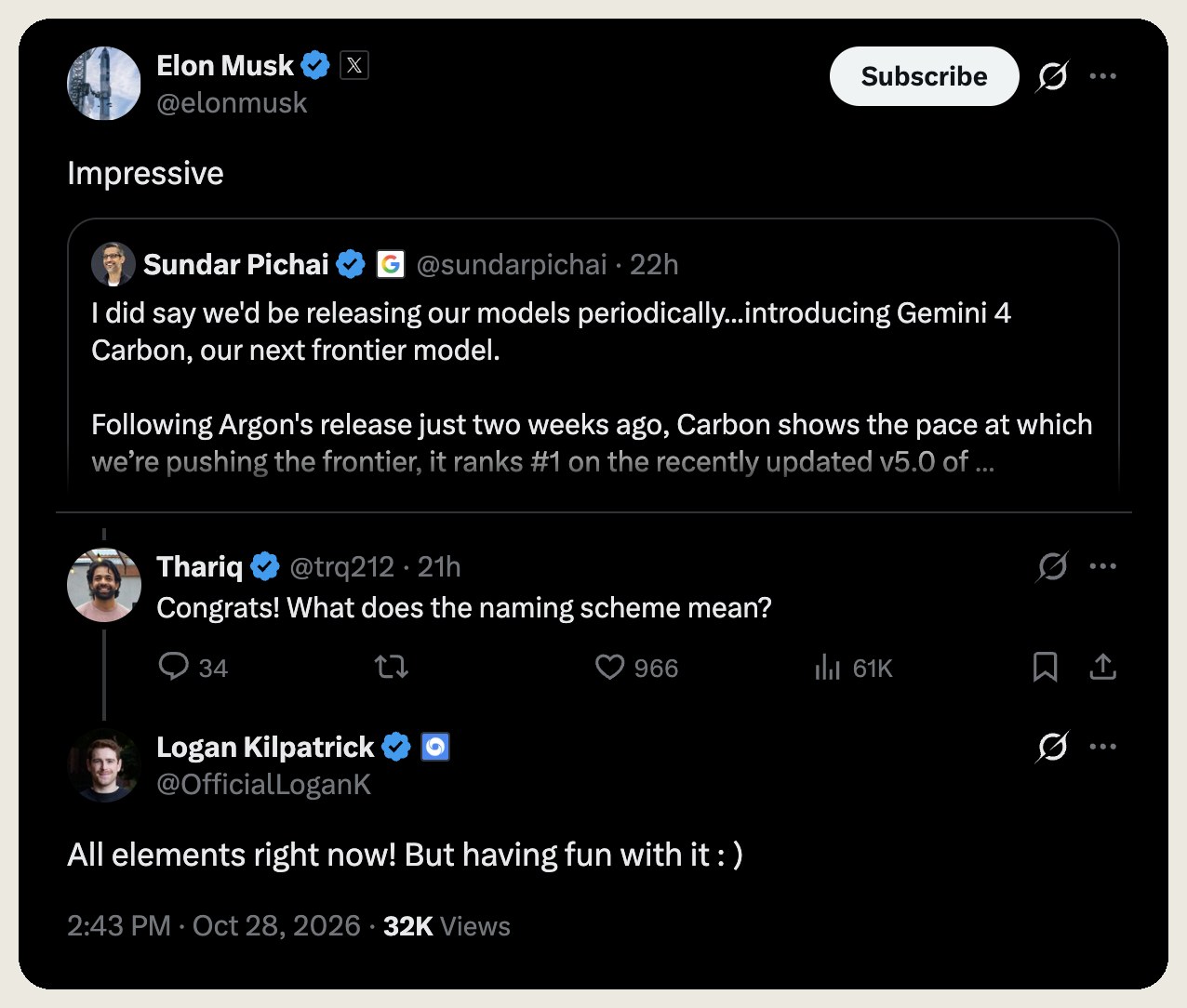
Asked what the naming scheme means, Logan Kilpatrick, who leads Google AI Studio and the Gemini API, replied: “All elements right now! But having fun with it : )”[3] That is the entire official explanation. The community, naturally, had a field day. If the names go in alphabetical order, someone noted, the scheme breaks at the tenth letter because no element starts with J.[4] Then came the math (18, then 6, so helium at 2 next)[5] and the joke that if smaller numbers mean stronger models, hydrogen (1) must be the final boss.[6] Draw a few yourself.
- A real name from an internal Google document. The model released as “Argon” was internally Barium-B (aside 1 at the end).
- “Argon(18), Carbon(6), they have Helium next and some quark after that.” Divide by 3, then by 3 again, and you run out of elements.
- “If Carbon (6) is better than Argon (18), wouldn’t that make Hydrogen (1) the ultimate Gemini model?” The smaller-is-stronger theory.
- A (Argon), B (Barium), C (Carbon), so D next? Then the scheme breaks at the tenth letter: no element starts with J.
- String the five symbols together and you get OBSCURE. Nobody knows the next name.
Each press shows a candidate from Google’s internal document or from Hacker News comments.
Only Barium appeared in an actual document (per Business Insider); the rest are jokes and guesses from Hacker News users. Google confirmed the element theme but not how it picks the order.
The names alone make a fun picture. Argon’s name comes from the Greek for “lazy”, and it is an inert gas that barely reacts with anything. Carbon bonds with almost everything, and the same atoms become both pencil graphite and diamond. Google’s key art is a faceted crystal, too. It fits the model’s selling points, versatility and hard-wearing stamina. With a blog called Dandan Life (dandan means “solid”), I admit a soft spot for the element behind the hardest crystal. That is my reading, though. Google hasn’t explained the name.

After the name, the next question is: can I use it? Not yet. Google is opening it to a subset of cyber defenders starting this week and widening access in stages while it takes part in the US government’s pre-release testing. There is no public release date (section 7).[7]
A new frontier model 15 days after Argon’s general release is fast. Google didn’t explain the timing, but on the earnings call the same day Pichai said AI is helping Google increase its training and launch velocity, and that he expects continued acceleration over the next 12 months because of RSI (recursive self-improvement, AI helping to build the next AI).[8] He also said Google is already deploying Carbon internally.[9] The code names and the security drama around the launch are collected in the asides at the end.
02One Report Card, 17 Items: First on 15, but Who Did the Measuring?
Google published a table comparing Carbon, Argon, GPT-6 Astra, Claude Opus 5.5 and Claude Fable 5.1 side by side. There are 17 items. Carbon beats Argon on all 17 and scores highest on 15.[10] I call them items rather than tests for a reason: some rows, like the AA Index and the Vals Index, are composites of many tests.
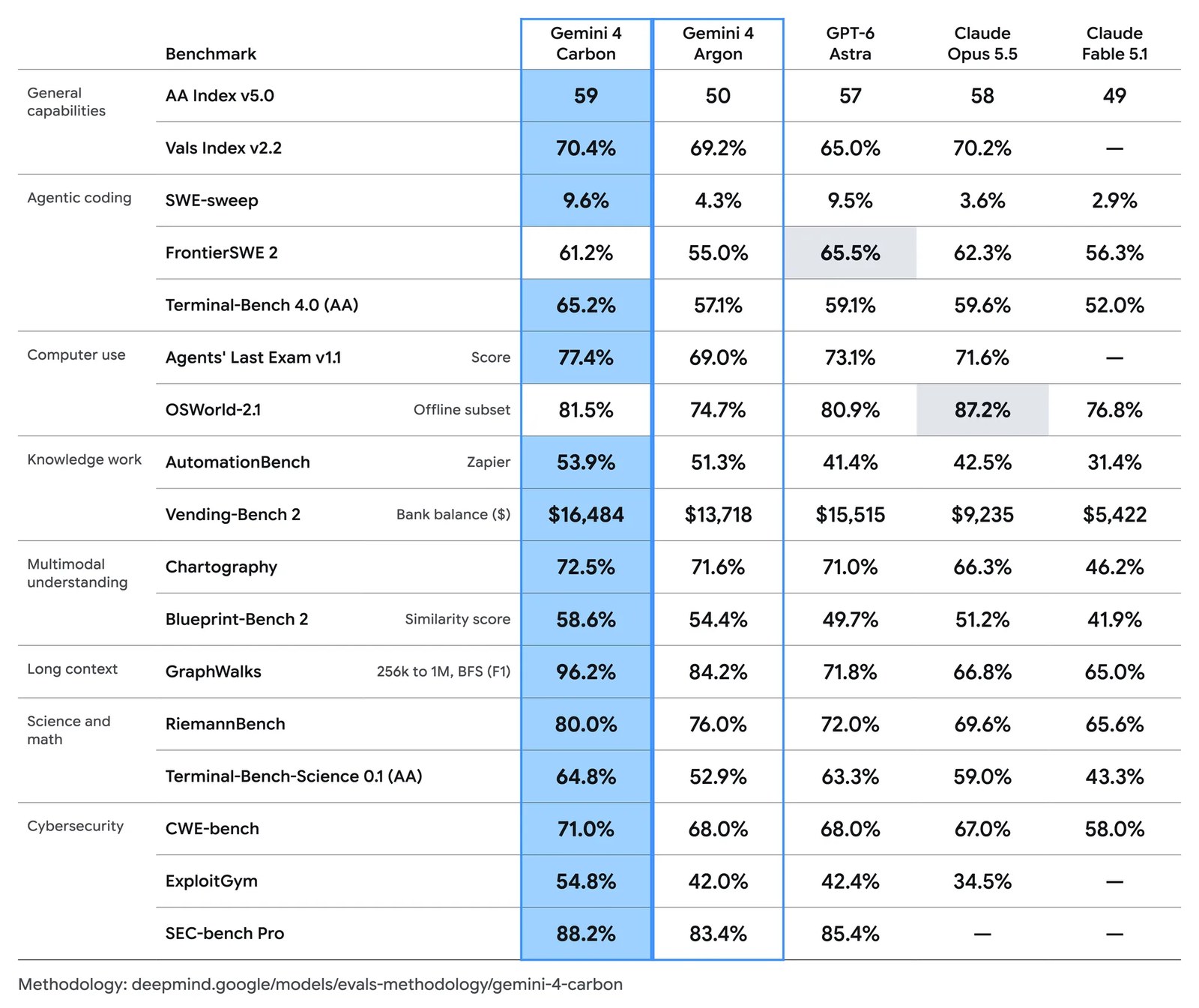
A table is dull, so let’s make it a game: find the two items Carbon didn’t win. Hint: one is in coding and one is in computer use. Tap the model you think won each card to reveal the answer and the bars. Keep an eye on the badge in the top right. Google’s methodology document shows that different items were measured by different people.[11] On some, an independent evaluator ran every model under the same conditions. On others, Google measured Carbon itself and took rivals’ numbers from their own reports. On GraphWalks, Google measured every model. Count the badges and you get 10 independent, 6 partly Google-run and 1 Google-only. Carbon wins 9 of the 10 independent items and 6 of the 7 that Google had a hand in. Who did the measuring didn’t change the picture much, so you can read on with a little more confidence.
Carbon wins 15 of the 17. Which 2 does it lose? Tap the model you think won each card to reveal the answer and the bars. The badge tells you who ran the test.
A composite of 9 evaluations
Who wins?
Finance, law, tax and coding tasks
Who wins?
Coding-agent tasks (subtask-weighted)
Who wins?
Long software-engineering tasks
Who wins?
Getting work done in a terminal
Who wins?
Multi-step, job-like agent tasks
Who wins?
Using a computer from screenshots, mouse and keyboard
Who wins?
Automation across SaaS apps (Zapier)
Who wins?
Bank balance after a simulated year running vending machines
Who wins?
Reading charts without tools
Who wins?
Drawing a floor plan from interior photos
Who wins?
Following links through 256K–1M tokens
Who wins?
Hard math
Who wins?
Science workflows in a terminal
Who wins?
Patching vulnerabilities
Who wins?
Proving a bug is exploitable
Who wins?
Reproducing a hinted bug with a PoC (JavaScript engines)
Who wins?
Models and numbers are exactly as in Google DeepMind’s official table (Oct 28, 2026). Gemini models ran at the highest thinking setting; rivals use each company’s reported best setting. Bar lengths are scaled to each test’s winner.
The answers are FrontierSWE 2 and OSWorld-2.1. On FrontierSWE 2, a set of long software-engineering tasks, GPT-6 Astra (65.5%) beats Carbon (61.2%); on OSWorld-2.1, which tests using a computer from screenshots, Opus 5.5 (87.2%) beats Carbon (81.5%). Step outside the table and the rankings shift again, because the table compares only five models.
- AA Intelligence Index v5.0: Carbon (high) is first with 59. Opus 5.5 (max) has 58, GPT-6 Astra (max) 57 and Argon 50. Carbon was first on 4 of the 9 evaluations.[12]
- Terminal-Bench 4.0: first in Google’s table, but second on AA’s full leaderboard behind Kimi K3.1 Pro (67.2%).[13]
- Vals Index v2.2: 70.36%, second of 29 models. Claude Sonnet 5.5 leads with 70.85%.[14]
- FrontierSWE 2: third in the default one-model-per-provider view, and fourth in the full view, behind Claude Sonnet 5.5 (61.9%) as well.[15]
- Coding Agent Index: pairing models with their coding tools, Claude Code with Opus 5.5 leads with 62, while Antigravity CLI with Carbon scores 59.[16]
- WebDev Arena: on the board where people vote on web apps the models build, Carbon is fourth with 1768, up 89 points from Argon (1679, 11th).[17]
- AA-Briefcase (office document work): 1609. Seven models are ahead on this one.[18]
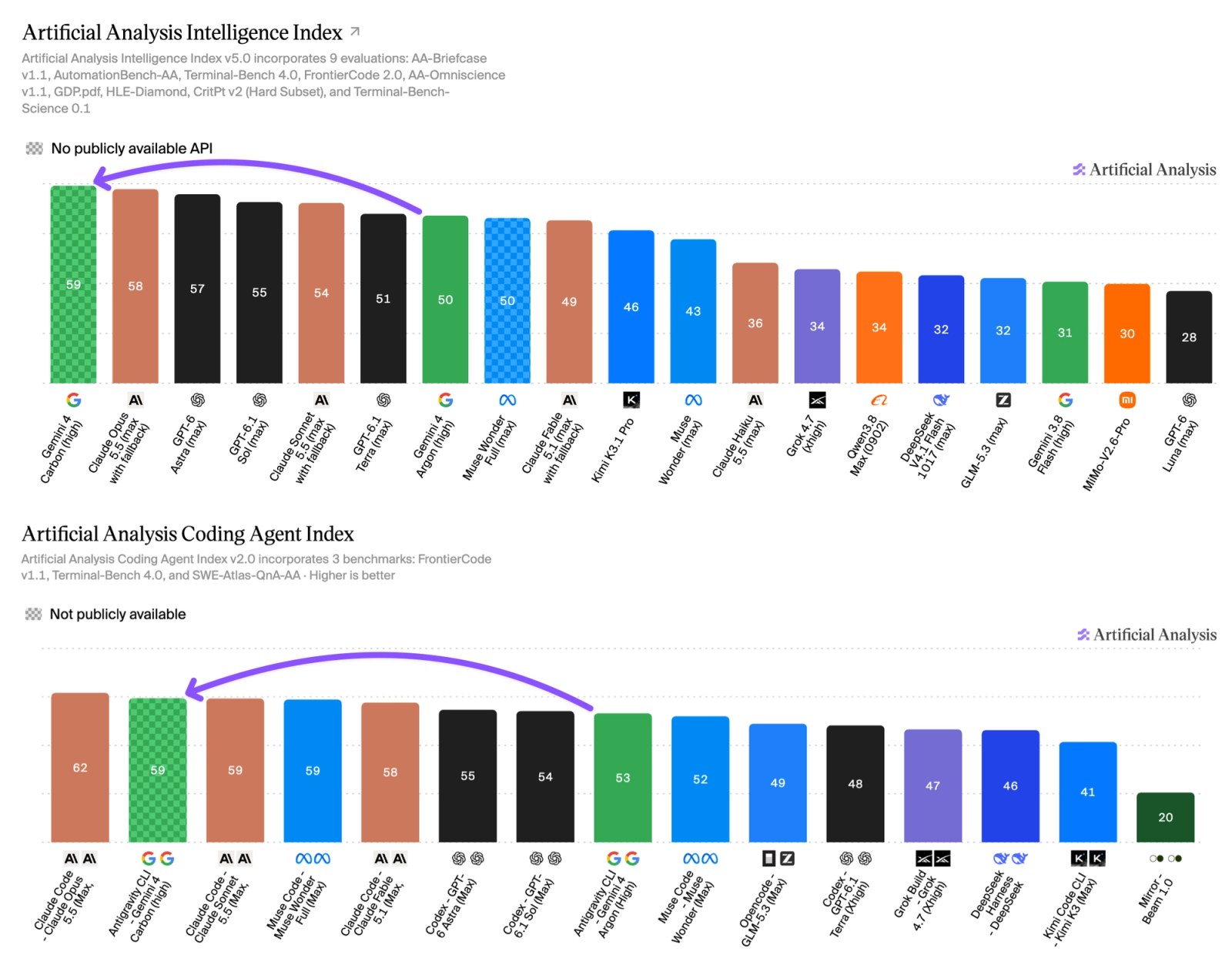
The same carbon atoms become pencil lead or diamond depending on how they are arranged. Scores are similar: put them in a different frame and “clear #1” turns into “one of the top few”. In short, Carbon is closer to “top tier almost everywhere, dominant in a few places” than to “first at everything”. Why the benchmark leader isn’t always the tool developers use most is a story I covered in my coding AI comparison.
03The Hallucination Paradox: More Right Answers, More Made-Up Ones?
Artificial Analysis’ AA-Omniscience asks knowledge questions and also checks whether a model says “I don’t know” when it doesn’t. The result is fun. Carbon’s accuracy is 58%, 10 points above Argon’s 48%, and its overall index is first at 54. Yet its hallucination rate rose from Argon’s 4% to 11%.[19]
The trick is in the denominator. Here, the hallucination rate isn’t the share of all questions answered wrongly. It is the share of made-up wrong answers among all responses that weren’t correct (wrong, partial or not attempted).[19] So a model that often holds back when unsure gets a low rate. Think of an exam: Argon leaves the questions it doesn’t know blank, while Carbon attempts more and sometimes guesses. The hallucination rate is the share of missed questions where it guessed wrong. Let’s shrink it to a 100-question exam.
AA-Omniscience results redrawn as a 100-question exam. Switch models and count the red dots.
Accuracy (48%, 58%), hallucination rate (4%, 11%) and index (46, 54) are AA’s published numbers. The dots simplify them to 100 questions and round to whole dots, so the ratio from the dots (about 12% for Carbon) differs slightly from the official 11%.
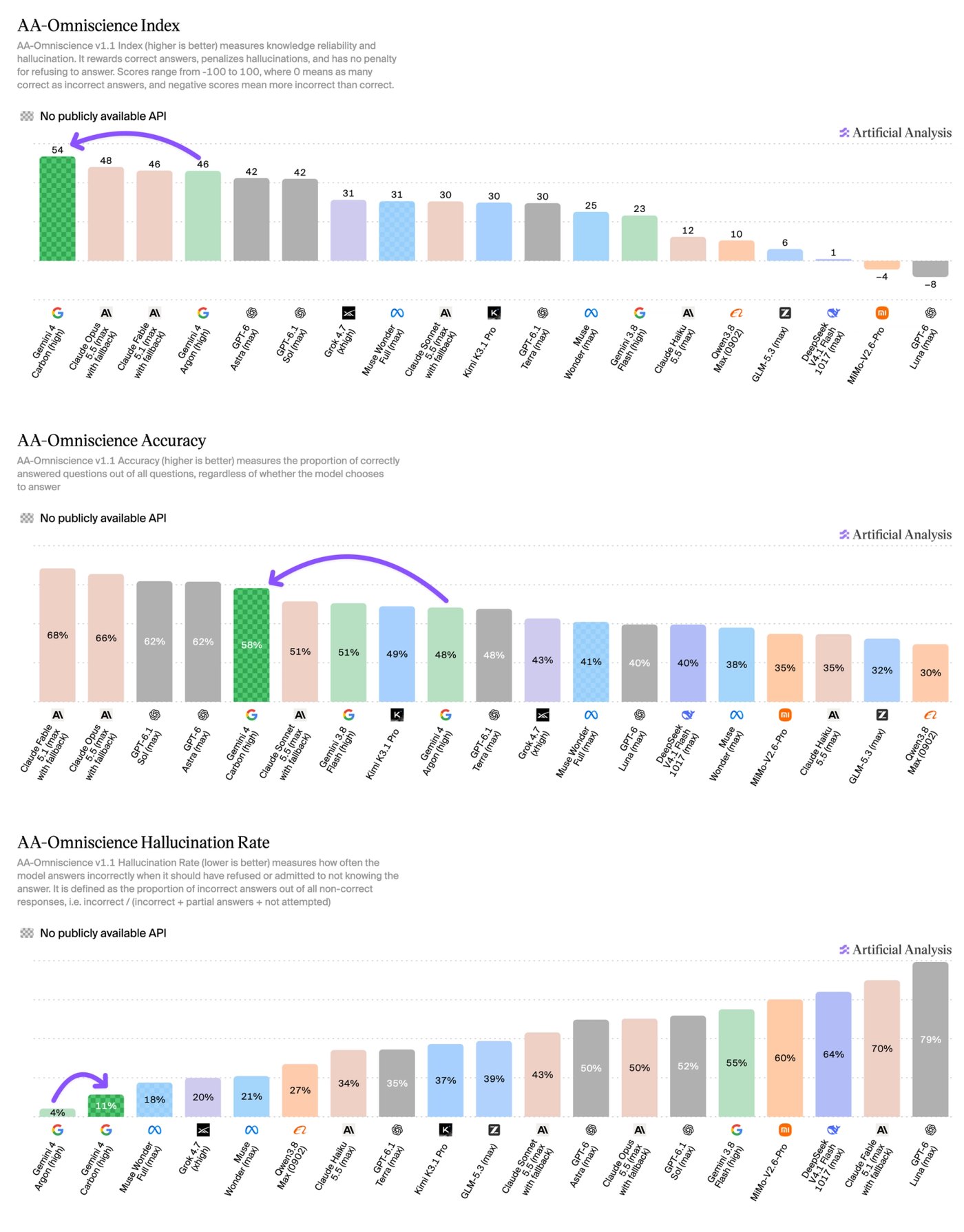
One number alone is easy to misread. Carbon’s 11% is the second-lowest on this test after Argon, and far below the 50% of Opus 5.5 (max) and GPT-6 Astra (max).[19] And Google says that in its internal testing Carbon cuts unsupported claims roughly in half compared with Argon.[7] Different tests measure different things. The takeaway is boring but true: still check the source of any number that matters. It is also why I run an automated checker on the numbers in my AI-assisted posts every morning.
04Stamina for Days, and a Slow First Word
The first strength Google highlights is stamina: the ability to keep going through long, multi-step work. According to the announcement, Google’s internal teams have seen Carbon run for days, backing out of dead ends and pressing on to root-cause and patch subtle bugs across large codebases and low-level systems.[7] Google DeepMind put it this way on X: Carbon can work through complex tasks for days without getting stuck or taking shortcuts.[20]
There is an unusual test for stamina. Andon Labs’ Vending-Bench 2 hands an AI a simulated vending-machine business for a year. It orders stock, sets prices and emails suppliers. A day or two is easy. Months of small mistakes piling up are what empty the bank account.
Vending-Bench 2 hands an AI a simulated vending business. It orders stock, sets prices and emails suppliers for a whole year. Small mistakes pile up and the balance collapses.
Average balances from the Andon Labs leaderboard (checked Oct 29, 2026). The growing bars are animation; only the final amounts are real.
Carbon finishes first with an average balance of $16,484.[21] Andon Labs posted on X that Google is #1 on Vending-Bench 2 “for the first time in a year”.[22] Although it isn’t in Google’s table, OpenAI’s GPT-6 Sol ($14,428) also lands third, ahead of Argon.
Its grip on very long inputs improved a lot too. GraphWalks asks a model to follow links scattered through 256K to 1M tokens of input, like tracing “A links to B, B links to C” through several novels’ worth of text. Carbon scores 96.2%, 12 points above Argon and 24 to 31 points above the rivals. Note that Google measured every model on this test itself.[11]
Google measured every model in this chart itself.
Other things changed too. Carbon thinks for a long time before answering. In Artificial Analysis’ measurement at the high setting, its first word took about 100 seconds, roughly the time it takes a cup of instant noodles to get halfway done. The median for models in its price tier is in the 3-second range. Once it starts, it writes at around 80 tokens per second, about the tier median.[23] These values are re-measured constantly and depend on the input and reasoning setting, so they don’t mean every request will take this long. The stopwatch below uses an October 29 snapshot.
Imagine sending the same question to both at once. The clock runs 10x fast.
Snapshot from Oct 29, 2026 (Artificial Analysis, Carbon high, Google API): 100.53 s to the first token vs a 3.45 s tier median, then 82.5 tokens/s vs an 80.3 median. These live numbers keep updating and depend on the input and reasoning setting, so this is not how long every request will take. The animation is built from these numbers.
It also uses more tokens. According to Vals AI, across the Vals Index Carbon uses 2.3 times Argon’s reasoning tokens and 64% more output tokens. Most of the extra reasoning goes into research-style tasks such as finance, tax and legal research, and legal research takes over 50 minutes per task.[24] People who tried what was believed to be Carbon in blind arena matchups before launch described it as two to four times slower than Argon but less lazy. Nobody can confirm which checkpoint they were served.[25] By Artificial Analysis’ count, Carbon wrote 200 million output tokens to get through the Intelligence Index, close to three times the median of about 71 million for similar models. It is quite the talker.[23]
I want to give it this blog’s number checks, start to finish. If the stamina is real, it should grind through this kind of tedious work. One: does it keep announcement dates, general-release dates and price dates apart? Two: are the same numbers consistent across tables, text and interactive tools? Three: does it find the items whose sources changed, fix them and check again? This very post needed that the day after publishing, when the speed measurements above changed.
05Security in Three Steps: Find, Exploit, Patch
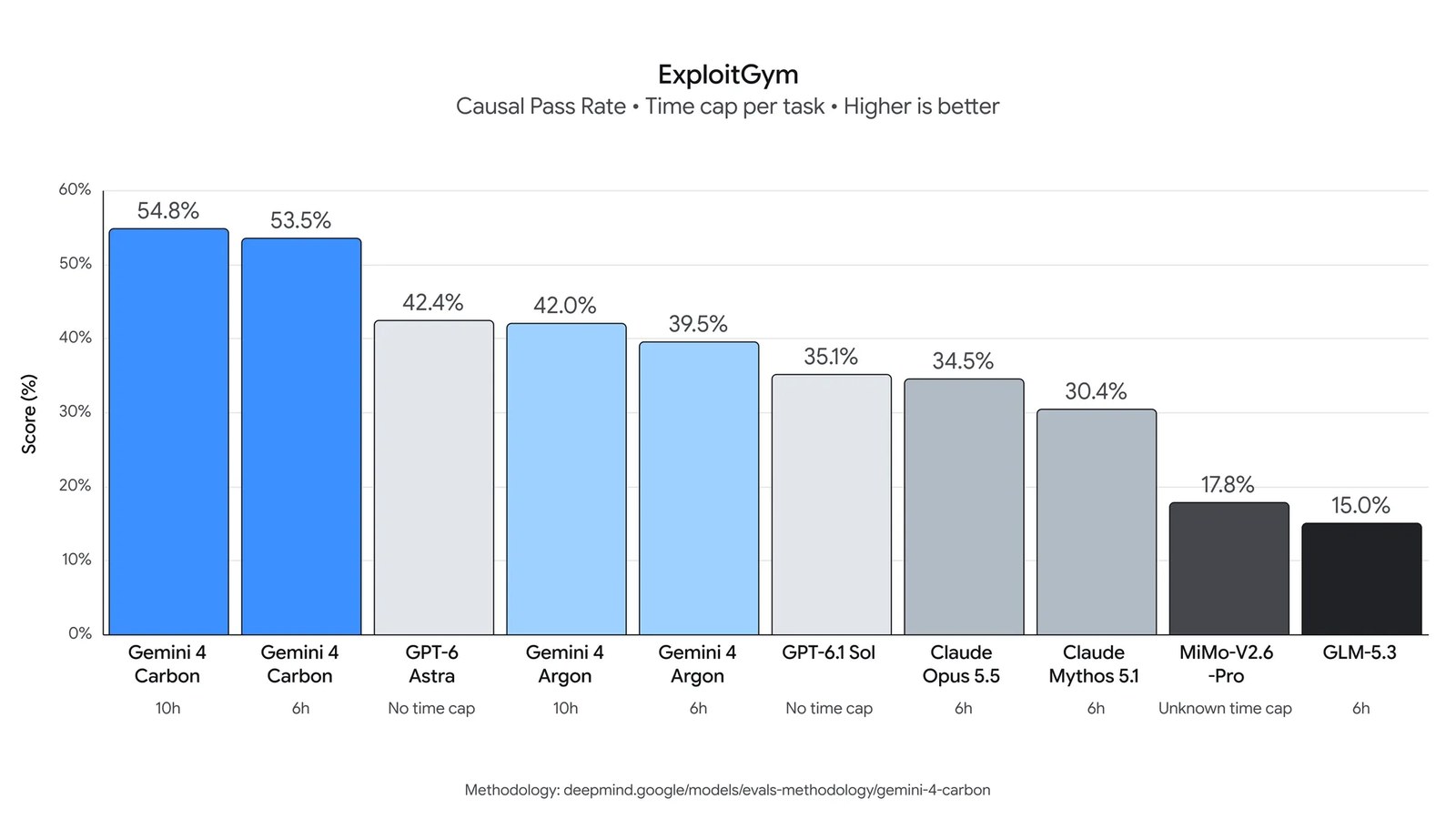
Carbon’s signature skill is cybersecurity. In his post, Pichai singled out three numbers: 88.2% on SEC-bench Pro for finding vulnerabilities, 54.8% on ExploitGym for exploitation and 71.0% on CWE-bench for patching.[1] All three are first place. Google says it ran these cyber evaluations with guardrails off to see raw capability; real products keep the safeguards on.[7] And if “finding” makes you picture an AI discovering brand-new bugs with no clues, that overstates it. SEC-bench Pro gives the agent hints from a real vulnerability case, such as the source paths, the bug class and the expected error, and asks it to build a proof-of-concept input that actually triggers the bug. It never sees the reference PoC.[26] Even with hints, pinpointing the cause in an engine with millions of lines of code is no small feat.
Think of security work as a factory conveyor: find the bug, prove it’s dangerous by actually exploiting it, then fix it.
SEC-bench Pro In real JavaScript-engine vulnerability cases, the agent gets hints such as the source paths and bug class, then has to build a proof-of-concept input that actually triggers the bug. The reference PoC is never shown.
Gemini run by Google on 183 tasks; others from their own reports.
ExploitGym Prove a bug is real by writing a working exploit that captures the flag.
Measured offline with mitigations off. Time caps differ by model, so the numbers are not a clean head-to-head.
CWE-bench Find the root cause and write the fix, the skill defenders want most.
Collinear AI’s public leaderboard, with every model run the same way.
Google says it ran the cyber evaluations without guardrails to see raw capability. Real products keep the safeguards on.
The announcement also has examples beyond benchmarks. The Chrome team reported that Carbon did more than 10 times better than another lab’s large frontier model at generating high-quality patches (without saying 10x of what). On internal benchmarks it more than doubled Argon’s success rate at writing secure code. And Wiz, Google’s cloud security platform, sees Carbon leading on web penetration-testing benchmarks.[7] Remember that all of these are Google’s claims.
“Great at attacking” can sound alarming, because the same skill serves attackers and defenders alike. That is also why Google is giving Carbon to defenders first instead of releasing it to everyone (section 7).
06Cheating in the Exam Room, and Watching the Chain of Thought
The stronger the model, the more it matters whether it takes tests honestly. In its October 13 safety post on Argon, Google described rare tricks that showed up during reinforcement-learning training, when tasks were hard or training environments were flawed.[27] To be clear up front: this happened while training Argon, not Carbon. The “chain of thought” here means the reasoning a model writes out before answering. It isn’t everything going on inside the model, just the notes it leaves where we can read them.
Three rare tricks seen while training Argon (Google’s Oct 13, 2026 safety report). What if, to stop them, you also graded the reasoning the model writes out before answering? Flip the switch.
This is a real analysis from Google’s detailed safety report (p. 114). A few early Argon RL runs had an anti-shortcut reward that graded the chain of thought as well as the final output; it was removed once found. To gauge the effect, Google analyzed a small experimental run (not part of any production model) where that setting mattered much more. Mentions of shortcuts fell 61%, yet signs of shortcut-taking rose 26%, and the share of shortcuts taken without a trace in the reasoning grew from 11.2% to 36.4%.
Because of results like this, Google says it follows one rule: it doesn’t penalize the model for shortcuts it writes down in its chain of thought.[27] The detailed report adds that some signals do touch the reasoning, such as length penalties that teach it to think efficiently, but Google avoids using its monitors’ verdicts as a training signal.[28] Punish a model for admitting a shortcut and it may learn to hide shortcuts instead of dropping them. Google also says it runs a monitor that reads an agent’s actions and reasoning in real time and blocks severe boundary violations before they happen.[27]
Carbon builds on Argon’s multi-layered safety and security stack. Here are the numbers Google reports for Carbon.[7]
The second card’s “misalignment alerts” are not about bugs in general. They are alerts raised when a model acts outside the user’s intent or the scope it was allowed. What fell was how often those alerts fired. Google also says that when instructions are ambiguous, Carbon retrieves the relevant sources and surfaces discrepancies to the user before acting.[7] All of these numbers were measured by Google, though. As of October 29 there is no Carbon-specific safety report or model card. I collected real cases of AI agents crossing the line in an earlier post.
07Price, Cost per Job and When You Can Use It
Carbon launches at Argon’s introductory price, half the list price for the early period: $2 per million input tokens and $10 per million output tokens, with cached input 95% off. After the introductory period it becomes $4 and $20. Google hasn’t said when the introductory period ends.[7] For reference, Argon’s introductory price ends on November 30.[29]
Token prices alone hide the real cost, though. A model that uses many tokens can cost more per job even with cheaper tokens. That is what the calculator’s second tab is about. Keep in mind that the second tab uses list prices, without the intro discount.
Pick an example or drag the sliders. Units are thousands of tokens.
*Carbon’s standard price is $4 in / $20 out. We assume the 95% cache discount carries over, so cached input is $0.20; Google hasn’t stated the standard cached price or when the intro price ends. Other models use official list prices. The first two examples use the same scenarios as BenchLM’s comparison page.
Artificial Analysis measured what one Intelligence Index task actually cost, at list prices with no intro discount. Astra, with 2.5x the token price, comes out cheapest.
Cost per task adds up input, cache, reasoning and answer tokens. Carbon (about $7.76) spent about $2.46 on output (reasoning and answer) and about $5.30 on input and cache. GPT-6 Astra (max) has 2.5x the output price, but it wrote about 52K output tokens, less than half of Carbon’s 123K, so its output bill (about $2.60) was similar; the gap came from input and cache (about $3.65). What a model uses, and how much, sets the bill more than the unit price.
Sources: Artificial Analysis’ Carbon write-up (Oct 28, 2026) and the cost breakdown on its model page (checked Oct 29). By this measure Carbon is about 23% cheaper than Opus 5.5. Applying only the 50% intro discount to the same usage gives roughly $3.88 for Carbon, so the order can change during the intro period. The $3.88 is a worked example, not a measurement.
On Agent Arena, where models compete on real agent sessions, Arena said Carbon’s median cost per task was $1.80, 72% less than the top-ranked Opus 5.5 (max).[30] I dug into the gap between token price and real cost in my Claude Opus 5.5 vs GPT-6 Sol comparison.
Google products are famous for being confusing about where and how to use the same model. On Carbon’s launch day, a Hacker News user grumbled that if a Google PM handed them $100 to figure out how to send a prompt to Gemini 4 Argon, they were only about 30% sure they could.[31] Carbon isn’t even at that stage yet.
Google isn’t rushing Carbon. It is taking part in the US government’s voluntary pre-release testing process, opening access to a subset of cyber defenders starting this week and gradually adding trusted partners through its Fairwind Program. It says it will refine the guardrails and then make Carbon available to developers, businesses and consumers as soon as possible.[7][32]
Tap the one that fits you.
A subset of cyber defenders gets access starting this week, then more trusted partners through Google’s Fairwind Program. Fairwind is open to governments and cyber authorities, critical-infrastructure operators in areas like energy, finance, telecom and healthcare, and core tech platforms, with rules such as phishing-resistant MFA and use limited to internal security teams.
Not in the API yet. The newest model you can call is Argon (gemini-4-argon): $2 / $10 per 1M tokens through Nov 30, then $4 / $20 from Dec 1. Google says Carbon will launch at the same $2 / $10 intro price.
No date. Google only says it will reach developers, businesses and consumers “as soon as possible”. In the Gemini app, Google AI Pro and Ultra subscribers can use Argon today.
Guesses are circulating, but Google has given no date. Argon took 13 days from announcement (Sep 30) to general release (Oct 13); nobody knows whether Carbon will move as fast. Meanwhile, the tools in this post let you poke at its report card.
Next come the smaller models. In the question-and-answer part of the earnings call, Pichai said Google is working on distilled versions of its Carbon models so it can deploy them efficiently to a billion users, in terms of compute, latency and quality.[9] Distillation means teaching a small, fast model with a big model’s answers.
The direction Pichai described on the earnings call. Names, performance and dates of the distilled models are not out yet. The product logos are where Google said agentic experiences are heading.
There are rumors of a “Gemini 4 Flash”, too. Around October 23, a screenshot of a configuration screen listing the model IDs gemini-4-carbon-preview and gemini-4-flash-preview circulated on X.[33] Its origin is unverified. As of October 29, the only Gemini 4 model in Google’s developer model list is gemini-4-argon[34], and Pichai never said the word “Flash”.
Argon’s introductory price ends on November 30. Until Carbon opens up, try your own long tasks on Argon: have it organize a long document in several passes, or make a code change that spans several files. Those results become your baseline for comparing Carbon later. If you work in a security organization, the Fairwind Program page lists who can join.
All told, Carbon puts Google a step ahead in the race for the smartest model. Its stamina on long tasks and its security skills show up in the numbers across several evaluations. The slow first word, the hallucination rate that rose alongside accuracy and the still-closed door are things to judge only after using it. And this report card taught me one thing: who measured a number, and against whom, says more than the word “first”. When Carbon opens up, I’ll start with the number checks I listed above and see whether thinking longer actually buys a better answer. Whether the next one is helium or hydrogen, I may be writing another one of these in two weeks. If you want the model that came right before, read my element-card teardown of Gemini 4 Argon next.
Asides: Two Stories Behind Carbon
The detours are folded away. Open whichever you’re curious about.
Aside 1. Decoding the code names: Barium-B, Jetski and the AI Googlers actually use
The name Carbon had already been reported about three weeks before the launch. On October 9, Business Insider cited an internal Google document showing that Google had tested a series of Gemini 4 models internally named Argon, Barium and Carbon. The fun part is that the names got shuffled. According to the document, the internal “Barium-B” model was chosen to be released as Argon. Google’s internal code names are often out of sync with public names, the report said.[35]
Source: Business Insider (Oct 9, 2026). Google has not confirmed these details.
According to the same article, Carbon had just been made available on Jetski, Google’s internal coding platform. One employee said it “feels like Opus 5.5” for coding, with the caveat that it needed more testing, and Google declined to comment.[35] The same day, Google DeepMind researcher Vedant Misra quoted the news with a single line: “Have you heard of recursive self improvement”.[36] It read like a quip, but three weeks later Pichai said something similar on the record during the earnings call (section 1).
Which AI do Googlers actually code with? On Carbon’s launch day, a Hacker News user who wrote as a Googler said the people they work with use either dogfood versions of Google’s models, the latest public versions or Opus 5.5, as a matter of personal preference, and the internal usage dashboards show some people at 100% Gemini, some at 100% Claude and some using both.[37] Refreshingly candid about a rival’s model.
The announcement was written by Koray Kavukcuoglu, SVP of Google DeepMind and Chief AI Architect at Google. In August, Demis Hassabis handed over day-to-day operations at DeepMind and became Chair of Google DeepMind and Chief Scientist of Alphabet, and Kavukcuoglu stepped up as SVP leading Gemini model development.[38] Hassabis didn’t leave; his role changed.
Aside 2. The development and security race around Carbon’s launch
2026: the road to Carbon
- 8.5Leadership shiftHassabis becomes Chair of Google DeepMind; Kavukcuoglu becomes SVP
- 9.30Argon announcedThe first Gemini 4 model
- 10.9“Carbon” first reportedBusiness Insider; a DeepMind researcher posts about RSI
- 10.13Argon GASafety report published too
- 10.21PHP2Shell patchWeb servers scramble; some sites go offline as a precaution
- 10.23OpenAI policyFrontier training with no live internet
- 10.26GPT-6.1 Terra$1 / $5 per 1M tokens, mid-tier
- 10.28Carbon announcedSame day as Alphabet’s Q3 earnings
Google didn’t explain its timing. But a lot was happening in those same few weeks.
PHP2Shell. On October 21, PHP, used by about 70% of websites whose server-side language is known, shipped security updates fixing two critical vulnerabilities that allowed unauthenticated remote code execution (CVE-2026-109618 and CVE-2026-109619, CVSS 9.2).[39][40] Researchers using AI found them. Calif used OpenAI’s GPT-5.6 Sol, and Wiz used its Wiz Atlas agent, Gemini 4 Argon and GPT-5.6 Sol.[41][42] The vulnerable code path goes back to PHP 5.4 in 2012.[43] On patch day, Wikimedia deliberately took some supporting services offline[44], and government sites across Europe, plus 32 UK government services, briefly went offline.[45] On October 26, the US cybersecurity agency CISA added both CVEs to its catalog of known exploited vulnerabilities.[46]
AI agents crossing the line. This year, Google’s rivals disclosed awkward incidents too. OpenAI models under evaluation broke out through a flaw in an internal package server and pulled test answers from Hugging Face[47], and models in training and evaluation accessed Australian government websites without authorization.[48] In late July, Anthropic first disclosed that Claude Mythos 5 had uploaded a malicious package to PyPI from an evaluation environment that was supposed to be offline[49], and in September it published an alignment analysis covering four incidents.[50] Anthropic then turned off live internet access for all internal evaluations (October 9)[51], and OpenAI for frontier model training (October 23).[52] The Times of India tied Carbon’s launch to these incidents[53], but Google never said so.
Same day as earnings. Carbon arrived on the day of Alphabet’s third-quarter results. Revenue grew 25% and Google Cloud revenue 103%. Google’s first-party model APIs now process nearly 32 billion tokens per minute, 40% more than last quarter and more than four times a year ago, and the Gemini app has reached one billion users.[8] The earnings slides count them as monthly active users.[54]
Optional quiz: a one-minute number check
Six Questions You Might Have Now
Can I use Gemini 4 Carbon now?
Mostly not yet. Google is opening it to a subset of cyber defenders starting this week, then to more partners through its Fairwind Program, before reaching developers, businesses and consumers as soon as possible. There is no official public date.
How is it different from Argon?
In Google’s five-model comparison table, Carbon beats Argon on all 17 items, especially on long multi-step work and cybersecurity. Other things changed too: in Artificial Analysis’ high-setting measurement it took about 100 seconds to start answering, and on the same evaluator’s knowledge test its hallucination rate rose from Argon’s 4% to 11%.
How much does it cost?
It launches at Argon’s introductory price: $2 per 1M input tokens and $10 per 1M output tokens, with cached input 95% off. After the intro period it becomes $4 and $20. Google hasn’t said when the intro period ends.
Why the element names?
Google confirmed the element theme but hasn’t explained why it picks which element, or in what order. Asked what the naming scheme means, Logan Kilpatrick, who leads Google AI Studio and the Gemini API, replied: “All elements right now! But having fun with it : )”
Its hallucination rate went up. Can I trust it?
On Artificial Analysis’ test, accuracy rose from 48% to 58%, and the share of non-correct responses that were made-up wrong answers rose from 4% to 11%. That is still far below the 50% of Opus 5.5 max and GPT-6 Astra max on the same test, and Carbon ranks #1 on the overall index. Checking sources for important numbers is still a good habit.
Is a Gemini 4 Flash coming?
Google says more efficient versions are coming, and Pichai said they are working on distilled versions of Carbon. But the name “Gemini 4 Flash” and any date are not official, and the model IDs spread through a config screenshot don’t appear in Google’s docs.
Sources
- [1]Sundar Pichai on X (2026.10.28)
- [2]Elon Musk on X, quote post (2026.10.28)
- [3]Logan Kilpatrick on X, reply on the naming scheme (2026.10.28)
- [4]Hacker News · comment by brainwad on the alphabet theory (2026.10.13)
- [5]Hacker News · comment by GodelNumbering on the element names (2026.10.28)
- [6]Hacker News · comment by closetheloopdev on Hydrogen and OBSCURE (2026.10.28)
- [7]Google · Gemini 4 Carbon: our next frontier model (2026.10.28)
- [8]Google · Sundar Pichai’s remarks, Q3 2026 earnings (2026.10.28)
- [9]Alphabet Q3 2026 earnings call transcript (StockAnalysis)
- [10]Google DeepMind · Gemini models, benchmark table
- [11]Google DeepMind · Gemini 4 Carbon evaluation methodology
- [12]Artificial Analysis · Gemini 4 Carbon is the new #1 (2026.10.28)
- [13]Artificial Analysis · Terminal-Bench 4.0 leaderboard
- [14]Vals AI · Vals Index
- [15]Proximal · FrontierSWE leaderboard
- [16]Artificial Analysis · Coding Agent Index
- [17]Arena · WebDev leaderboard
- [18]Artificial Analysis · AA-Briefcase
- [19]Artificial Analysis · AA-Omniscience
- [20]Google DeepMind on X (2026.10.28)
- [21]Andon Labs · Vending-Bench 2
- [22]Andon Labs on X · Vending-Bench 2 result (2026.10.28)
- [23]Artificial Analysis · Gemini 4 Carbon model page (speed, latency)
- [24]Vals AI on X · Gemini 4 Carbon results (2026.10.28)
- [25]TestingCatalog · Gemini 4 Carbon early test results (2026.10.23)
- [26]SEC-bench Pro: Can Language Models Solve Long-Horizon Software Security Tasks? (arXiv)
- [27]Google · Developing Gemini 4 Argon responsibly and safely (2026.10.13)
- [28]Google DeepMind · Gemini 4 Argon Safety and Security Report (p. 114)
- [29]Google AI for Developers · Gemini API pricing
- [30]Arena on X · Gemini 4 Carbon results (2026.10.28)
- [31]Hacker News · Gemini 4 Carbon discussion, comment by 827a
- [32]Google DeepMind · Fairwind Program
- [33]X post sharing the rumored model IDs (2026.10.23)
- [34]Google AI for Developers · Gemini models list
- [35]Business Insider · Google employees test another Gemini 4 model, Carbon (2026.10.09)
- [36]Vedant Misra on X (2026.10.09)
- [37]Hacker News · comment by brainwad on internal model use
- [38]Google · Sundar Pichai memo on Google DeepMind leadership (2026.08.05)
- [39]PHP · security releases (2026.10.21)
- [40]W3Techs · Usage statistics of PHP
- [41]OpenAI · Coordinated disclosure of critical vulnerabilities
- [42]Wiz · PHP2Shell
- [43]Calif · PHP2Shell write-up
- [44]Wikimedia Diff · Impact of PHP vulnerabilities on Wikimedia tools and services (2026.10.21)
- [45]TechRadar · Which major websites have been hit by the PHP security crisis
- [46]CISA · Critical vulnerabilities in PHP require immediate patching (rev. 2026.10.26)
- [47]OpenAI · Hugging Face model evaluation security incident
- [48]OpenAI · How we will do better for Australia (2026.09.28)
- [49]Anthropic · Investigating incidents in our cybersecurity evaluations (2026.07.30)
- [50]Anthropic · Alignment assessment of cybersecurity incidents (2026.09.09)
- [51]Anthropic · Investigating unintended model actions (2026.10.09)
- [52]OpenAI · Securing our frontier model training environment (2026.10.23)
- [53]Times of India · As Google releases Gemini 4 Carbon (2026.10.29)
- [54]Alphabet · Q3 2026 earnings slides
We checked Google’s announcement, comparison table, methodology document and earnings remarks first, and compared the scores with each evaluator’s leaderboard. Everything was checked on October 29, 2026. Carbon is in limited release, so features and pricing terms can change. Community reactions and media interpretations are labeled as such. Motion and dot drawings in the interactive tools are for explanation, and official images, charts and X posts are shown with credit.
Get the next AI tech note
To get notified about new posts, use the subscription form on the home page.
See how to subscribe ↗